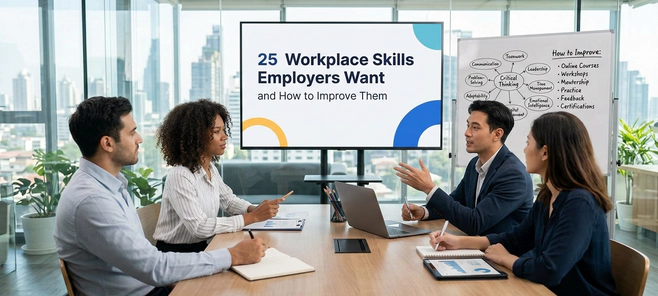
Workplace skills matter in every job, but not all skills matter equally at every stage of your career. Entry-level candidates usually win with reliability, communication, coachability, and basic digital fluency. Mid-career professionals need stronger project ownership, cross-functional collaboration, and judgment. Senior people get measured on leadership, decision-making, influence, and how well they help others perform. If you want a practical guide to workplace skills, not another vague list, you’re in the right place.
Employers still care about technical ability, of course. But hiring managers rarely reject candidates because they can’t make a spreadsheet formula on day one. They reject them because they communicate poorly, miss deadlines, freeze when priorities change, or can’t work well with other people. The modern workplace rewards people who can combine job-specific knowledge with strong employability habits and professional judgment.
This guide breaks down the difference between workplace skills, employability skills, job skills, and professional skills. Then it covers 25 skills employers want most, how to improve each one, how those priorities change by career stage, and how to prove your skills on a resume, cover letter, and in interviews. You’ll also get industry-specific examples, remote-work skills, AI-era skills, and a self-audit checklist you can use today.
What are workplace skills?
Workplace skills are the abilities that help you perform effectively in a work environment. Some are technical, like using Excel, SQL, or a point-of-sale system. Others are behavioral, like teamwork, time management, and communication. The best way to think about workplace skills is simple: they are the skills that help you get work done well, with other people, under real-world conditions.
A lot of articles lump everything together and call it a day. That gets messy fast. Here’s a clearer breakdown.
Workplace skills vs employability skills vs job skills vs professional skills
- Workplace skills are the broad set of skills you use to function and succeed at work, including soft skills, digital skills, and practical work habits.
- Employability skills are the portable skills that help you get hired and stay valuable across jobs, such as communication, teamwork, reliability, and problem-solving.
- Job skills are role-specific abilities required for a particular job, such as coding in Python, drafting legal contracts, operating a forklift, or running payroll.
- Professional skills usually refers to the polished behaviors and standards expected in professional settings, such as business writing, meeting etiquette, judgment, discretion, and executive presence.
These categories overlap. Communication is a workplace skill, an employability skill, and a professional skill. SQL is a workplace skill for an analyst, but not for a kindergarten teacher. That’s why job seekers should separate universal skills from role-specific skills instead of treating every skill the same.
What professional skills are in practice
Professional skills are the habits and behaviors that make other people trust you in a work setting. They’re less about raw talent and more about how you operate when expectations, deadlines, and other people are involved. Someone can be technically excellent and still look unready for bigger responsibility if they write sloppy emails, handle conflict badly, or need constant reminders.
The main professional skills usually include:
- Business writing - writing emails, updates, reports, and messages that are clear, concise, and easy to act on.
- Verbal communication - speaking in a way that makes your point understandable without rambling, hedging, or creating confusion.
- Meeting etiquette - showing up prepared, staying on topic, listening, and not wasting 30 minutes on something that needed 5.
- Professional judgment - knowing what to escalate, what to solve yourself, and how your choices affect the team.
- Discretion - handling sensitive information carefully and not treating workplace details like gossip material.
- Accountability - owning mistakes, following through, and being the person who closes loops instead of leaving loose ends.
- Time and priority management - focusing on what matters first, not just whatever is loudest in your inbox.
- Stakeholder communication - tailoring updates to different audiences, because your manager, client, and teammate don’t all need the same level of detail.
- Conflict management - disagreeing directly and respectfully, without turning tension into a personal feud.
- Executive presence - sounding calm, prepared, and credible under pressure, even if you’re still learning the role.
A simple example helps. If a client deadline is at risk, a professional response sounds like this: “We’re likely to miss Thursday because the vendor data came in incomplete. I can send a partial version by 4 p.m. today, or the full report Friday morning once the numbers are verified. My recommendation is Friday morning so we don’t publish errors.” That’s judgment, communication, accountability, and discretion all working together.
A practical framework: universal skills vs role-specific skills
Use this two-part framework when thinking about your value in the labor market.
- Universal workplace skills help in almost every job: communication, teamwork, reliability, adaptability, time management, problem-solving, professionalism, and digital collaboration.
- Role-specific skills depend on the function and industry: CAD for engineers, CRM management for sales reps, EMR systems for nurses, bookkeeping for accountants, or inventory control for warehouse supervisors.
If your resume is heavy on role-specific skills but light on universal skills, employers may worry about fit. If it’s the opposite, they may worry you can’t do the actual job. You need both.
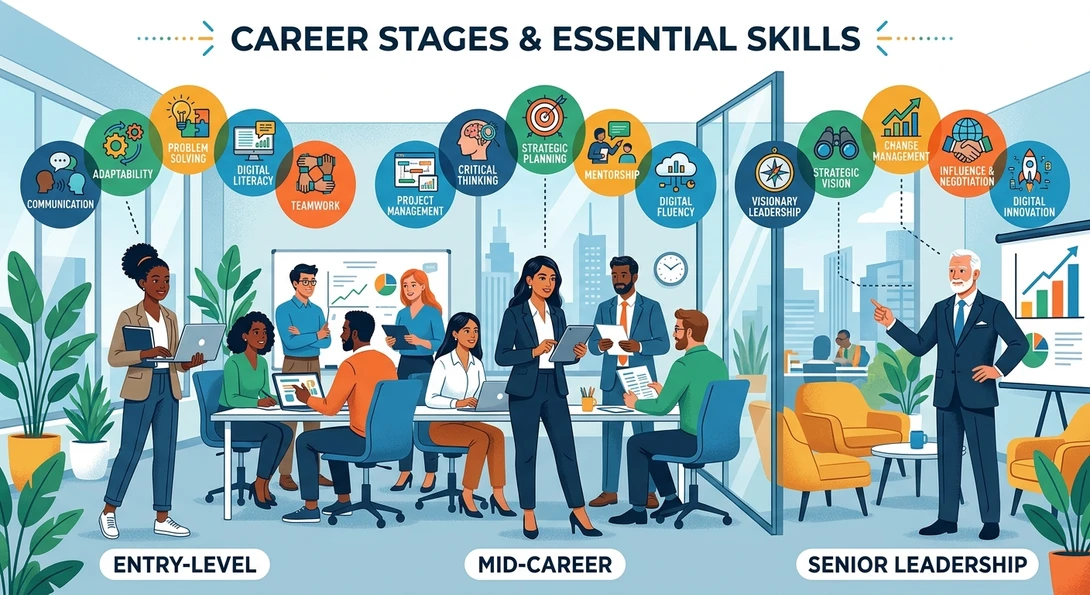
Which workplace skills matter most by career stage?
Career stage changes the hiring equation more than most people realize. A new graduate doesn’t need the same profile as a department head. Here’s the practical version.
Entry-level candidates
The most important workplace skills are:
Hiring managers at this stage ask a blunt question: can this person be trusted to show up, learn fast, and work well with others? Deep expertise is nice. Consistency matters more.
Mid-career professionals
The priority list shifts toward:
- Project management
- Cross-functional collaboration
- Critical thinking
- Initiative
- Conflict resolution
- Business writing and presentation skills
- Adaptability under changing priorities
At this level, employers want less supervision and more ownership. They expect you to spot problems before they become expensive.
Senior and leadership roles
Now the must-have skills become:
A senior employee who only delivers individual work isn’t really operating at senior level. The real test is whether they improve systems, clarify direction, and raise the performance of others.
The 25 workplace skills employers want most, and how to improve them
Below is a ranked list that balances universal value with relevance in modern workplaces, including remote and hybrid settings. Each skill includes what it means, why employers care, and one practical way to get better.
1. Communication
Communication means expressing ideas clearly in speaking, writing, and day-to-day interactions. Employers care because bad communication creates delays, confusion, rework, and tension.
To improve it, write shorter emails with a clear ask, deadline, and next step. For example: “Please review slides 5 to 9 by 3 p.m. Thursday and flag any pricing issues.” That’s better than a long wall of text. Also practice summarizing meetings in three bullets. If you can explain the issue, the decision, and the owner, you’re already ahead of many employees.
2. Reliability and dependability
This is the skill nobody brags about and every manager wants. Reliability means showing up on time, meeting commitments, and following through without drama.
Improve it by using one task system, not five. A calendar plus a simple task list works. If you miss deadlines, don’t promise harder, plan better. Break work into checkpoints and update people before a deadline slips, not after.
3. Teamwork and collaboration
Teamwork is your ability to coordinate with others toward a shared goal. Employers want people who can contribute without turning every project into a personality test.
Get better by making your work visible and useful. In a team project, post status updates, confirm ownership, and ask clarifying questions early. A simple message like “I own the draft, Sam owns the data check, and we’re on track for Friday” prevents chaos.
4. Problem-solving
Problem-solving means identifying the issue, finding the cause, evaluating options, and acting. Employers love it because problems never stop.
Use a simple habit: define the problem in one sentence, list three causes, propose two options, recommend one. In customer service, that might look like reducing repeat complaints by fixing a confusing return policy instead of answering the same question 50 times a week.
5. Adaptability
Adaptability is your ability to stay effective when priorities, tools, or processes change. That’s not optional anymore. Teams reorganize, software updates, budgets shrink, and AI tools alter workflows fast.
To build it, expose yourself to small controlled changes. Volunteer to test a new tool, join a cross-functional project, or take on a process you haven’t owned before. People become adaptable by practicing adaptation, not by claiming it in interviews.
6. Time management
Time management is really priority management. Busy people aren’t always effective people. Employers care about output, not heroic calendar suffering.
Try time-blocking your top two priorities each day. If your role is reactive, reserve specific windows for email and chat instead of checking them every five minutes. Even 90 minutes of focused work daily can change your performance.

7. Digital literacy
Digital literacy includes comfort with common workplace software, file management, spreadsheets, collaboration tools, and basic troubleshooting. In many office roles, this is now as basic as writing was 20 years ago.
Improve it by mastering the tools your industry actually uses. For office jobs, that often means Excel, Google Workspace, Slack, Zoom, and project tools like Asana or Trello. For a job seeker, learning one practical shortcut per day for 30 days is a smart, low-stress approach.
8. Critical thinking
Critical thinking means evaluating information carefully instead of reacting to the first answer that sounds good. It matters more now because AI can produce polished nonsense at scale.
Practice asking: What evidence supports this? What assumptions are baked in? What could go wrong? If you’re using AI tools, verify sources, numbers, and recommendations before acting on them. Employers increasingly value people who can judge output, not just generate it.
9. Professionalism
Professionalism includes tone, judgment, accountability, respect, and basic workplace etiquette. It doesn’t mean sounding stiff or dressing like a corporate robot. It means acting in a way that builds trust.
A practical upgrade is learning response standards. Reply to messages within a reasonable window, own mistakes quickly, and keep disagreements factual. Small habits shape your reputation fast.
10. Initiative
Initiative is acting without waiting to be chased. Managers notice people who solve small issues before they become major headaches.
Start with one improvement per month. If you see repeated scheduling confusion, create a shared template. If new hires ask the same question repeatedly, document the answer. Initiative doesn’t require grand gestures. Often it’s just useful follow-through.
11. Emotional intelligence
Emotional intelligence is your ability to understand your own emotions, read other people well, and respond appropriately. Strong EQ reduces conflict and improves teamwork, leadership, and customer interactions.
To improve, pause before replying when you’re irritated. Ask one more question than feels necessary. If a teammate misses a deadline, don’t assume laziness first. Ask what blocked the work. That tiny shift can change the conversation.
12. Leadership
Leadership isn’t a job title. It’s the ability to create clarity, support performance, and move a group toward a goal. Employers look for leadership potential long before they hand out manager titles.
Build it by running small things well. Lead a meeting, mentor an intern, coordinate a rollout, or onboard a new teammate. Leadership evidence often starts with moments, not promotions.
13. Conflict resolution
Workplace conflict isn’t automatically bad. Avoided conflict is usually worse. Conflict resolution means addressing disagreements early, fairly, and without making the whole room tense.
Use this formula: name the issue, describe the impact, ask for a solution. For example, “We missed the client deadline because approvals came in late. Can we agree on a 24-hour review window for future drafts?” Calm and specific beats emotional and vague every time.
14. Organization
Organization means keeping information, tasks, and resources in order so work doesn’t fall through cracks. Managers often use “organized” as shorthand for low-maintenance and low-risk.
Improve it by standardizing where things live. One naming convention for files, one source of truth for project status, one template for recurring work. Friction drops quickly when the system makes sense.
15. Business writing
Writing well at work means being clear, concise, and useful. It affects email, reports, documentation, chat messages, proposals, and summaries. Poor writing wastes time, even in fast-moving teams.
A reliable method is BLUF: bottom line up front. Start with the conclusion, then add supporting detail. Example: “We should delay launch by one week due to unresolved payment errors affecting 12% of test transactions.” That beats six paragraphs of suspense.
16. Presentation skills
Presentation skills help you explain ideas confidently in meetings, client calls, pitches, and updates. Even technical roles need this. The best idea in the room loses if nobody understands it.
Practice with structure: problem, insight, recommendation, next step. Record yourself for two minutes and watch it back. Slightly painful, very effective. You’ll spot filler words, rushed pacing, and weak openings fast.
17. Customer focus
Customer focus means understanding what the customer, client, patient, or end user actually needs, then acting accordingly. This matters beyond sales and support. Internal teams have customers too.
Improve it by asking better questions. What problem is the person trying to solve? What does success look like from their side? A finance analyst who reduces reporting errors helps internal customers just as much as a retail associate helps shoppers.
18. Decision-making
Decision-making is choosing a direction with appropriate speed and confidence. Some employees stall because they want perfect certainty. Work rarely offers that luxury.
Get better by classifying decisions. Reversible decisions should be made quickly. Irreversible or expensive decisions deserve more analysis. This one habit prevents overthinking and panic-driven choices.
19. Learning agility
Learning agility is your ability to pick up new skills, tools, and concepts quickly. Employers care because half the job may change before the title does.
A practical tactic is skill stacking. Spend 20 minutes a day building one complementary skill. A recruiter learns basic data reporting. A marketer learns prompt design and analytics. A warehouse lead learns scheduling software. Small gains compound.
20. Project management
Project management is planning, coordinating, tracking, and delivering work on time. You don’t need a PMP to benefit from the skill.
Improve it by always defining scope, owner, due date, risk, and next milestone. If those five things are unclear, the project isn’t managed yet. Even a tiny launch or event runs better with that structure.
21. Accountability
Accountability means owning outcomes, not just activities. Employers value people who don’t vanish when something goes wrong.
Build it by using this sentence more often: “Here’s what happened, here’s what I learned, and here’s how I’ll prevent it next time.” That’s a strong career sentence. Excuses are not.
22. Creativity
Creativity at work isn’t just for designers. It’s finding better approaches, generating options, and improving systems. Employers need this because routine work gets automated first.
Boost it by collecting examples outside your field. A healthcare admin can learn from airline check-in flows. A warehouse manager can borrow visual controls from manufacturing. New ideas often come from cross-pollination.
23. Remote and hybrid collaboration
This skill deserves its own spot now. Remote work requires clear asynchronous communication, documentation, meeting discipline, and trust-building without constant physical proximity.
Improve it by writing updates people can understand without a meeting. Use status notes that include progress, blockers, decisions needed, and deadlines. Strong remote workers reduce ambiguity. Weak ones create it.
24. AI and automation fluency
AI fluency doesn’t mean everyone needs to become an engineer. It means knowing where AI tools can save time, where they fail, and how to check their output. According to the World Economic Forum’s Future of Jobs Report 2025, analytical thinking, resilience, flexibility, leadership, and AI-related skills are rising in importance across industries.
You can improve this skill by choosing one repetitive task and testing whether AI can help draft, summarize, categorize, or brainstorm. Then verify accuracy manually. That’s the key. Smart use, not blind trust.
25. Resilience under pressure
Resilience is the ability to stay functional during stress, setbacks, or uncertainty. Employers aren’t looking for superheroes. They want people who can recover, adjust, and keep moving.
Build it with habits, not slogans. Better planning, realistic workloads, recovery time, and escalation before a crisis all help. Resilience looks impressive from the outside, but most of it is preparation and self-management.
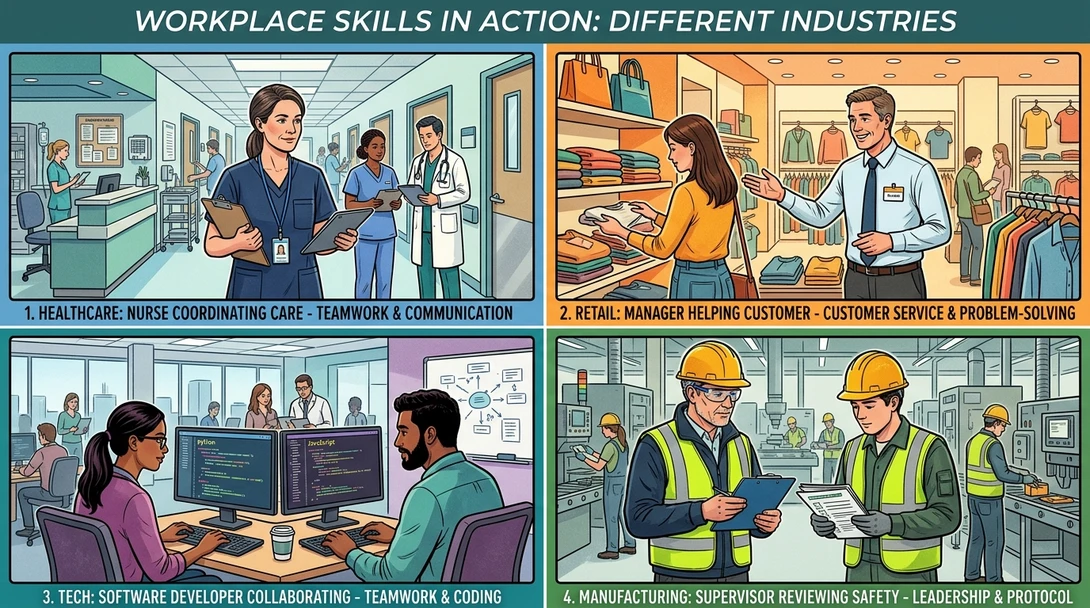
Industry-specific examples of workplace skills
The same skill looks different across industries. That’s where many candidates get tripped up. They list generic strengths instead of translating them into job-relevant examples.
Healthcare
A nurse needs communication, empathy, teamwork, documentation accuracy, time management, and calm decision-making. In this context, communication includes patient education, charting, and coordination with physicians and support staff.
Retail
A retail supervisor relies on customer service, conflict resolution, sales awareness, scheduling, coaching, and inventory organization. Adaptability matters a lot because staffing, traffic, and promotions can change by the hour.
Technology
A software engineer needs technical depth, yes, but also business communication, documentation, collaboration, prioritization, and critical thinking. Great engineers don’t just code. They explain trade-offs, estimate realistically, and work across product and design teams.
Skilled trades and manufacturing
Electricians, machinists, and production leads need safety awareness, reliability, problem-solving, reading technical instructions, communication, and quality control. Professionalism here often looks like precision, compliance, and zero shortcuts.
Sales
Sales roles require communication, resilience, active listening, negotiation, CRM discipline, follow-up, and commercial judgment. A rep who talks well but fails to document pipeline activity is not as strong as they think.
Administrative and operations roles
These roles depend heavily on organization, discretion, scheduling, written communication, process improvement, and digital literacy. Strong admins often keep teams functioning without much recognition. Good managers know how valuable that is.
Skills worth learning now, grouped by time to learn
Not every useful skill takes months of study. Some give you a quick return in a week or two. Others need steady practice before they become real strengths. If you’re deciding what to learn now, sort skills by time-to-usable, not by hype.
Skills you can improve in a few days to 2 weeks
These won’t make you an expert overnight, but you can become noticeably better fast.
- Email and message clarity - start using a simple structure: purpose, key detail, deadline, next step. First step: rewrite your next three work messages so the ask is in the first sentence.
- Calendar and task management - one clean system beats scattered reminders. First step: put all deadlines and meetings into one calendar and create one running task list for the week.
- Meeting notes and summaries - teams remember what gets written down. First step: after your next meeting, send a 4-line summary with decisions, owners, deadlines, and open questions.
- Spreadsheet basics - filters, sorting, simple formulas, and clean formatting save time in almost any office role. First step: practice building a simple tracker with columns for task, owner, due date, and status.
- AI prompt basics - better prompts usually produce better drafts. First step: take one routine task, such as summarizing notes, and test three prompt versions to compare the output.
Skills that usually take 2 to 8 weeks of steady practice
These are still very learnable, but they improve through repetition, feedback, and real use.
- Business writing - strong writing comes from editing, not inspiration. First step: choose one recurring document type, such as weekly updates, and build a repeatable template.
- Presentation skills - comfort grows once you hear yourself out loud a few times. First step: record a 2-minute explanation of a work topic and cut anything vague, repetitive, or too long.
- Project coordination - basic project management starts with visibility. First step: run one small project using a tracker with scope, owner, due date, risk, and next milestone.
- Conflict resolution - most people need practice staying calm and specific. First step: write out one difficult conversation using the formula issue, impact, request.
- Remote collaboration - clear async updates are learnable. First step: send one weekly status update with progress, blockers, decisions needed, and next deadline.
Skills that often take 2 to 6 months to build well
These become valuable because they compound. You don’t cram them in a weekend.
- Advanced Excel or data reporting - useful for analysts, coordinators, recruiters, finance staff, and operations roles. First step: pick one real work report and rebuild it using formulas, pivot tables, or cleaner data structure.
- Public speaking confidence - this improves through repeated exposure, not positive thinking. First step: volunteer to present one short update each week, even if it’s only 3 minutes.
- Leadership and delegation - leading people well takes repetition and reflection. First step: take ownership of one small process or recurring meeting and practice assigning clear responsibilities.
- Stakeholder management - this grows as you learn what different people care about. First step: map one project’s stakeholders and note what each person needs to know, when, and in what format.
- Process improvement - spotting waste gets easier once you study how work actually moves. First step: document one repetitive workflow from start to finish and circle the steps that cause delays or confusion.
Skills that may take 6 months or more, but pay off for years
These are long-game skills. They shape promotions more than most people realize.
- Strategic thinking - seeing beyond today’s task list takes business context and pattern recognition. First step: once a week, ask how your team’s work connects to revenue, cost, risk, customer experience, or growth.
- Deep technical or role-specific expertise - this is what separates solid performers from go-to experts. First step: choose one core tool or specialty in your field and commit to a defined learning plan instead of random tutorials.
- Executive presence - calm, credible communication under pressure usually comes from repeated high-stakes exposure. First step: prepare more than usual for important updates and practice delivering your recommendation in 30 seconds.
- High-level decision-making - good judgment improves after you’ve seen consequences play out. First step: after major decisions, review what you assumed, what happened, and what you’d change next time.
If you’re stuck choosing, start with one fast skill and one compounding skill. For example, improve email clarity this week while also building project management over the next two months. That mix gives you quick wins and real career value.
How to improve workplace skills faster, without spending a fortune
Most people improve workplace skills through repetition and feedback, not expensive courses. Formal training can help, but don’t wait for permission or a budget.
Use the 70-20-10 rule
A common learning model suggests roughly 70% of development comes from on-the-job experience, 20% from feedback and coaching, and 10% from formal study. It’s not a law of physics, but it’s directionally useful. Skill growth usually happens in real work.
- 70% experience: volunteer for projects, presentations, process fixes, training new hires, or customer-facing tasks.
- 20% feedback: ask your manager, mentor, or trusted peer for one specific improvement point after a task.
- 10% study: use courses, books, webinars, or official training to sharpen gaps.
Get specific with feedback
Don’t ask, “Any feedback?” That’s too broad and usually gets you a polite non-answer. Ask, “What is one thing I could do to make my updates clearer?” or “Where did I slow the project down?” Specific questions produce useful answers.
Track proof, not just progress
Keep a running log of wins, numbers, and examples. If you improved a process, note the before and after. If you handled 40 customer tickets a day with a 96% satisfaction score, write that down. This becomes gold for resumes and interviews later.
How to show workplace skills on a resume, cover letter, and in interviews
This is where job seekers often mess up. They list skills as adjectives with no evidence. “Excellent communicator.” “Strong leader.” “Team player.” Fine, maybe. Prove it.
On your resume
Use measurable bullet points that demonstrate the skill in action.
Bad example:
Strong communication and teamwork skills.
Better examples:
- Led weekly project updates across marketing, sales, and operations, improving on-time campaign launches from 78% to 92%.
- Resolved 25 to 30 customer issues per day while maintaining a 4.8 out of 5 average satisfaction rating.
- Created a new file naming system that reduced document retrieval time for the team by 30%.
- Trained 6 new hires on scheduling software and standard procedures, cutting onboarding time by 1 week.
A simple formula works well: action verb + task + result.
In your cover letter
Pick 2 or 3 workplace skills that matter most for the role and tie them to short proof points. Don’t rewrite your resume in paragraph form.
Example:
In my current operations role, I combine organization, cross-team communication, and problem-solving to keep high-volume workflows on track. Last quarter, I redesigned our intake tracker and reduced processing delays by 18%, while improving handoffs between customer support and billing.
That sounds credible because it is concrete.
In interviews
Use the STAR method, situation, task, action, result, but keep it tight. Nobody wants a seven-minute answer about one calendar mishap in 2021.
For communication, say something like:
Our team had repeated errors because handoff notes were inconsistent. I created a short standardized template, trained the team on how to use it, and within six weeks rework dropped by about 20%.
For adaptability, say what changed, how you responded, and what happened next. Specific beats polished every time.
A self-assessment checklist for workplace skills
Use this quick audit to identify your biggest gaps. Rate yourself from 1 to 5 on each item, where 1 means weak and 5 means consistently strong.
- I communicate clearly in email, chat, meetings, and documentation.
- I meet deadlines reliably and warn others early if risks appear.
- I work well with different personalities and functions.
- I stay productive when plans change.
- I can explain how I solve problems, not just that I solve them.
- I use common workplace tools confidently.
- I write clear updates, summaries, or reports.
- I handle feedback without getting defensive.
- I can resolve disagreements professionally.
- I know how to prioritize high-impact work.
- I can point to examples of leadership or initiative.
- I know how AI tools can help my work, and where they need human review.
If you score mostly 3s, that’s normal. Pick the two lowest scores that matter most for your target role and work on those for the next 30 to 60 days. Don’t try to fix everything at once. That’s how improvement plans become abandoned tabs.
Common mistakes people make with workplace skills
A few patterns show up constantly in hiring.
- Listing vague skills with no proof.
- Confusing confidence with competence.
- Focusing only on technical skills and ignoring behavior.
- Claiming leadership before showing ownership.
- Ignoring remote collaboration and digital communication skills.
- Using AI output without checking facts, tone, or accuracy.
One more mistake deserves mention. People often choose skills that sound impressive instead of skills that are actually weak. If your real issue is organization or follow-through, work on that first. Career growth usually comes from fixing the boring weaknesses.
Final thoughts
The best workplace skills are not the flashiest ones. Employers consistently reward people who communicate clearly, follow through, adapt quickly, solve problems, and make the team better. Add role-specific ability on top of that, and you become much easier to hire and promote.
If you’re early in your career, focus on reliability, professionalism, communication, teamwork, and digital basics. If you’re mid-career, build ownership, judgment, and project skills. If you’re aiming for leadership, get very good at decision-making, influence, coaching, and clarity. That’s the progression. It’s not glamorous, but it works.
The smartest move is to treat workplace skills like a system, not a personality trait. Choose the ones that matter most for your target role, practice them in visible ways, collect proof, and talk about them with specifics. That’s how employers spot real value.

Sources
The trends cited in this article align with employer and workforce research from the World Economic Forum Future of Jobs Report 2025 and resources from the U.S. Department of Labor on soft skills and workplace readiness. For readers who want to review the underlying material, see World Economic Forum Future of Jobs Report 2025 and U.S. Department of Labor, Soft Skills: The Competitive Edge.