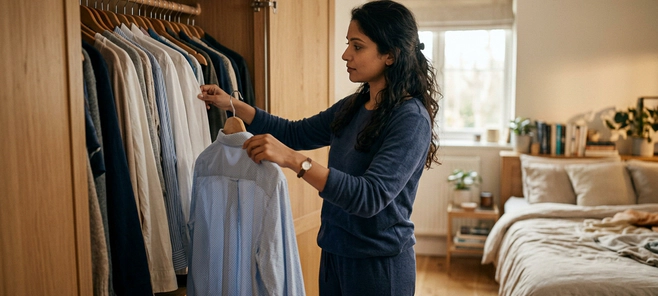
The best interview outfit rule is surprisingly simple: dress one level more polished than people typically dress in that job. Not two levels. Not full corporate armor “just to be safe.” One level up. A three-piece suit for a warehouse interview feels as off as a hoodie at a bank. The point is not to look expensive. The point is to show good judgment.
Hiring managers read clothing as a signal. Fair or not, they do it fast. Within a few seconds, they’re forming opinions about self-awareness, professionalism, attention to detail, and whether you understand the environment you want to join. Your outfit won’t get you hired on its own, but the wrong one can create friction you didn’t need.
Candidates often overthink the wrong things. They obsess over brands, trendy shoes, or whether a certain color is “allowed.” Most interviewers care far more about fit, cleanliness, appropriateness, and whether your appearance looks intentional. A clean $70 blazer that fits well beats a designer jacket that looks stiff and wrong for the setting. Every time.
This guide breaks down what “one level up” actually looks like across industries, what changes for virtual interviews, how seniority affects expectations, what to wear on a tight budget, and which mistakes quietly cost people interviews. You’ll also get practical outfit formulas and a quick decision framework you can use in under a minute.
The 30-second decision rule before you open your closet
If you’re unsure what to wear, run through these five questions in order. For most people, the answer becomes obvious by question three.
- Did the employer mention a dress code? If they said business casual, follow that. Don’t reinterpret it as “creative casual.” If they said casual, that still means neat, intentional, and interview-appropriate.
- What do people at the company actually wear? Check the team page, LinkedIn profiles, event photos, recruiting videos, and recent social posts. Use real employee photos, not stock images from the website header.
- Is the role client-facing? Reception, consulting, sales, account management, branch leadership, and front-desk roles usually call for a more polished look than internal back-office jobs.
- How senior is the position? Expectations rise with responsibility. A team lead, director, or head-of candidate usually needs a more executive presence than an entry-level applicant at the same company.
- Still unsure? Ask. A short note to recruiting works well: “Is there a dress code you’d recommend for the interview?” That’s professional, not awkward.
If you genuinely can’t tell, go slightly more polished rather than too relaxed. A little overdressed usually reads as respectful. Too casual can read like you didn’t take the meeting seriously.
Why interview attire matters more than people like to admit
A lot of career advice likes to pretend clothes shouldn’t matter. In a perfect world, maybe they wouldn’t. In real hiring, they do. Interviewers make snap judgments, then spend the next 30 to 60 minutes confirming or correcting them. That first impression sets the tone.
Clothing affects three things right away: how credible you look, how comfortable you feel, and how easily the interviewer can picture you in the role. If you’re dressed appropriately, people stop thinking about your outfit and focus on your answers. That’s exactly what you want.
There’s also a confidence factor. Candidates speak differently when they feel put together. They sit better, fidget less, and come across as more composed. I’ve seen strong applicants undercut themselves because they spent the first 15 minutes worrying they wore the wrong thing. Don’t hand yourself that distraction.
The core rule by industry: what “one level up” really means
Industry norms vary a lot. A Manhattan law firm, a Midwest manufacturing plant, a San Francisco startup, and a public school district do not read clothes the same way. Blanket advice like “always wear a suit” is outdated and often bad advice. Context wins.
Banking, insurance, law, accounting, corporate finance
Traditional business dress still matters here, especially for client-facing, licensed, or leadership-track roles. If you’re interviewing at a bank, large insurance carrier, law firm, private equity shop, or public accounting firm, classic business attire is usually the safest move. Dark, neutral colors work best. Keep accessories minimal. Closed-toe, polished shoes matter.
A navy or charcoal suit is rarely wrong. A crisp shirt or blouse, conservative dress shoes, and a structured bag or portfolio are strong choices. Ties are optional in some firms and still expected in others. Look at photos of partners, advisors, or branch leaders. They’ll tell you more than generic internet advice will.
If the company leans modern, you may be able to skip the tie or wear a less rigid equivalent to a full suit. Still, don’t drift into startup casual. These fields tend to reward polish and restraint. Loud patterns, flashy logos, or overly trendy pieces can hurt more than help.
Consulting, real estate, B2B sales, client services
These jobs sit between traditional corporate and modern business style. You need to look professional and convincing, because your appearance is part of how people assess whether clients will trust you. That’s especially true in real estate, sales, consulting, recruiting, and partnership-facing roles.
A blazer, tailored pants, a structured dress, or a polished skirt-and-top combination usually works well. You want to look sharp, not stiff. This is a good place for smart business attire. It says, “I can represent the company well,” without feeling like you’re heading to a board meeting at 8 a.m.
Candidates miss the mark here by going too casual. Clean sneakers may be fine at some software companies, but they’re riskier in real estate brokerage, enterprise sales, and boutique consulting. If you’ll later be pitching, negotiating, or presenting, your interview outfit should make that easy to imagine.
Tech, software, product, data, UX, engineering
This is where people overcorrect. They hear that tech is relaxed and show up looking ready for a lazy Saturday. Or they arrive in a full formal suit and look disconnected from the company culture. Both can feel off.
For most tech companies, polished smart casual works well. Think dark jeans with no distressing, chinos, clean trousers, a button-down, knit top, blouse, polo, or simple sweater. Footwear should be clean and understated. Minimal sneakers can be perfectly fine in many places. Beat-up running shoes are not.
There’s an important split within tech. A startup with 25 employees in Austin may expect something much looser than a Fortune 500 tech team inside a healthcare, automotive, or financial company. The second setting often calls for a blazer or at least a more structured outfit, especially from mid-level up.
If you’re interviewing for product management, solutions engineering, sales engineering, or a leadership role, lean more polished than you would for an entry-level developer job. The more cross-functional and visible the role, the more appearance tends to matter.
Startups, media, design, agencies, marketing
Personality matters here, but don’t confuse personality with chaos. The best outfits in creative environments look intentional, current, and well-edited. The worst look like costumes, either too formal or too performatively artsy.
A clean smart-casual outfit with one distinctive touch usually lands well. That could be a well-cut overshirt, quality knitwear, sharp boots, a structured blazer over a simple tee, or a modern dress with subtle accessories. The operative word is subtle. You want style, not theater.
Creative employers often pay close attention to fit and self-presentation. They may not care whether you’re wearing formal businesswear, but they will notice if your clothes look sloppy, wrinkled, stained, or thoughtless. Creative does not mean messy.
Healthcare, clinics, nursing, medical administration
Most healthcare jobs involve scrubs, lab coats, or role-specific uniforms on the job. That does not mean you should wear scrubs to the interview unless they specifically invite you to a working interview or practical assessment. For standard interviews, aim for clean, professional, and easy to move in.
Smart business or polished smart casual usually works. Closed-toe shoes are a smart choice, especially if there may be a facility tour. In hospitals and clinics, interviewers often value neatness, reliability, and calm professionalism over fashion. Keep jewelry simple, avoid overpowering fragrance, and choose clothes that let you move comfortably.
For administrative healthcare roles, such as office manager, patient coordinator, or practice administrator, go one step more polished than you would for a bedside or operational role. You’re being assessed as someone patients and providers will interact with regularly.
Education, higher ed, training, childcare
In education, the sweet spot is professional but approachable. You want to look like someone who can stand in front of students, meet with parents, and speak credibly with administrators. Too stiff can feel distant. Too casual can look unprepared.
A blazer with trousers, a modest dress, a collared shirt with chinos, or another neat business-casual combination usually works. If you have to give a sample lesson, expect to stand, write, walk, or crouch. Wear something that stays put and lets you move. Fussy outfits are a bad idea here.
For higher education and administrative roles, expectations may rise a bit, especially at private institutions or for leadership posts. If you’re interviewing for a dean, department chair, or director role, go more formal than you would for a classroom support position.
Retail, hospitality, restaurants, travel
Brand standards matter a lot in these industries. The right outfit for a luxury hotel is different from the right outfit for a fast-casual restaurant, a fashion retailer, or an outdoor gear store. Study the company’s customer-facing image. Their website, Instagram, and location photos are useful clues.
As a rule, dress a bit more polished than the employees on the floor. If store staff wear branded polos and casual pants, smart casual is probably right for the interview. If you’re interviewing at an upscale hotel, fine dining restaurant, or concierge desk, increase the formality. Clean shoes are non-negotiable in hospitality.
Style-sensitive retail is its own category. Fashion brands may expect a stronger personal point of view, but they still expect polish. Wear something aligned with the brand, not a head-to-toe costume version of it. A candidate interviewing at a premium denim brand doesn’t need runway styling. They need taste and judgment.
Warehouse, logistics, manufacturing, skilled trades
Please don’t wear a suit to a warehouse or plant interview unless the employer clearly tells you to. It often reads as impractical and disconnected from the work. A clean, simple outfit is better: plain pants, chinos, dark jeans without rips, a polo, button-down, or neat solid top, plus sturdy closed-toe shoes.
If there’s a facility walkthrough, safety matters more than style. No sandals. No loose, impractical footwear. No clothes that suggest you didn’t think through where you were going. Supervisors in these environments usually care far more about reliability, punctuality, and common sense than fashion details.
For trades and field-service roles, wear something respectful that still fits the reality of the job. Clean work boots may be appropriate in some settings. A pressed shirt with heavy-duty boots can work far better than officewear that looks borrowed and uncomfortable.
Government, public sector, nonprofits
Government interviews are often more formal than candidates expect. Even if the office has relaxed over the years, interview settings still tend to reward conservative, orderly presentation. Smart business is usually a safe baseline. Think polished, neutral, and understated.
Nonprofits vary, but many value professionalism without flash. Expensive-looking status pieces, oversized logos, or ultra-trendy outfits can send the wrong message. That doesn’t mean you need to hide your style. It means your appearance should fit the mission and culture of the organization.
Outfit formulas that work almost every time
Instead of thinking in rigid “men’s” versus “women’s” rules, it’s more useful to think in levels of formality. Pick the version that fits your role, industry, and comfort level. The best interview outfit is one you can wear confidently for 90 minutes without adjusting it every five seconds.
Business formal
Best for law, finance, executive roles, and conservative corporate settings.
- Matching suit in navy, charcoal, gray, or black.
- Simple shirt, blouse, shell, or knit underlayer.
- Closed-toe dress shoes or polished loafers.
- Minimal jewelry and a structured bag or portfolio.
- Optional tie depending on company norms.
Smart business
Best for consulting, education, healthcare administration, public sector roles, and many mid-size companies.
- Blazer or sport coat with tailored pants, a skirt, or a simple dress.
- Button-down, blouse, fine-gauge sweater, or polished knit top.
- Loafers, flats, ankle boots, or clean dress shoes.
- Neutral colors with one subtle accent if you want it.
Smart casual
Best for tech, startups, creative companies, some retail roles, and more relaxed offices.
- Dark jeans or chinos with no rips, fading, or sloppy hems.
- Polo, blouse, button-down, quality tee under a blazer, or simple knitwear.
- Clean minimalist sneakers, loafers, flats, or boots.
- Clothes that fit well and look fresh, not weekend-worn.
What to wear for a video interview
Video interviews changed a lot of habits, but not the basic standard. You still need to look like you took the meeting seriously. The difference is that camera, lighting, and framing matter almost as much as the clothes.
Wear roughly what you’d wear in person, or half a step less formal if you’re certain the company is casual. Solid colors usually look better on camera than tiny patterns. Mid-tones and jewel tones often read better than stark white or all black. Busy stripes can flicker. Very pale colors can wash you out.
Dress fully, not just from the waist up. It sounds obvious, yet people still make this mistake. You may need to stand up unexpectedly. Looking polished only from the chest upward is a gamble with no upside.
A few practical video interview tips matter more than most candidates realize:
- Check your outfit on camera the day before. Some fabrics shine strangely under light.
- Make sure the background is clean and not visually chaotic.
- Position light in front of you, not behind you. Window light works well.
- Avoid noisy bracelets, giant earrings, or anything that hits the desk or microphone.
- Sit far enough from the camera that your outfit reads as intentional, not cropped awkwardly.
What changes for second interviews, panel interviews, and working interviews
Not every interview requires the same outfit. The format matters.
For a first interview, aim for the clearest, safest version of appropriate for that industry. This is not the time to experiment.
For a second or final interview, match or slightly refine what worked the first time. If the first round made it clear the office is much more relaxed than expected, you can adjust down a notch. Don’t swing wildly the other direction. Consistency helps.
For a panel interview, lean a touch more polished. You’re meeting several decision-makers at once, often including more senior people. A stronger executive presence helps.
For a working interview, trial shift, classroom demo, or facility visit, practical considerations matter more. Ask what you’ll be doing. If you’ll be walking the floor, shadowing staff, teaching a sample lesson, or touring a site, dress for movement and safety while still looking prepared.
Seniority changes the standard
A lot of candidates miss this. The same company may expect very different things from an entry-level applicant and a director candidate. Seniority raises the bar for polish, even in casual cultures.
A junior software engineer at a startup can often interview in neat smart casual. A VP of Product at that same startup should probably add more structure, maybe a blazer, sharper shoes, and an overall more executive look. The reason is simple. Leaders are evaluated partly on presence. Can investors, clients, peers, and teams picture you representing the company?
Client exposure also matters. If the role includes presentations, media, fundraising, board interaction, or customer meetings, go more polished than the average internal employee. Your outfit should reflect the most visible version of the job, not the most relaxed day in the office.
Common interview outfit mistakes that actually cost people opportunities
These are the issues hiring teams mention again and again. None are about luxury. Most are about judgment.
- Clothes that don’t fit. Too tight, too loose, too long, too short, constantly slipping, pulling, or bunching. Poor fit reads as careless fast.
- Wrinkles, lint, stains, pet hair, scuffed shoes. Small details matter because they signal preparation.
- Trying too hard to look “corporate.” Borrowed suits, stiff outfits, and uncomfortable shoes can make you look like you’re playing a role.
- Overly casual choices. Hoodies, athletic wear, distressed denim, flip-flops, or gym sneakers are rarely defensible.
- Too much fragrance. This is a bigger issue than people think, especially in healthcare, small meeting rooms, and shared offices.
- Distracting accessories. Noisy jewelry, massive logos, novelty ties, or statement pieces that dominate the room.
- Ignoring weather and logistics. If it’s 95°F or snowing, plan accordingly. Arriving sweaty, soaked, or freezing hurts your composure.
How to build a strong interview outfit on a budget
You do not need an expensive wardrobe. You need a small number of clean, well-fitting basics. A surprisingly good interview capsule can be built with 5 to 8 pieces.
A practical budget setup might include one dark blazer, one pair of tailored pants or a simple interview dress, one pair of dark chinos or dark jeans if your target industry allows it, two solid tops, and one pair of polished shoes. In many U.S. cities, you can put this together for $150 to $300 if you shop carefully at outlet stores, discount retailers, consignment shops, or secondhand platforms.
Alterations matter more than brand. A $25 hemming job can make budget clothes look far better. Prioritize fit in the shoulders, waist, and length. Neutral colors stretch farther than bold ones, because you can rewear them across multiple interviews without anyone noticing.
If you’re short on money, spend first on shoes and fit. Interviewers notice shoes more than people think. They don’t need to be premium leather. They do need to be clean and in good condition.
Community resources can help too. Many cities have nonprofit career closets or workforce centers that provide free interview clothing. Dress for Success is one well-known example for women, and local workforce agencies often know similar programs for all job seekers.
Grooming, hair, nails, and accessories: the details that finish the look
Interview presentation is not just clothing. Grooming is part of the package. You don’t need to look polished in a glossy, magazine way. You do need to look clean, rested, and put together.
Hair should be neat and off your face enough that you aren’t constantly touching it. Facial hair should look intentional. Nails should be clean. Makeup, if you wear it, should feel like you, not like stage makeup. Jewelry should support the outfit, not dominate it.
Bags matter too. If possible, carry a structured tote, portfolio, briefcase, or clean backpack that fits the setting. A torn tote bag or gym bag can drag down an otherwise strong outfit. Small detail, big effect.
A simple color guide if you tend to overthink
If color choices stress you out, stick to easy combinations. Navy, charcoal, black, gray, white, cream, camel, olive, and muted blue are safe in most industries. Burgundy or deep green can work well as accent colors.
Bright neon shades, highly reflective fabrics, and loud prints are riskier unless you’re in a creative field where that’s truly part of the brand. Even then, use restraint. You want the interviewer to remember your answers, not your fluorescent shirt.
Interview outfit checklist for the night before
Do this the evening before, not 20 minutes before you leave.
- Try on the full outfit, including shoes, belt, socks, tights, outerwear, and bag.
- Sit down, stand up, walk, and reach forward in it.
- Check for wrinkles, missing buttons, loose threads, lint, deodorant marks, and stains.
- Confirm the weather and choose outerwear that won’t ruin the look.
- Pack copies of your resume, a notebook, and anything the employer requested.
- If it’s virtual, test your outfit on camera.
If you still have no idea what to wear, use this cheat sheet
Here’s the short version.
- Bank, law firm, finance office: suit or equivalent business formal.
- Consulting, real estate, public sector, healthcare admin: smart business.
- Tech company, startup, product team: polished smart casual, maybe add a blazer for senior roles.
- Warehouse, manufacturing, trades: clean practical clothes with closed-toe shoes, no suit.
- Retail or hospitality: match the brand, then go one level more polished.
- Teaching or childcare: professional, approachable, easy to move in.
Final advice: aim for credibility, not perfection
The right interview outfit does one job well: it helps the interviewer believe you belong there. That’s it. It should fit the company, fit the role, fit your body, and let your attention stay on the conversation.
Don’t chase perfect. Chase appropriate, clean, comfortable, and slightly more polished than the everyday standard for the job. That rule works in far more situations than any trend-based advice ever will.
If you can walk into the room feeling like yourself, just sharper and more intentional, you’re probably dressed exactly right.