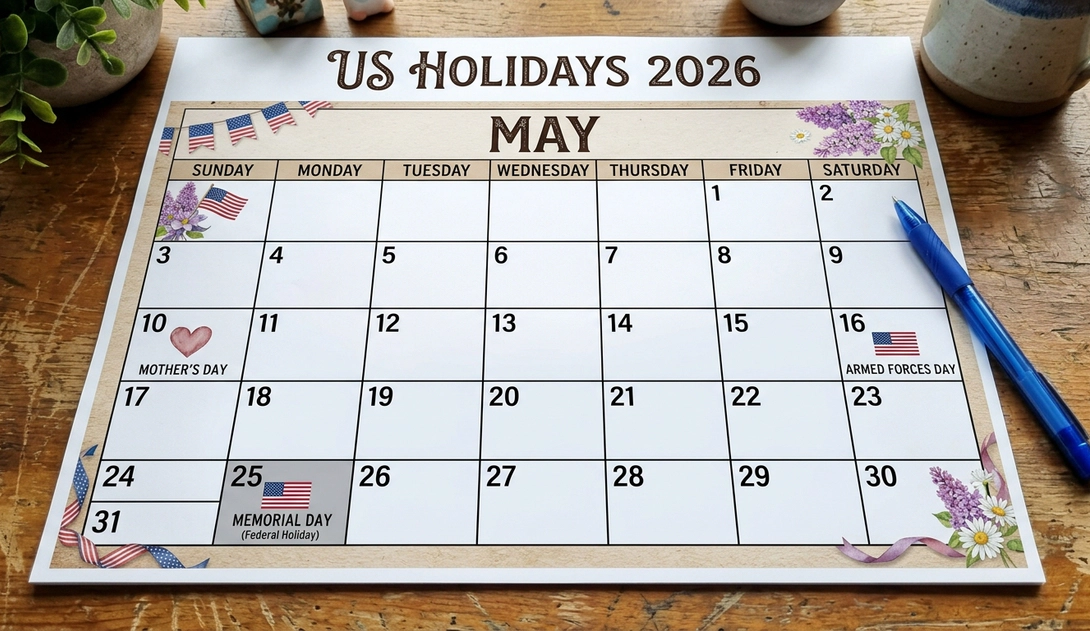
Many people search for federal holidays 2026 just to confirm dates. That’s useful, but it rarely answers the follow‑up questions. Will banks close? Does USPS deliver mail? Are financial markets open? Do private employers have to give employees the day off?
Another point often surprises readers. The United States does not have a single nationwide paid‑holiday system for all workers. Federal holidays apply to federal government offices, but state governments maintain their own holiday calendars, and private companies set their own policies.
This guide starts with the official 2026 U.S. federal holiday calendar, including observed dates and long weekends. It also explains how holidays affect banks, mail delivery, state offices, and private employers, because those schedules often differ.
Federal Holidays 2026: Full List With Observed Dates
The United States recognizes 11 official federal holidays established by federal law. Federal government offices close on these days, and most federal employees receive paid leave.
Observed dates sometimes differ from the calendar date. If a holiday falls on Saturday, federal offices usually observe it on the preceding Friday. If it falls on Sunday, it is typically observed on Monday.
| Holiday | Date (2026) | Day | Observed Date |
|---|
| New Year’s Day | January 1, 2026 | Thursday | January 1, 2026 |
| Martin Luther King Jr. Day | January 19, 2026 | Monday | January 19, 2026 |
| Washington’s Birthday | February 16, 2026 | Monday | February 16, 2026 |
| Memorial Day | May 25, 2026 | Monday | May 25, 2026 |
| Juneteenth National Independence Day | June 19, 2026 | Friday | June 19, 2026 |
| Independence Day | July 4, 2026 | Saturday | July 3, 2026 |
| Labor Day | September 7, 2026 | Monday | September 7, 2026 |
| Columbus Day | October 12, 2026 | Monday | October 12, 2026 |
| Veterans Day | November 11, 2026 | Wednesday | November 11, 2026 |
| Thanksgiving Day | November 26, 2026 | Thursday | November 26, 2026 |
| Christmas Day | December 25, 2026 | Friday | December 25, 2026 |
A quick takeaway. Most federal holidays occur on Monday, which creates several three‑day weekends during the year.
Federal vs State vs Company Holidays
Holiday schedules in the U.S. operate at three different levels. Confusion usually happens when people assume one schedule applies to everyone. It does not.
| Category | Who Sets It | Who Usually Closes | Examples |
|---|
| Federal holidays | U.S. federal government | Federal agencies, many banks | Independence Day, Thanksgiving |
| State holidays | Individual state governments | State agencies, courts, some schools | Cesar Chavez Day (CA), Patriots’ Day (MA) |
| Company holidays | Private employers | Varies by employer | Company Christmas break |
These calendars overlap but are not identical. A federal office may close while a state agency stays open, and a private company may choose a completely different schedule.
Understanding that difference prevents a lot of practical mistakes, especially with banking deadlines, court filings, or job start dates that depend on local government offices.
What Are State Holidays?
Each U.S. state has the authority to declare its own public holidays for state employees and government agencies. These holidays usually apply to state offices, courts, and some public schools. They do not automatically apply to federal offices or private employers.
Some state holidays match the federal calendar exactly. Others reflect regional history or local traditions. As a result, the number of recognized holidays can differ noticeably from state to state.
Examples include:
• Cesar Chavez Day on March 31 in California
• Patriots’ Day in Massachusetts and Maine on the third Monday in April
• Texas Independence Day on March 2 in Texas government offices
• Pioneer Day on July 24 in Utah
A resident of Boston, for instance, might see government offices closed on Patriots’ Day while federal offices continue operating normally. Someone in California may encounter closures for Cesar Chavez Day even though it is not a federal holiday.
Because each state sets its own calendar, there is no single nationwide list of state holidays. Residents usually check their state government website or local court calendar for the exact schedule.
Download the 2026 Federal Holiday Calendar
HR teams, recruiters, and operations managers often want the holiday schedule in a format that can be shared across calendars and scheduling systems. The 2026 calendar usually appears in several practical formats.
• Printable PDF calendar for office notice boards
• CSV file for payroll or HR software
• ICS calendar file for Google Calendar, Outlook, or Apple Calendar
• Simple spreadsheet version for planning work schedules
ICS files are especially practical. Import the file once and every federal holiday appears automatically in your calendar. Most scheduling software recognizes the format immediately.
Companies often attach the file to onboarding documentation or publish it in internal HR portals. That small step prevents confusion about observed days off later in the year.
What Typically Closes on Federal Holidays?
The phrase “federal holiday” can be misleading outside the federal government. Some services close completely. Others operate normally or follow their own holiday schedules.
A short disclaimer helps here. Closure policies can vary by organization, location, and year. Always check the specific institution if a deadline or payment matters.
Federal Government Offices
Federal agencies close on all eleven federal holidays. That includes organizations such as the IRS, Social Security Administration, passport offices, and federal courts.
State and local government offices often follow a similar schedule, but not always. Cities and counties sometimes recognize fewer holidays or observe additional regional ones.
USPS and Mail Delivery
The United States Postal Service generally suspends regular mail delivery on federal holidays, and most post offices close. Priority Mail Express shipments may still move through the system in certain situations.
Private delivery companies follow their own schedules. FedEx and UPS commonly operate on several federal holidays while closing or limiting service on major ones such as Thanksgiving Day, Christmas Day, and New Year’s Day.
Banks
Many U.S. banks follow the Federal Reserve holiday schedule, which overlaps heavily with federal holidays. Branch locations frequently close on those days.
However, the schedules are not identical in every situation. Some financial institutions keep limited hours on certain holidays, and online banking services usually remain available even when branches are closed.
Processing delays are the main issue. Transfers, ACH payments, and payroll deposits may settle on the next business day if a holiday interrupts the banking schedule.
Stock Market
The New York Stock Exchange and Nasdaq operate under a separate trading calendar. Several dates overlap with federal holidays, but the schedules are not identical.
Key differences include:
• Markets close on Good Friday, which is not a federal holiday
• Markets usually remain open on Columbus Day
• Markets usually remain open on Veterans Day
Because of this, federal offices may close while financial markets continue normal trading.
Federal Holidays vs Banking Holidays vs Market Holidays
These terms often appear together but refer to different schedules.
Federal Holidays
Defined in U.S. law for federal government employees. Federal agencies close and employees receive paid leave.
Federal Reserve Banking Holidays
Determined by the Federal Reserve system. On these dates, many payment networks pause settlement processing and bank branches frequently close. Most of these dates align with federal holidays, but policies can differ between financial institutions.
Stock Market Holidays
Set independently by stock exchanges such as the NYSE and Nasdaq. Their schedule includes Good Friday but excludes Columbus Day and Veterans Day.
These differences explain why certain financial services continue operating even when federal government offices are closed.
Paid Holidays in the Private Sector
U.S. labor law does not require private employers to provide paid holidays. The Fair Labor Standards Act focuses on minimum wage and overtime rules, not paid time off.
Despite that, most full‑time workers still receive several paid holidays through employer policies. According to the U.S. Bureau of Labor Statistics (2023 data), about 79 percent of private‑sector workers receive paid holidays as part of their benefits package.
Typical employer holiday schedules include:
• Six to ten paid holidays per year
• Major federal holidays such as Thanksgiving, Christmas, and Independence Day
• One or two floating holidays employees can schedule themselves
• Additional PTO instead of a fixed holiday calendar in some tech companies
Retail, healthcare, hospitality, and logistics companies often operate on federal holidays because demand stays high. Employees in those industries may receive holiday premium pay, commonly time‑and‑a‑half or double pay.
Large corporations sometimes add company‑specific days off. Examples include a full week shutdown between Christmas and New Year’s, or an extra “wellness day” during slower business periods.
Long Weekends in 2026
Several federal holidays create automatic three‑day weekends in 2026. These periods often influence travel demand, hiring schedules, and consumer spending.
• Martin Luther King Jr. Day weekend: January 17 to January 19
• Washington’s Birthday weekend: February 14 to February 16
• Memorial Day weekend: May 23 to May 25
• Labor Day weekend: September 5 to September 7
• Columbus Day weekend: October 10 to October 12
Independence Day creates a slightly different pattern in 2026. July 4 falls on Saturday, so the federal holiday is observed on Friday, July 3. Many workers end up with a three‑day weekend from July 3 through July 5.
How Many Workdays Are in 2026?
A typical year contains about 260 workdays after removing weekends. The exact number changes depending on the calendar and how holidays fall during the week.
In 2026:
• Total days in the year: 365
• Weekend days: 104
• Weekdays: 261
• Federal holidays on weekdays: 11
• Remaining business days in the year: 250
Payroll teams, consultants, and project managers often use this number when estimating billing schedules or staffing capacity.
Planning Tips for Employers and HR Teams
Holiday calendars influence recruiting timelines, payroll processing, and onboarding schedules more than many teams expect. A few small adjustments prevent delays.
Avoid scheduling interviews during long holiday weekends. Response rates tend to drop and many candidates travel or disconnect from work communication during those periods. Scheduling interviews earlier in the week or after the holiday usually produces better response times and fewer last‑minute cancellations.
Payroll timing also matters. If direct deposit normally processes on Friday and a banking holiday falls on Thursday, payroll systems often require submissions one day earlier. HR and finance teams usually adjust internal payroll deadlines around federal holidays to prevent delayed payments.
Hiring activity itself follows seasonal patterns. Many companies slow recruiting in late December and resume hiring after New Year’s Day, while hiring activity typically increases again in January and early February once budgets and staffing plans reset for the year.

Quick Overview of Each 2026 Federal Holiday
A brief explanation helps clarify the background behind each federal holiday on the calendar.
New Year’s Day
Observed on January 1. One of the oldest widely recognized holidays in the United States. Many businesses operate with reduced hours.
Martin Luther King Jr. Day
Observed on the third Monday in January. Honors the civil rights leader and his role in the Civil Rights Movement. Congress established the holiday in 1983 and the first national observance occurred in 1986.
Washington’s Birthday
Created to honor George Washington. Many businesses refer to it informally as Presidents’ Day and retail promotions often occur during this weekend.
Memorial Day
Observed on the last Monday of May. Honors U.S. military personnel who died while serving in the armed forces. It also marks the unofficial start of summer in the United States.
Juneteenth National Independence Day
Commemorates June 19, 1865, when enslaved people in Texas learned they were free following the Civil War. It became a federal holiday in 2021.
Independence Day
Celebrates the adoption of the Declaration of Independence in 1776. Fireworks displays, parades, and large public gatherings are common nationwide.
Labor Day
Honors American workers and the labor movement. Congress established the holiday in 1894 after major labor disputes highlighted worker rights issues.
Columbus Day
Observed on the second Monday of October. Some states and cities instead recognize Indigenous Peoples’ Day on the same date.
Veterans Day
Recognizes all U.S. military veterans who served in the armed forces. This differs from Memorial Day, which specifically honors those who died in service.
Thanksgiving Day
Celebrated on the fourth Thursday of November. It consistently ranks as the busiest travel period of the year in the United States. Many companies also close the following Friday.
Christmas Day
Observed on December 25. One of the most widely celebrated holidays nationwide, with significant retail activity throughout December.
Frequently Asked Questions About U.S. Holiday Schedules
How many federal holidays are there in the United States?
There are 11 official federal holidays recognized by the U.S. government. These dates apply to federal agencies and most federal employees.
Do all states follow the federal holiday calendar?
No. Many states observe the same major holidays, but each state can add its own holidays or modify observance rules. That means state office closures can differ from the federal schedule.
Do banks always close on federal holidays?
Many banks follow the Federal Reserve holiday schedule, which largely overlaps with federal holidays. However, policies vary by institution and some financial services remain available online even when branches close.
Do private companies have to give employees federal holidays off?
No federal law requires private employers to provide time off for federal holidays. Paid holidays depend on employer policies and employment contracts.
How many paid holidays do private employees usually get?
Most U.S. full‑time workers receive 6 to 10 paid holidays per year, depending on the company. Large employers often follow the federal calendar for major holidays but may add or remove certain dates.
What happens when a federal holiday falls on a weekend?
If a federal holiday falls on Saturday, it is usually observed on Friday. If it falls on Sunday, it is typically observed on Monday. This rule determines when federal offices close.
Final Thoughts
The 2026 federal holiday calendar provides a useful starting point for planning the year. Federal agencies close on eleven dates, banks often follow a similar schedule, and several long weekends appear throughout the calendar.
However, federal holidays are only part of the picture. State governments maintain their own holiday calendars, sometimes adding regional observances, and private employers design their own paid‑holiday policies based on industry, location, and company culture.
Checking the correct calendar for your situation, federal, state, or employer‑specific, prevents missed deadlines and scheduling surprises during the year. For HR teams and job seekers alike, understanding those differences makes planning much easier.