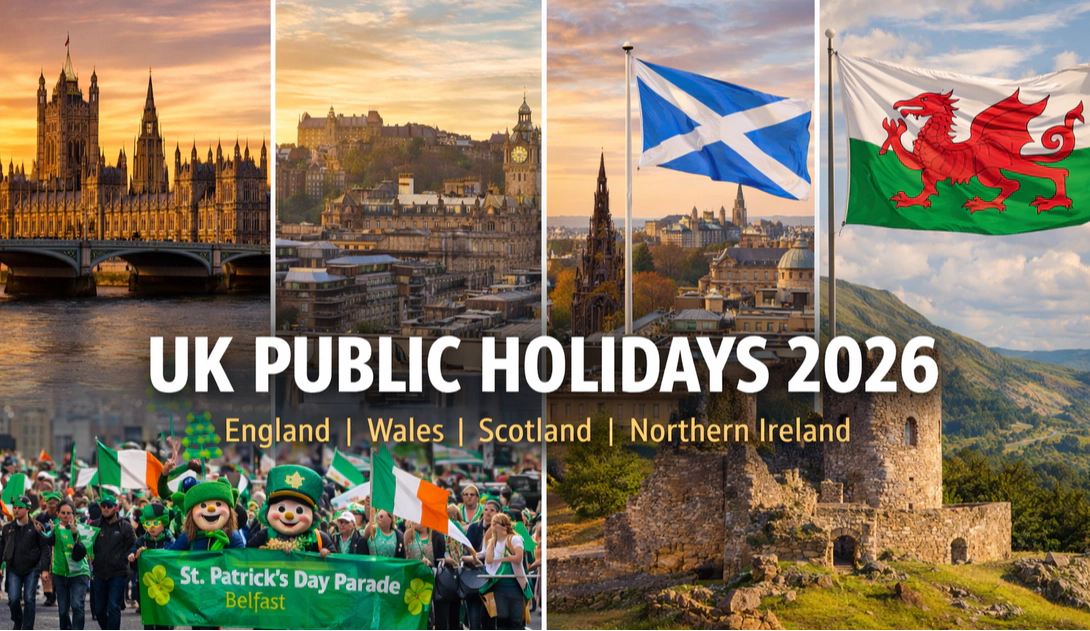
Most people search “UK bank holidays” for one simple reason. They want the dates. But the dates alone don’t help much if you’re planning travel, scheduling staff, or organising your year.
In the United Kingdom, public holidays are officially called Bank Holidays, a term used across England, Wales, Scotland, and Northern Ireland. Each nation follows its own calendar, although England and Wales share the same schedule.
Knowing the exact holiday dates matters for far more than booking a short break. Businesses adjust operations, recruitment slows temporarily, and employees often plan annual leave around these days to create longer breaks.
What Are UK Bank Holidays?
A bank holiday is a public holiday recognised across the UK when many banks, government offices, and businesses close. The concept dates back to the Bank Holidays Act of 1871, which created official closure days for banks and financial institutions.
The law originally applied only to England, Wales, and Ireland. Scotland followed its own traditional holiday structure for decades. Over time the idea expanded beyond banking and became part of the national work calendar.
Today, most public holidays are governed by the Banking and Financial Dealings Act 1971. This legislation established the modern framework for bank holidays and allows the UK government to declare additional holidays by royal proclamation.
That power explains why extra holidays occasionally appear. Royal weddings, jubilees, and coronations often trigger one‑off national days off.
The UK does not share a single national holiday calendar. England and Wales usually observe eight bank holidays each year. Scotland typically has nine, and Northern Ireland has ten due to additional cultural celebrations.
Those differences affect travel planning, shift scheduling, and job contracts. A worker in Belfast, for example, receives two additional public holidays compared with someone working in London.
A Brief History of UK Bank Holidays
Public holidays in Britain evolved gradually rather than appearing all at once. Before the late nineteenth century, workers mainly relied on traditional religious festivals or unofficial local holidays.
The Bank Holidays Act 1871, introduced by politician and banker Sir John Lubbock, formalised four public holidays in England and Wales. They were:
- Easter Monday
- Whit Monday
- First Monday in August
- Boxing Day
Over time the system evolved. New Year’s Day became an official holiday across the UK in 1974. The Spring Bank Holiday replaced the older Whit Monday holiday in 1971, fixing the date to the last Monday in May.
Another major change occurred in 1978 when the August bank holiday in England and Wales moved from the first Monday of August to the last Monday. Scotland retained the original early‑August schedule.
These adjustments created the pattern that most people recognise today.
UK Bank Holidays 2026 Overview
If you’re planning travel, business activities, or simply organising your year, knowing the UK bank holidays in 2026 is essential. The schedule varies slightly depending on the nation within the UK.
England and Wales share the same calendar. Scotland and Northern Ireland add several unique holidays tied to national traditions.
Below is a full breakdown of bank holidays in 2026 by region.
Bank Holidays 2026 in England and Wales
England and Wales follow identical public holiday dates each year.
- New Year’s Day — 1 January 2026 (Thursday)
- Good Friday — 3 April 2026 (Friday)
- Easter Monday — 6 April 2026 (Monday)
- Early May Bank Holiday — 4 May 2026 (Monday)
- Spring Bank Holiday — 25 May 2026 (Monday)
- Summer Bank Holiday — 31 August 2026 (Monday)
- Christmas Day — 25 December 2026 (Friday)
- Boxing Day, substitute day — 28 December 2026 (Monday)
Boxing Day itself falls on Saturday, 26 December 2026. Because the holiday lands on a weekend, the official substitute bank holiday will be observed on Monday, 28 December.
Most schools, banks, government offices, and many private businesses close on these days. Retail, healthcare, transport, and hospitality sectors usually remain operational.
Scotland Bank Holidays 2026
Scotland follows a different schedule and observes several additional holidays.
- New Year’s Day — 1 January 2026 (Thursday)
- 2nd January Holiday — 2 January 2026 (Friday)
- Good Friday — 3 April 2026 (Friday)
- Early May Bank Holiday — 4 May 2026 (Monday)
- Spring Bank Holiday — 25 May 2026 (Monday)
- Summer Bank Holiday — 3 August 2026 (Monday)
- St Andrew’s Day — 30 November 2026 (Monday)
- Christmas Day — 25 December 2026 (Friday)
- Boxing Day, substitute day — 28 December 2026 (Monday)
Key differences in Scotland include:
- Easter Monday is not a nationwide bank holiday
- The Summer Bank Holiday occurs on the first Monday of August, not the last Monday
- St Andrew’s Day on 30 November is a national holiday
Scotland also maintains local public holidays set by individual councils. Cities such as Glasgow, Edinburgh, and Aberdeen often observe additional civic holidays tied to local traditions or historic events. Many offices and schools close on those dates even though they are not nationwide bank holidays.
These variations matter for companies operating across the UK. A business with offices in London and Edinburgh often runs on different holiday schedules.
Northern Ireland Bank Holidays 2026
Northern Ireland observes two additional public holidays not recognised in England, Wales, or Scotland.
- New Year’s Day — 1 January 2026 (Thursday)
- St Patrick’s Day — 17 March 2026 (Tuesday)
- Good Friday — 3 April 2026 (Friday)
- Easter Monday — 6 April 2026 (Monday)
- Early May Bank Holiday — 4 May 2026 (Monday)
- Spring Bank Holiday — 25 May 2026 (Monday)
- Battle of the Boyne, substitute day — 13 July 2026 (Monday)
- Summer Bank Holiday — 31 August 2026 (Monday)
- Christmas Day — 25 December 2026 (Friday)
- Boxing Day, substitute day — 28 December 2026 (Monday)
St Patrick’s Day on 17 March is unique to Northern Ireland.
The Battle of the Boyne is traditionally celebrated on 12 July. In 2026 that date falls on a Sunday, so the official holiday will be observed on Monday, 13 July.
UK Bank Holidays 2027 and 2028 Preview
Long‑term planning often requires looking beyond the current year. Employers planning staffing models, travel companies scheduling tours, and event organisers frequently plan two or three years ahead.
Upcoming bank holidays for England and Wales include:
2027
- New Year’s Day — 1 January 2027 (Friday)
- Good Friday — 26 March 2027
- Easter Monday — 29 March 2027
- Early May Bank Holiday — 3 May 2027
- Spring Bank Holiday — 31 May 2027
- Summer Bank Holiday — 30 August 2027
- Christmas Day, substitute — 27 December 2027
- Boxing Day, substitute — 28 December 2027
2028
- New Year’s Day — 3 January 2028 (substitute)
- Good Friday — 14 April 2028
- Easter Monday — 17 April 2028
- Early May Bank Holiday — 1 May 2028
- Spring Bank Holiday — 29 May 2028
- Summer Bank Holiday — 28 August 2028
- Christmas Day — 25 December 2028
- Boxing Day — 26 December 2028
Dates may change if special national holidays are declared.
One‑Off and Special Bank Holidays
The UK occasionally adds extra public holidays for major national events. These are declared under powers granted by the Banking and Financial Dealings Act.
Recent examples include:
- Queen Elizabeth II Platinum Jubilee — 3 June 2022
- State Funeral of Queen Elizabeth II — 19 September 2022
- Coronation of King Charles III — 8 May 2023
- Royal wedding of Prince William and Catherine Middleton — 29 April 2011
These extra holidays are rare but have significant economic impact. Retail activity often spikes while office productivity drops temporarily.
UK Bank Holidays Multi‑Year Comparison
Many websites list holidays for a single year. That helps in the short term but doesn’t reveal long‑term patterns. A multi‑year overview helps businesses plan projects, hiring schedules, and marketing campaigns.
Here is a simplified comparison for England and Wales.
| Holiday | 2024 | 2025 | 2026 |
|---|
| New Year’s Day | Jan 1 | Jan 1 | Jan 1 |
| Good Friday | Mar 29 | Apr 18 | Apr 3 |
| Easter Monday | Apr 1 | Apr 21 | Apr 6 |
| Early May Bank Holiday | May 6 | May 5 | May 4 |
| Spring Bank Holiday | May 27 | May 26 | May 25 |
| Summer Bank Holiday | Aug 26 | Aug 25 | Aug 31 |
| Christmas Day | Dec 25 | Dec 25 | Dec 25 |
| Boxing Day | Dec 26 | Dec 26 | Dec 28 (substitute) |
Substitute days appear whenever a public holiday lands on a weekend. The following Monday or Tuesday becomes the official day off.
Downloadable Bank Holiday Calendars (ICS, Google, Outlook)
Lists are useful for quick checks, but most professionals prefer importing holidays directly into their digital calendar. That prevents meetings or deadlines from being scheduled on public holidays.
Most platforms support the ICS calendar format, which automatically adds bank holidays every year.
Common formats include:
- ICS calendar files compatible with Apple Calendar and Outlook
- Google Calendar holiday subscriptions
- CSV lists used by HR planning tools
- Team scheduling imports used in workforce management software
Many HR departments maintain a shared holiday calendar so managers can quickly identify staffing gaps. For remote teams spread across regions, a shared calendar prevents confusion about local holidays.
Employee Rights on UK Bank Holidays
A common misunderstanding is that employees automatically receive a paid day off on every bank holiday. UK employment law is more nuanced.
There is no automatic statutory right to paid leave on a bank holiday. Whether someone receives the day off depends on their employment contract.
Under the Working Time Regulations 1998, full‑time employees are entitled to 5.6 weeks of paid annual leave per year, which equals 28 days for someone working five days per week. Employers may include bank holidays within this allowance.
Two common workplace policies exist:
- 20 annual leave days plus 8 bank holidays
- 28 total days including bank holidays
Employers are not legally required to offer higher pay for working on a bank holiday unless it is specified in the employment contract. Many companies still provide double pay, time‑and‑a‑half, or time off in lieu.
Part‑time employees receive holiday entitlement on a pro‑rata basis and must not be treated less favourably than full‑time staff.
Employees unsure about their rights should check their employment contract or speak with HR before assuming a bank holiday is automatically a day off.
Retail Trading Laws and Holiday Restrictions
Most bank holidays do not impose mandatory closures on businesses. Shops, restaurants, and attractions can open normally. However, several laws restrict trading during specific holidays.
Key examples include:
- Large shops in England and Wales must close on Easter Sunday
- Large stores must close on Christmas Day if it falls on a weekday
- Large retailers opening on Sundays can only trade for six consecutive hours
These restrictions come from the Sunday Trading Act 1994 and related regulations. Smaller shops under 280 square metres are usually exempt.
Transport and Public Services During Bank Holidays
Transport schedules often change on public holidays. Rail operators, bus networks, and underground systems typically run reduced Sunday‑style timetables.
Christmas Day is the biggest exception. Most of the UK public transport network shuts down entirely on 25 December, including National Rail services and the London Underground.
Boxing Day services vary by region. Major cities such as London, Manchester, and Glasgow run limited services, but rural areas often have none.
Airports remain operational during holidays, although security queues and flight delays often increase during long weekends.
School Holidays and Half‑Term Breaks
Families planning travel need to consider school holidays as well as bank holidays. The two often overlap.
Typical school breaks in England include:
- February half‑term (one week)
- Easter holidays (two weeks)
- May half‑term near the Spring Bank Holiday
- Summer holidays from late July to early September
- October half‑term
- Christmas holidays in late December
Travel prices rise sharply during these periods. Accommodation in coastal towns and national parks can sell out months in advance.
How to Turn Bank Holidays Into Long Weekends
Bank holidays are ideal anchors for longer breaks. A single day of annual leave can transform a three‑day weekend into four or five days away from work.
Example strategy for a Monday bank holiday:
- take Friday off before the holiday
- combine it with the weekend
- enjoy four consecutive days away from work
Easter often creates even longer opportunities. Taking four days of leave around Easter weekend can sometimes produce a ten‑day break depending on the calendar.
Workers who plan early usually secure these dates before colleagues request them. Many companies approve leave on a first‑come basis.
Visiting the UK During Bank Holiday Weekends
Bank holiday weekends are popular travel periods across the UK. National parks, seaside towns, and major cities often host festivals and events.
Popular activities during long weekends include:
- coastal trips to Cornwall, Brighton, or the Isle of Wight
- countryside hiking in the Lake District or Snowdonia
- city festivals and food markets
- music festivals and outdoor concerts
Museums, restaurants, and tourist attractions usually remain open, although they may operate shorter hours. Hotels and trains often reach capacity quickly, so early booking helps.
Industry Impact: Who Actually Works on Bank Holidays?
Not every sector shuts down. Some industries actually become busier during long weekends.
Retail and Hospitality
Shopping centres, restaurants, and tourist destinations often see a surge during bank holiday weekends. Retailers frequently hire temporary staff before Easter, summer holidays, and Christmas.
Logistics and Delivery
Parcel volumes rise sharply before long weekends. Warehouses and delivery networks usually operate reduced but active schedules.
Drivers and warehouse staff often receive overtime incentives.
Banking and Finance
Financial markets close on bank holidays, and most physical bank branches shut their doors. Digital banking platforms still operate, so technical teams remain on standby.
Healthcare
Hospitals never close. NHS staff operate on rotating schedules that run throughout the year. Bank holidays are typically treated as standard shifts within these rotations.
Planning Work Schedules Around Bank Holidays
Managers often underestimate how disruptive bank holidays can be. Productivity dips before and after long weekends, and absence rates rise when employees extend breaks with annual leave.
A few simple planning steps make a big difference:
- publish the full holiday calendar at the start of the year
- limit how many employees can take bridge days off
- adjust project deadlines around long weekends
- communicate payroll policies for bank holiday shifts
Recruitment teams also see predictable slowdowns around major public holidays. Hiring activity can drop between 10 and 25 percent during periods such as Easter and Christmas, according to hiring platform reports from 2023 and 2024.
Possible Future Changes to UK Bank Holidays
Public holidays occasionally become political topics. Several proposals have circulated over the past decade.
Ideas discussed in Parliament and policy reports include:
- creating a UK national day in late autumn to boost tourism
- moving some holidays to fixed calendar dates rather than Mondays
- adding extra regional holidays for England similar to Scotland’s local system
None of these proposals have been implemented yet, but governments sometimes introduce changes during major national celebrations.
Final Thoughts
Understanding the UK bank holidays calendar helps employees plan leave, businesses organise operations, and travellers schedule trips across the country.
The dates may look simple on paper, but regional differences, substitute days, and occasional one‑off holidays can easily cause confusion.
Keeping a reliable calendar and checking the correct nation’s schedule prevents last‑minute surprises. With the right planning, those scattered public holidays can turn into longer breaks, smoother staffing schedules, and fewer missed deadlines.
More in Public Holidays:
US Federal Holidays
Public Holidays in the UAE