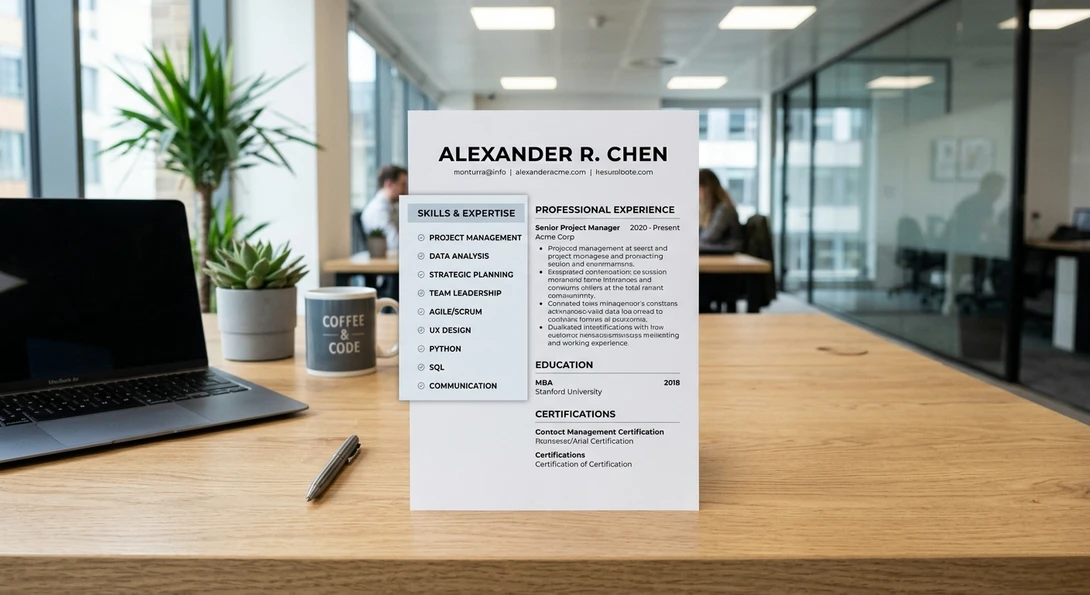
Hiring managers skim resumes fast. Often under 10 seconds. The skills section plays a big role in that quick scan. Done right, it shows exactly what you can do and helps your resume pass automated screening systems. Done poorly, it becomes a generic list that recruiters ignore.
Most career advice stops at “include communication and teamwork.” That advice barely scratches the surface. Strong resumes connect skills to measurable outcomes, mirror the language of the job description, and include keywords that applicant tracking systems actually detect.
This guide explains how listing skills on a resume actually works in 2026 and beyond. You’ll learn how to extract skills from job postings, structure them for ATS scanning, decide whether to show proficiency levels, and avoid outdated or meaningless entries. Real examples included.
Why the Skills Section Matters More Than Ever
Recruiters rely heavily on software filters before they ever see your resume. According to Jobscan research from 2024, roughly 98 percent of Fortune 500 companies use applicant tracking systems (ATS) to screen candidates.
These systems scan resumes for keywords related to qualifications, tools, and competencies. Skills sections create a concentrated block of those keywords, which makes them easier for software to detect.
Human readers still matter. A hiring manager glancing at a resume wants an immediate answer to a simple question: can this person actually do the job? A well structured skills section gives that answer in seconds.
What Should the Section Be Called?
Candidates often wonder whether the section should be labeled Skills, Core Competencies, Technical Skills, or Areas of Expertise.
For applicant tracking systems, the safest choice is simple. Use Skills or Technical Skills. These headings appear most frequently in resumes and ATS systems reliably recognize them.
Alternative titles can work, but they sometimes reduce keyword matching or confuse older ATS parsing systems. A hiring manager rarely cares about the heading name. They care about the clarity of the skills listed underneath it.
If your role is highly technical, “Technical Skills” makes sense. For most roles, plain Skills remains the safest and most widely understood option.
Hard Skills vs Soft Skills on a Resume
Every resume should include a mix of technical abilities and behavioral strengths. Recruiters expect both.
Hard Skills
Hard skills are specific, teachable abilities. They are measurable and often tied to tools, certifications, or technical knowledge.
- Python programming
- Google Analytics
- Financial modeling
- CAD design
- Medical coding (ICD‑10)
Soft Skills
Soft skills describe how you collaborate, solve problems, and manage work. They matter, but they shouldn’t appear as vague claims with no context.
- Team leadership
- Conflict resolution
- Project coordination
- Stakeholder communication
Instead of writing “strong communication,” show evidence. Example: “Presented quarterly marketing performance reports to a 12 person executive team.”
Should You Include Skill Proficiency Levels?
Many candidates wonder whether to label skills as expert, intermediate, or beginner, or display visual indicators like stars, progress bars, or percentages.
Most recruiters don’t trust these scales. They’re subjective and inconsistent. One person’s “expert” might mean five years of experience, another might mean ten.
Visual indicators cause an even bigger issue. Applicant tracking systems often struggle to read graphical elements such as progress bars or star ratings. In many cases they get ignored completely.
Plain text works best for both ATS and human readers. If you want to show depth, do it through context rather than ratings.
Better approaches include:
- Mentioning years of experience, for example “Python (5 years)”
- Referencing real work, such as “Advanced Excel modeling for financial forecasts”
- Pairing the skill with a certification
- Demonstrating it in your work history bullets
Language proficiency is the main exception. Recruiters expect clear levels for foreign languages, which we’ll cover shortly.
How to Extract Resume Skills Directly From a Job Description
One of the most reliable resume strategies is simple. Mirror the language employers already use.
Job postings reveal the exact skills hiring teams care about. The trick is turning that information into targeted resume content.
Step 1: Identify Repeated Keywords
Scan the job description and highlight repeated terms. Skills mentioned multiple times usually represent critical requirements.
Example from a marketing manager posting:
- Marketing automation
- HubSpot
- Campaign analytics
- Lead generation
Those phrases should appear naturally in your resume if you genuinely have that experience.
Step 2: Separate Tools From Competencies
Job descriptions usually mix technical tools and broader capabilities. Capture both categories.
Example breakdown:
Tools: Salesforce, Tableau, SQL
Competencies: data analysis, forecasting, reporting
Including both improves keyword matching for ATS systems.
Step 3: Integrate Skills Across the Resume
Skills shouldn’t live only in the skills section. Recruiters expect them to appear across the document.
Strong placement areas include:
- Skills section
- Work experience bullet points
- Resume summary
If you want a deeper walkthrough, read how to tailor your resume to a job description.
Prioritize Skills Based on the Job You Want
Many candidates make a simple mistake. They keep the same skills list for every application. Recruiters notice quickly.
The order of your skills should reflect the priorities of the role. If a job description mentions SQL five times and Python once, SQL belongs near the top.
A practical method:
- Highlight the top 8 to 10 required skills from the job posting.
- Move those skills to the beginning of your skills section.
- Place secondary tools and supporting abilities afterward.
- Remove unrelated skills entirely.
Recruiters scan from top to bottom. The first few items should mirror the role as closely as possible.
What a Strong Resume Skills Section Actually Looks Like
Advice helps, but candidates often want to see the finished product. Below are complete examples of how a real skills section might appear on a resume, including grouping and ordering.
Example: Marketing Manager Skills Section
Skills
Marketing Platforms: HubSpot, Marketo, Salesforce Marketing Cloud
Advertising and Acquisition: Google Ads, LinkedIn Ads, Meta Ads Manager, campaign budget management
Analytics and Data: Google Analytics 4, Looker Studio dashboards, conversion tracking, A/B testing
Growth Strategy: lead generation funnels, lifecycle marketing, marketing automation workflows
Content and SEO: keyword research, on page SEO optimization, content strategy
Tools: Ahrefs, SEMrush, Zapier, Notion
Example: Software Engineer Skills Section
Technical Skills
Programming Languages: Python, JavaScript (ES6+), TypeScript, Go
Frontend Development: React, Next.js, HTML5, CSS3, Tailwind CSS
Backend Development: Node.js, REST API design, GraphQL
Databases: PostgreSQL, MongoDB, Redis
Cloud and Infrastructure: AWS (EC2, S3, Lambda), Docker, Kubernetes
Developer Tools: Git, CI/CD pipelines, automated testing frameworks
Example: Data Analyst Skills Section
Technical Skills
Data Analysis: SQL (advanced queries), Python (Pandas, NumPy), statistical analysis
Data Visualization: Tableau, Power BI, Looker Studio dashboards
Data Processing: Excel advanced formulas, Power Query, data cleaning
Reporting: KPI dashboards, automated reporting workflows
Tools: Jupyter Notebook, Git, Google BigQuery
These examples share three patterns recruiters like to see: grouped skills, clear categories, and tools that align with real job descriptions.
Resume Format Changes How Skills Appear
Different resume formats treat the skills section very differently. Choosing the right structure matters.
Chronological Resume
The most common format. Work history appears in reverse chronological order.
In this format, the skills section acts as a quick summary near the top. Evidence appears later in job descriptions.
Functional Resume
Functional resumes organize experience by skill groups rather than job history.
Example structure:
- Data Analysis Experience
- Leadership and Team Management
- Client Communication
This format sometimes works for career changers. Many recruiters dislike it because it hides timeline details, so use it carefully.
Hybrid Resume
A hybrid resume blends both structures. A large skills section appears at the top, followed by traditional work experience.
This format is popular in technical fields because it highlights tools and technologies immediately.
How to List Language Skills on a Resume
Language skills often deserve their own section, especially for international roles. European employers in particular expect this.
Typical language proficiency levels include:
- Native
- Fluent
- Advanced
- Intermediate
- Basic
In Europe, the CEFR scale is widely used: A1, A2, B1, B2, C1, C2. Many multinational companies recognize it.
Example language section:
English: Native
Spanish: C1 Professional proficiency
German: B2 Upper intermediate
Language ability can influence hiring decisions in international companies, customer support roles, hospitality, consulting, and global tech teams.
What NOT to Include in a Resume Skills Section
A crowded skills section often weakens a resume rather than improving it. Certain entries signal outdated thinking or filler content.
Common examples to remove:
- Obvious basics such as “Internet use” or “email”
- Generic buzzwords like “hard worker” or “team player”
- Tools everyone in the profession already uses
- Skills unrelated to the target role
- Extremely outdated software
Even Microsoft Office sometimes falls into this category. For administrative or finance roles it can matter. For software engineers or designers it adds little value unless you highlight advanced features like Excel VBA or complex modeling.
Another mistake is keyword stuffing. Some candidates copy dozens of skills from a job description hoping to game the ATS. Recruiters notice quickly when those tools never appear in your experience section.
ATS Keyword Optimization for Skills Sections
Applicant tracking systems do not interpret resumes like humans. They scan text for matching phrases and structured categories.
A few formatting rules improve your chances dramatically.
- Use plain text skill names such as “Project Management” instead of creative variations
- Avoid graphics, icons, star ratings, or progress bars
- Include both acronyms and full names when relevant, for example “Search Engine Optimization (SEO)”
- Keep the section near the top third of the resume
Industry Specific Resume Skills
Recruiters evaluate resumes differently depending on the profession. Listing skills that match a specific industry dramatically improves relevance.
Technology and Software Development
- Python
- JavaScript and TypeScript
- React or Vue frameworks
- REST API development
- Git workflows
- Docker containerization
- Cloud platforms (AWS, Azure, GCP)
- CI/CD pipelines
Marketing and Digital Marketing
- Search engine optimization (SEO)
- Google Ads campaign management
- Marketing automation platforms
- Conversion rate optimization
- Email marketing systems
- CRM platforms (HubSpot, Salesforce)
- Marketing analytics dashboards
Creative and Design Roles
- Adobe Creative Cloud
- Figma interface design
- Brand identity development
- Typography and layout
- UX research and usability testing
- Motion graphics or animation
Human Resources
- Applicant tracking systems
- Talent sourcing strategies
- Employee relations
- HRIS platforms
- Compensation benchmarking
- Labor law compliance
Legal and Compliance
- Legal research
- Contract drafting
- Regulatory compliance
- Case management software
- Litigation support
Hospitality and Service Industry
- Guest experience management
- Reservation systems
- Event coordination
- Revenue management
- Multilingual customer service
Manufacturing and Industrial Roles
- Lean manufacturing
- Six Sigma methods
- CNC machining
- Production planning
- Quality control systems
- Industrial safety compliance
Pair Skills With Certifications and Credentials
Certifications often act as credibility signals. They show that a skill was formally tested or validated by an external organization.
Examples recruiters recognize immediately:
- Project Management Professional (PMP)
- Certified Public Accountant (CPA)
- AWS Certified Solutions Architect
- Certified ScrumMaster (CSM)
- CompTIA Security+
Including both the certification and the skill strengthens credibility. Example: “Agile project management, Certified ScrumMaster (CSM).”
Pair Skills With Measurable Proof
Skills alone don’t convince hiring managers. Proof does.
Instead of listing abilities in isolation, connect them to outcomes in your work history.
Weak Example
Skills: Leadership, Communication, Project Management
Strong Example
Project Management: Led a cross functional team of 8 to deliver a SaaS product launch 3 weeks ahead of schedule.
Data Analysis: Built SQL dashboards that reduced reporting time by 40 percent.
Communication: Presented monthly analytics insights to executive leadership.
Keep Resume Skills Consistent With LinkedIn and Your Portfolio
Recruiters rarely evaluate a resume in isolation. Most check LinkedIn within seconds. Some will also open portfolios, GitHub repositories, or design profiles.
If the skills listed across these platforms contradict each other, it creates doubt.
A simple rule helps avoid that problem:
- Your top skills should match across resume and LinkedIn
- Projects in your portfolio should demonstrate those skills
- Certifications should appear consistently across profiles
Developers often link GitHub repositories. Designers may reference Behance or Dribbble. Analysts sometimes include public dashboards or case studies. Evidence makes skill claims far more credible.
Using AI Tools to Build a Skills Section
AI tools now help many candidates draft resumes. Used carefully, they can save time. Used blindly, they produce generic lists that recruiters see every day.
Useful ways to apply AI during the process:
- Extract keywords from a job description
- Compare your resume against job requirements
- Suggest missing technical tools relevant to the role
Common pitfalls appear quickly. AI tools sometimes invent software names, exaggerate experience, or suggest irrelevant skills. Always verify every entry before adding it to your resume.
A practical approach is simple. Ask the AI to identify skill keywords from several job postings, then manually choose the ones that match your real experience.
Regional Differences: Resume vs CV
Resume conventions vary significantly between regions.
In the United States and Canada, a resume is typically a concise one or two page document focused on work experience and skills. Photos and personal details are rarely included.
In the United Kingdom, the document is usually called a CV, but its structure often resembles the American resume.
Across much of Europe, CV formats may include additional elements:
- A dedicated language section
- More detailed education history
- Optional photo or personal information
- Europass formatting in some countries
International job seekers should adjust their skills section to match local expectations, especially regarding language proficiency and certifications.
Only List Skills You Can Defend in an Interview
Inflated skills lists create problems during interviews. Hiring managers often test skills directly with follow up questions.
If you list a tool or competency, expect questions like:
- “Tell me about a project where you used this skill.”
- “What challenges did you run into?”
- “Which tools or techniques did you apply?”
A good rule: if you cannot describe a real example in under 30 seconds, remove the skill.
Which Skills to Emphasize at Different Career Stages
The ideal skills mix changes as your career develops.
Entry Level Candidates
Focus on tools, coursework, and internships. Employers expect limited experience but still want evidence of practical ability.
- Academic projects
- Software tools learned in school
- Research and analytical methods
- Collaboration and teamwork
Mid Career Professionals
Balance technical expertise with operational impact.
- Process improvement
- Team leadership
- Budget management
- Cross department collaboration
Senior and Leadership Roles
Highlight strategic influence and decision making.
- Organizational leadership
- Strategic planning
- Stakeholder management
- Large scale project oversight
Skills Shaped by Modern Workplace Trends
Technology shifts constantly change which skills employers expect. AI tools and automation now appear in job postings across marketing, finance, HR, operations, and software development.
Examples increasingly visible in listings include:
- AI assisted research and analysis
- Prompt design for generative AI tools
- Workflow automation tools such as Zapier or Make
- Data visualization and dashboard building
- Basic cybersecurity awareness
Employers rarely expect candidates to be “AI experts.” They expect practical usage, such as accelerating research, drafting content, or automating repetitive reporting tasks.
Frequently Asked Questions About Resume Skills
How many skills should a resume include?
Most recruiters prefer a focused list instead of a massive catalog. Around 12 to 20 relevant skills works well for most roles.
Should you include proficiency levels?
For most technical or professional skills, avoid labels like expert or beginner. They are subjective and provide little useful information. Demonstrating the skill through achievements is far more convincing.
Are visual skill bars or star ratings a good idea?
Usually not. Graphics often break ATS parsing and many recruiters view them as gimmicks. Plain text skill names work better.
Where should the skills section appear on a resume?
Place it in the top third of the document, usually after the summary section and before work experience. That placement helps both ATS systems and recruiters scan quickly.
Final Thoughts
A strong skills section does three things at once. It improves ATS keyword matching, gives recruiters an immediate snapshot of your capabilities, and reinforces the achievements described in your work history.
Treat your resume as a document that evolves with your career. Update it every 6 to 12 months or whenever you complete a major project, certification, or new tool training. During each update, check three things: whether your top skills still match current job postings, whether outdated tools should be removed, and whether your experience bullets clearly prove the abilities you list.
Candidates who maintain that alignment between skills, experience, and market demand tend to move through hiring pipelines much faster.