Job scams are rising fast. In 2023 alone, the U.S. Federal Trade Commission reported more than $450 million lost to employment scams, a sharp jump from just a few years earlier. The explosion of remote work, global recruiting, and AI-generated content has made it easier than ever for scammers to create convincing job offers.
This topic also became personal for our team recently. After CrawlJobs was mentioned in a Yahoo Finance article, scammers started impersonating our platform and sending fake job messages. Most of these messages targeted people in Canada. Based on reports and message volumes we observed, we estimate that more than 50,000 scam messages per day may be reaching Canadian residents using our name.
None of those messages come from us. CrawlJobs never contacts job seekers on WhatsApp or Telegram with job offers. We never ask for payments or personal documents through messaging apps.
For job seekers, the risk isn’t just losing money. Fake recruiters collect personal information, steal identities, and sometimes use victims as money mules in financial fraud. The worst part is that many scam listings look almost identical to real ones.
This guide breaks down how job scams actually work, shows real examples of fraudulent messages, and gives you a step-by-step system to verify whether a job listing is legitimate before you apply or share personal information.
The Rapid Rise of Job Scams Worldwide
Employment scams used to be simple. A poorly written email promised easy money for stuffing envelopes. Most people ignored them. Today’s scams are far more sophisticated.
Several trends have fueled the surge:
- Remote work opened global hiring pipelines, which scammers exploit by posing as international recruiters
- Messaging apps like WhatsApp and Telegram allow scammers to reach thousands of job seekers instantly
- AI tools make it easy to generate professional job descriptions and fake company websites
- Massive layoffs in tech created a large pool of job seekers actively searching for opportunities
According to the FBI Internet Crime Complaint Center (IC3), employment scams were among the fastest-growing online fraud categories in 2023. The average reported loss exceeded $2,000 per victim, though some scams involve fake check deposits worth tens of thousands.
The problem is global. Canada, the United Kingdom, India, and Australia all reported record levels of job scam complaints in the last two years. Fraud rings often operate across borders, targeting job boards, LinkedIn users, and recent graduates.
Most Common Types of Job Scams in 2026
Understanding the patterns behind fake job offers helps you recognize them quickly. These scams appear repeatedly across job boards and messaging apps.
1. Fake Remote Work Jobs
Remote job scams exploded after 2020. Fraudsters advertise positions like “remote data entry specialist” or “virtual assistant” with surprisingly high pay and minimal qualifications.
Typical warning signs include:
- Salary claims like $35 per hour for simple typing work
- No interview or a short text interview via chat
- Requests to purchase equipment using a check sent by the company
- Communication only through messaging apps
The classic version involves a fake check scam. The “employer” sends a check for office equipment. You deposit it, buy supplies from a specific vendor, and send money. Weeks later the check bounces. The victim owes the bank thousands.
How the Fake Check Scam Actually Works
Many victims assume that if a bank shows the money in their account, the check must be legitimate. That assumption is exactly what scammers exploit.
A typical fake check job scam follows a predictable sequence:
- A recruiter claims you were hired for a remote role
- They send a check worth $2,000 to $5,000 for equipment
- Your bank temporarily credits the funds
- The scammer instructs you to buy equipment from a specific “vendor”
- You send money via transfer, crypto, or gift cards
- Days or weeks later the bank discovers the check is fake
- The bank removes the funds from your account
At that point the money you sent to the scammer is already gone.
2. AI Training and Data Labeling Scams
AI companies really do hire contractors to label data, so scammers copy that model. Listings promise quick online work labeling images or training chatbots.
The scam typically asks for:
- A “platform access fee”
- Cryptocurrency payment for onboarding
- Identity documents before any interview
Legitimate AI data companies never charge workers to access tasks.
3. Fake Recruiters on LinkedIn
LinkedIn impersonation scams increased dramatically in 2024. Attackers clone real recruiter profiles or create convincing ones with stolen company logos.
Common tactics:
- Messaging candidates about “confidential roles” with high salaries
- Sending application forms that collect passport or SSN details
- Directing candidates to external websites that mimic real companies
4. Gig Platform and Task Scams
These scams target freelancers and gig workers. Victims are told they can earn money by completing simple online tasks such as boosting app rankings or writing short reviews.
The trick: workers must deposit money first to unlock higher-paying tasks. Early payouts appear real, which builds trust. Eventually the platform locks the account and demands larger deposits.
A typical progression looks convincing at first:
- The platform gives you 5 small tasks worth $2 to $5 each
- You complete them and successfully withdraw $20 or $30
- The system then offers “premium tasks” promising $100+ payouts
- To unlock them, you must deposit $50 or $100
- After payment, the platform claims you must complete a larger batch of tasks
- New deposits are required to continue
- Eventually the account is frozen and support stops responding
That initial small payout is deliberate. Scammers know that once someone sees real money arrive, their skepticism drops dramatically.
5. Reshipping and Money Mule Jobs
These scams recruit people as “logistics coordinators” or “package processing agents.” The job involves receiving packages at home and forwarding them overseas.
Behind the scenes, criminals purchase electronics or luxury items using stolen credit cards. Those packages are shipped to the “employee.” The worker then reships them to international addresses provided by the scammers.
A typical reshipping scam looks like this:
- You are hired as a “package inspector”
- Packages arrive at your home
- You are asked to remove invoices and ship them overseas
- Payment is promised after 30 days
- The payment never arrives
- Law enforcement traces the stolen goods to your address
Many victims don’t realize they were used in a fraud operation until investigators contact them.
6. MLM and Business Opportunity Job Scams
Some scams disguise themselves as legitimate employment but are actually multi-level marketing or business opportunity schemes.
The job listing advertises roles like “marketing associate” or “sales partner.” During the interview process, the candidate learns they must purchase starter kits, training programs, or inventory.
Red flags include:
- Paying hundreds of dollars to join
- Income based mainly on recruiting other people
- Pressure to buy products or inventory upfront
Some MLMs operate legally, but many job listings hide the true nature of the work until late in the process.
Payment Method Red Flags That Almost Always Indicate a Scam
The payment method requested during hiring often reveals a scam faster than the job description itself. Legitimate employers use payroll systems and pay employees. They do not ask candidates to send money through unusual channels.
Watch for these high-risk payment requests:
- Gift cards such as Apple, Google Play, or Steam cards
- Wire transfers through services like Western Union or MoneyGram
- Cryptocurrency payments such as Bitcoin or USDT
- Peer payment apps like Cash App, Venmo, or Zelle
- Requests to send money to a “vendor” or “training provider”
Gift cards are especially popular with scammers because they are difficult to trace and almost impossible to reverse once redeemed. Law enforcement agencies report that gift card fraud alone costs consumers hundreds of millions of dollars annually.
If a recruiter asks you to pay using any of these methods during the hiring process, stop communicating immediately. Real companies pay employees through payroll or reimburse documented expenses after hiring.
Real Examples of Scam Job Messages
Many job scams follow nearly identical scripts. If you recognize the patterns, they stand out immediately.
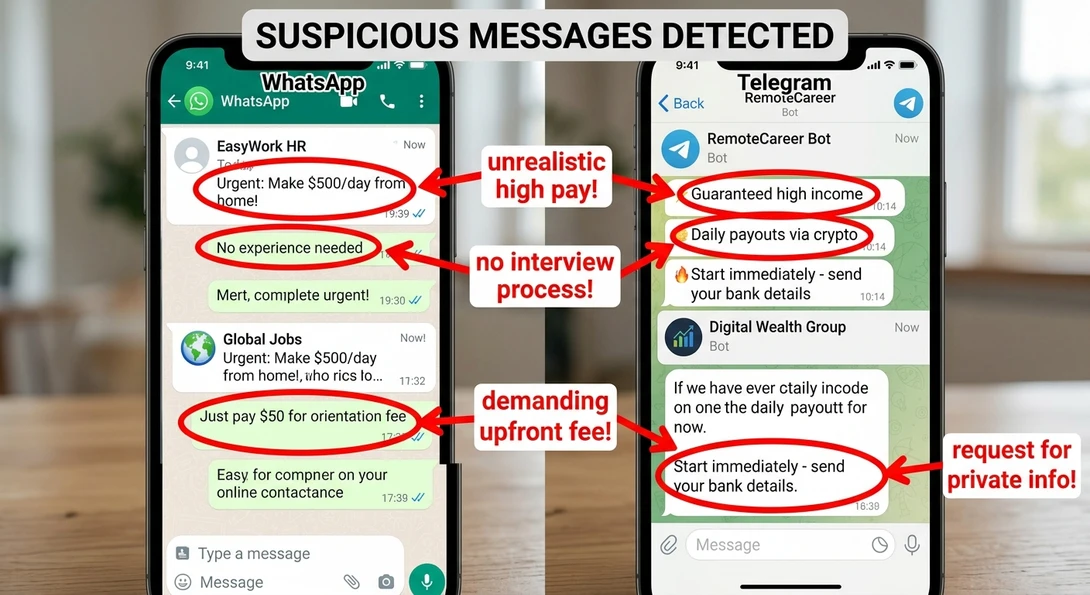
Here are three real-style examples based on common reports from job seekers.
“Hello, we found your resume online. Our company is offering a remote position with a salary of $3,800 monthly. Training is provided and no experience required. Please contact our HR manager on Telegram to start immediately.”
Red flags: generic greeting, high pay for low skill work, and moving communication to Telegram.
“Congratulations! You have been selected for the Data Entry Operator position. To begin, purchase the secure work software license for $79. The company will reimburse you with your first paycheck.”
Any legitimate employer covers software costs. Paying upfront is almost always fraud.
“Our finance department will send you a check to purchase your work laptop. Deposit the check and confirm once the funds clear so we can arrange equipment delivery.”
That is the classic fake check scam. Banks may show funds temporarily before discovering the fraud.
Legitimate Job Listings vs Scam Listings
At a glance, scam listings often look professional. The difference appears when you examine details closely.
Legitimate job postings usually include:
- Clear company name with a verifiable website
- Detailed responsibilities and required qualifications
- A professional recruiter email tied to the company domain
- A structured hiring process with interviews
Scam listings often include:
- Extremely high pay for entry-level work
- Vague job descriptions copied from other postings
- Gmail or Outlook recruiter emails
- Requests for payment or personal information early in the process
How Legitimate Employers and Staffing Agencies Actually Hire
Understanding how real hiring works makes scams much easier to detect.
Most legitimate employers follow a predictable process:
- You submit an application through a career page or job board
- A recruiter schedules a phone or video interview
- Additional interviews happen with managers or team members
- A written offer is provided before employment begins
Legitimate staffing agencies operate differently from scammers in several important ways. They are paid by the employer, not by the candidate.
A real recruiter will never ask you to:
- Pay for access to job listings
- Purchase equipment before starting work
- Send cryptocurrency or gift cards
- Share sensitive documents before a verified interview
If money enters the conversation during hiring, treat it as a serious warning sign.
Step-by-Step Process to Verify Whether a Job Listing Is Legitimate
Before applying or responding to a recruiter, run through this verification process. It takes five minutes and prevents most scams.
Step 1: Search the Company Independently
Never rely on the link inside the job posting. Instead, open a new browser tab and search for the company yourself.
Check whether:
- The company website lists the same job opening
- The business has a legitimate LinkedIn page
- The company appears in news, reviews, or public records
Step 2: Verify the Recruiter’s Identity
Look at the recruiter’s email domain. A recruiter claiming to work for Google should not use a Gmail address.
Search the recruiter’s name on LinkedIn. Check whether:
- The profile has a long work history
- Mutual connections exist
- The account has recent activity and endorsements
Step 3: Analyze the Job Description
Scam listings frequently copy text from real job posts. Paste a sentence from the description into Google inside quotation marks.
If the same paragraph appears in dozens of unrelated job ads, something is wrong.
Step 4: Evaluate the Hiring Process
Real hiring takes time. Most companies conduct at least one video or phone interview.
Be suspicious if:
- You receive a job offer immediately
- The interview happens entirely through chat
- You are asked to move to WhatsApp or Telegram
Step 5: Watch for Money Requests
Legitimate employers never require payments for:
- Training
- Software
- Equipment
- Background checks
Any request for payment during hiring should end the conversation immediately.
Step 6: Get a Second Opinion
Scammers rely heavily on urgency. They pressure candidates to respond quickly before the victim has time to think. A simple second opinion can break that pressure.
Before sending personal information or money, show the message to someone you trust:
- A friend or family member
- A colleague familiar with hiring practices
- A mentor, career advisor, or recruiter
- Online communities focused on job searching or scam reporting
Fresh eyes often notice red flags you missed. Many scam victims later say a friend immediately spotted the problem once they shared the messages.
Quick Job Scam Prevention Checklist
Many readers prefer a quick reference before applying to a job. This checklist summarizes the most common warning signs.
Pause and verify the opportunity if you notice any of these:
- The job promises unusually high pay for simple tasks
- Communication happens mainly through messaging apps
- The recruiter uses a personal email address
- The company website looks recently created or incomplete
- The hiring process skips interviews
- You are asked for payment or cryptocurrency
- The recruiter pushes you to act quickly
One warning sign might be harmless. Several together usually indicate a scam.
How to Report Job Scams
Reporting scams helps authorities identify fraud networks and prevent more victims. Many scams continue because they go unreported.
Different countries provide official government portals where employment scams and online fraud can be reported. If you encounter a suspicious job offer, report it through the appropriate authority below.
| Country | Official Fraud Reporting Agency | Website |
|---|
| United States | Federal Trade Commission (FTC) | https://reportfraud.ftc.gov |
| United Kingdom | Action Fraud (National Fraud & Cyber Crime Reporting Centre) | https://www.actionfraud.police.uk |
| Canada | Canadian Anti-Fraud Centre | https://antifraudcentre-centreantifraude.ca |
| Australia | Scamwatch – Australian Competition & Consumer Commission | https://www.scamwatch.gov.au |
| New Zealand | Netsafe – Online Safety and Cyber Fraud Reporting | https://www.netsafe.org.nz |
You should also report the scam to:
- The job board where the listing appeared
- LinkedIn or the social network used by the scammer
- Your local consumer protection agency
- Your bank if financial information was shared
Providing screenshots, phone numbers, and message transcripts increases the chance investigators can track the operation.
What To Do If You Already Sent Money or Information
Even careful job seekers sometimes get caught by well-organized scams. Acting quickly improves the chances of limiting financial damage or identity theft.
Start with the financial side immediately. Contact your bank, credit card provider, or payment platform and report the transaction as fraud. Many banks can attempt chargebacks or transaction reversals, especially if the report is made within the first 24 to 48 hours.
Take these steps as quickly as possible:
- Call your bank or credit card provider and request a fraud investigation
- Ask whether the payment can be reversed or frozen
- Report the transaction inside the payment app if Cash App, Venmo, PayPal, or Zelle was used
- Save receipts, screenshots, and transaction IDs
- Stop communicating with the scammer immediately
If you shared personal identification documents, treat it as a potential identity theft situation.
Protect yourself by:
- Placing a credit freeze or fraud alert with major credit bureaus
- Monitoring bank and credit card activity closely for several months
- Changing passwords for email, banking, and job search accounts
- Enabling two-factor authentication on important accounts
Some victims later receive follow-up messages from people claiming they can “recover the lost funds” for a fee. These are usually recovery scams, a second fraud attempt targeting the same victim. Legitimate law enforcement agencies do not charge fees to investigate fraud.
Smart Job Searching Reduces Scam Risk
A structured job search dramatically lowers your chances of encountering scams. Focus on reputable job boards, company career pages, and professional networking platforms.
Job scams thrive on urgency and excitement. Slow down, verify every opportunity, and trust your instincts. A legitimate job opportunity will still be there tomorrow. A scam usually disappears the moment you start asking questions.