In the modern era, skills and soft skills have become some of the most commonly used terms in career development and recruitment. Previously, only hard skills were considered valuable professional skills. However, today, recruiters clearly understand that both hard skills and soft skills are essential. Career growth, salary progression, promotion, and leadership roles depend heavily on communication skills and soft skills, not only on technical expertise.
Soft Skills Meaning?
Soft skills refers to abilities that are not directly connected to machines, production processes, or physical tasks. These skills are mostly related to human behavior, communication style, attitude, and the way an individual interacts with others in personal and professional environments.
Many soft skills are connected to behavioral aspects that help a person communicate effectively and present themselves properly to others. These skills work as an internal process. They may not be directly related to a specific task, but they are strongly connected to how the task is performed and how successful the final outcome becomes.
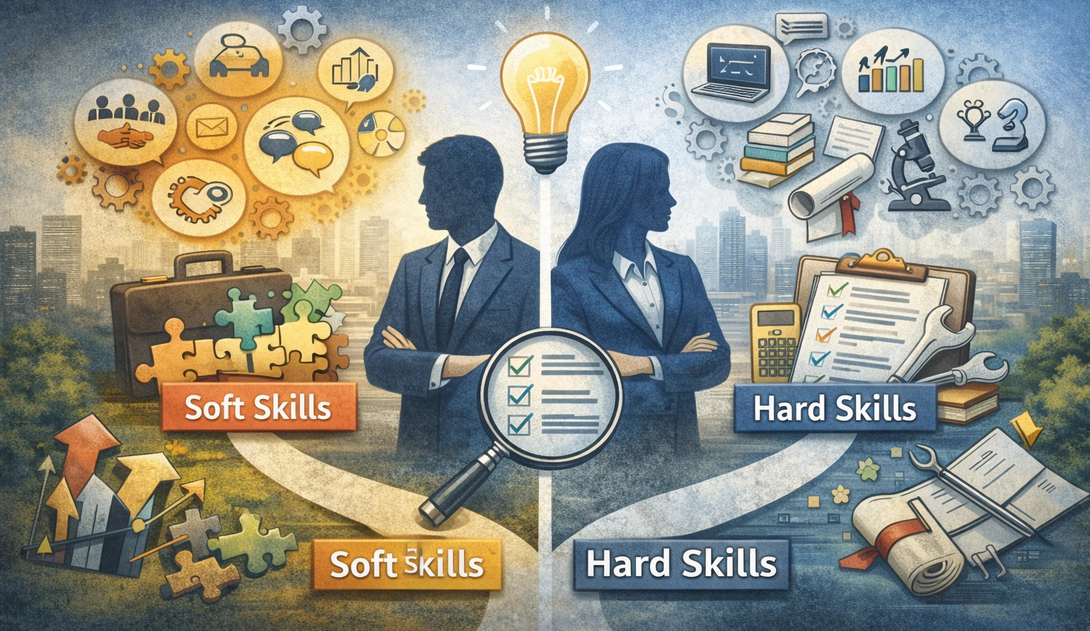
There is a clear difference between hard skills and soft skills. Hard skills are usually linked to a specific trade, profession, or technical sector. People can learn hard skills through formal education, courses, or training programs. Soft skills, on the other hand, take time to develop. They are part of a continuous learning process and cannot be mastered simply by completing a single course. Practice, self-awareness, and real life experience play a major role in building strong soft skills.
Soft Skills Examples That Matter in Professional Life
Communication Skills and Soft Skills
Communication is one of the most important soft skills in any profession. Many people are technically sound and highly experienced, but they struggle to present their skills effectively. As a result, they fail to make a strong impression during meetings, presentations, or job interviews. This gap is often related to weak soft skills communication.
Communication does not only mean delivering a formal presentation or giving a speech. It includes overall speaking style, response pattern, tone of voice, facial expressions, body language, listening ability, and even motivation style. All these elements together define how effectively a person communicates.
Today, recruiters actively look for communicative professionals for executive, supervisory, and managerial positions. To improve communication skills, individuals can receive training in verbal, nonverbal, and written communication. However, improvement takes time because communication skills develop mainly through regular practice and real interaction.
Problem Solving Skills
Organizations are no longer looking for employees who only identify problems. They want professionals who can also propose solutions. In traditional systems, people who pointed out problems were often praised as intelligent. In modern workplaces, what matters more is how you analyze a problem, how broadly you look at it, and how effectively you reduce its impact.
Problem-solving skills reflect a person’s critical thinking ability. Tools, systems, and logistics may remain constant, but with strong soft skills and problem-solving capacity, individuals can use available resources more productively.
To develop this skill, professionals can study different business case studies, follow industry-related podcasts, observe how leaders handle challenges, and learn modern problem-solving frameworks. Over time, this practice helps build confidence and structured thinking.
Leadership Skills
Leadership skills are another highly valued category of soft skills. Leadership is not a single ability, but a combination of several sub-skills. A person who can motivate a team, guide people toward a shared goal, and maintain trust can be considered to have leadership skills.
Leadership does not follow a fixed process. It is closely connected to personal characteristics, communication style, emotional awareness, and motivational approach. It also depends on how well someone understands team members and inspires them to perform at their best.
Jobs that require teamwork, coordination, or management responsibilities strongly demand leadership qualities. To build leadership skills, individuals need to understand human diversity, basic psychology, communication patterns, teamwork dynamics, and conflict management.
Teamwork
Even million-dollar companies struggle when individual performers fail to work as a team. An organization may have many talented individuals, but without teamwork, achieving a shared goal becomes difficult. That is why recruiters look for candidates who have individual potential but can also collaborate effectively.
Teams are made up of people with different strengths, skills, and personalities. Some individuals may perform better than others in specific areas, and this is completely normal. What matters is how these differences are combined to achieve collective success.
To improve teamwork skills, professionals should support others in developing their abilities and remain open to learning from colleagues. Celebrating individual achievements as team success helps create trust, bonding, and long-term collaboration.
Adaptability
Many skilled professionals struggle because they are rigid in their beliefs, habits, or working styles. However, workplace situations change constantly. Teams evolve, leadership styles shift, and organizational priorities are updated. Adaptability refers to how well a person adjusts to these changes.
Being adaptable means staying flexible, accepting feedback, and adjusting behavior when necessary. It does not mean losing personal values, but rather understanding when change is required.
To improve adaptability, individuals need to stay open-minded, reduce ego-driven reactions, and believe that continuous growth is possible. Viewing change as an opportunity rather than a threat helps professionals remain relevant in a competitive environment.
Emotional Intelligence
In both personal and professional life, situations can be complex and emotionally charged. People themselves are complex, and conflict is one of the most common challenges in any workplace. Emotional intelligence plays a critical role in managing these situations.
Emotional intelligence means understanding your own emotions and recognizing the emotions of others. It also involves responding thoughtfully instead of reacting impulsively. When practiced properly, emotional intelligence reduces misunderstandings and helps resolve conflicts constructively.
Strong emotional intelligence creates a healthy workplace environment. It builds trust, improves relationships, and supports long-term professional growth. In leadership and team-based roles, this soft skill is often as important as technical knowledge.
Why Communication Skills and Soft Skills Shape Career Growth
Recruiters today clearly understand that technical expertise alone is not enough. Communication skills and soft skills directly influence how professionals perform, collaborate, and grow within an organization. Promotions, leadership opportunities, and performance evaluations are increasingly linked to these skills.
While hard skills may help someone get shortlisted, soft skills often determine who gets hired, promoted, or trusted with responsibility. Investing time in developing soft skills is not optional anymore. It is a long-term career strategy that supports both professional success and personal development.