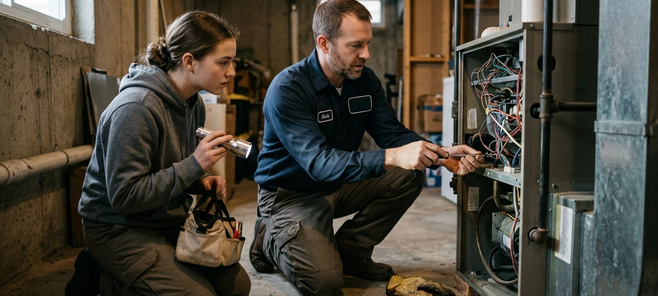
An HVAC apprenticeship is one of the most practical ways to break into heating, ventilation, air conditioning, and refrigeration work in the United States. You earn while you learn, build real field skills, and avoid the common trap of finishing a program with no hands-on experience. For a lot of people, that’s the biggest selling point. You don’t just study HVAC systems, you work on them with experienced techs and start building a career from day one.
A good apprenticeship can teach you how service calls actually go, how installs are planned, how tools are used safely, and how to deal with customers when a system quits in the middle of summer. It also helps answer the questions people usually have right away: How long is an HVAC apprenticeship? Do you get paid? Do you need school first? How do you apply? This guide covers all of that in plain English.
What an HVAC apprenticeship actually is
An HVAC apprenticeship is structured on-the-job training, usually combined with classroom instruction or related technical training. You work under a more experienced technician, often called a journeyman, lead installer, or senior service tech depending on the company or program. The idea is simple: learn the trade by doing the work, not by reading about it alone.
Most apprentices spend their early months doing support work. That can mean carrying equipment, setting condensers, pulling wire, cleaning coils, labeling duct runs, helping with startup checklists, and riding along on maintenance calls. Over time, you start handling more technical tasks like checking refrigerant pressures, tracing electrical faults, replacing components, brazing line sets, or assisting with airflow diagnostics.
This matters because HVAC isn’t one narrow job. It includes residential service, commercial rooftop work, refrigeration, controls, hydronics, heat pumps, ventilation systems, and indoor air quality equipment. An apprenticeship gives you exposure to the real trade, not just the version described in a brochure.
How long an HVAC apprenticeship takes
The short answer is that HVAC apprenticeships commonly last 3 to 5 years, depending on the training model, employer, and the kind of work you do. Some company-based programs feel less formal and move faster. Union or committee-run programs often have a more defined schedule with required classroom hours and wage progression steps.
That said, don’t get too hung up on the number alone. You can become useful on a crew much sooner than that. Many apprentices are contributing in a meaningful way within the first few months if they show up on time, listen, ask smart questions, and keep improving. The full apprenticeship period is really about building range and judgment, not just surviving long enough to get a title.
A better question is this: How long until you can work with less supervision? For basic install tasks, maybe not long. For diagnostics, refrigeration work, electrical troubleshooting, airflow balancing, and customer-facing service, it usually takes longer. HVAC has too many moving parts for shortcuts to work out well.
Do HVAC apprentices get paid?
Yes, in most cases, HVAC apprentices are paid. That’s one of the biggest reasons people choose this route over a full-time school-only path. You’re working, and employers expect productive labor even while you’re learning. Pay usually starts lower than what an experienced technician earns and rises as you gain hours, skills, and independence.
The exact pay structure varies. Some shops give scheduled raises every six months or after specific skill milestones. Others are less formal and raise pay when the apprentice becomes more useful. A union-style program may have a clearer progression. A small local contractor might handle it through direct performance reviews with the owner or service manager.
Here’s the part people don’t say loudly enough: your first HVAC job may include a lot of grunt work. That’s normal. If you’re loading sheet metal, cleaning out a truck, organizing fittings, or spending half a day in an attic, it doesn’t mean the apprenticeship is bad. It means you’re in the trade. The key is whether the company is also teaching you. If months go by and you’re only a helper with no growth, that’s a red flag.
HVAC apprenticeship vs trade school
Plenty of beginners ask whether they should go straight into an HVAC apprenticeship or attend trade school first. Honest answer: either path can work. The better choice depends on your budget, your local job market, and how quickly you can get hired.
Trade school can help you learn fundamentals before stepping onto a truck. You may get exposure to refrigeration cycles, electrical basics, recovery procedures, airflow concepts, and component identification. That can make your first months on the job less overwhelming. But school alone rarely replaces field experience. Employers know the difference between someone who can pass a quiz and someone who can diagnose a no-cool call while sweating in a 130-degree attic.
An apprenticeship puts you in the field sooner. You make money earlier, see actual systems, and learn how real crews operate. The downside is that some companies train well and others don’t. You need to choose carefully.
| Path | Best for | Main upside | Main drawback |
|---|
| HVAC apprenticeship | People who want to earn while learning | Real job experience from the start | Training quality depends on employer |
| Trade school first | People who want structured classroom basics | Smoother start with technical concepts | Tuition cost and less real-world experience |
| School plus apprenticeship | People who can combine both | Strong theory plus hands-on training | Takes more time and planning |
What you learn during an HVAC apprenticeship
A solid HVAC apprenticeship should teach more than equipment names and tool handling. It should build your judgment. That’s what separates a helper from a technician.
You can expect to learn skills like these:
- Reading gauges, meters, and temperature measurements on service calls
- Identifying common components such as contactors, capacitors, relays, motors, igniters, and control boards
- Assisting with ductwork, airflow checks, filter changes, and venting tasks
- Installing condensers, air handlers, furnaces, thermostats, mini-splits, and refrigerant lines
- Understanding the basics of heating cycles, cooling cycles, and heat pump operation
- Learning how job sites are prepared, materials are staged, and paperwork is handled
- Talking to customers professionally and explaining basic findings without sounding lost
- Working safely in attics, crawl spaces, rooftops, mechanical rooms, and occupied homes
The exact mix depends on where you land. A residential replacement company may teach installs faster than diagnostics. A service-heavy contractor may throw you into troubleshooting earlier. A commercial shop might expose you to package units, larger ventilation systems, or building controls.
Where to find an HVAC apprenticeship
Most people don’t find an HVAC apprenticeship through one perfect source. They piece it together from local contractors, union programs, trade schools, workforce centers, job boards, and plain old phone calls. If you want in, cast a wide net.
Good places to look include:
- Local HVAC contractors hiring helpers, installers, or apprentice technicians
- Union apprenticeship programs in your area
- Trade schools with employer partnerships
- Equipment distributors that know which companies are growing
- Local job fairs and skilled trades hiring events
- State workforce offices and career centers
- External job platforms such as Apprenticeship.gov at https://www.apprenticeship.gov
Don’t ignore smaller contractors. Big names get attention, but a 12-person shop can give an apprentice excellent hands-on training if the owner cares about development. Smaller shops also tend to expose beginners to more variety because everyone has to pitch in.
Call companies even if they aren’t advertising a formal apprenticeship. Ask whether they’re hiring helpers or trainees for install or service. Lots of people enter HVAC through a helper role that becomes an apprenticeship in practice, even if nobody uses that exact title.
How to apply, even if you have no experience
No experience is common. Employers know beginners start somewhere. What they want to see is reliability, basic mechanical interest, and the ability to learn without constant babysitting.
Your resume should be simple and honest. Highlight things that actually matter in the field: attendance, physical stamina, safe tool use, customer service, warehouse work, driving experience, construction exposure, military experience, maintenance work, or anything that shows you can show up and handle a real day of work. If you’ve repaired cars, worked on motorcycles, helped remodel homes, or done electrical side jobs with family, say so.
A short resume summary can work well. Example:
Entry-level HVAC apprentice candidate with hands-on experience in warehouse operations and home renovation projects. Comfortable using hand tools, lifting equipment, working outdoors, and learning from senior technicians. Known for reliability, punctuality, and strong customer-facing communication.
Your application should also answer the unspoken question: Why HVAC? A weak answer is, “I just need a job.” A better answer is, “I like practical work, I want a trade with long-term growth, and I want to build technical skills I can keep improving for years.” That sounds like someone who’ll stick.
What employers look for in HVAC apprentices
Managers usually aren’t expecting a beginner to know everything. They are looking for clues that you won’t be a headache. That’s blunt, but true.
The strongest entry-level candidates usually show these traits:
- They arrive on time and communicate clearly if something changes
- They can work in heat, cold, tight spaces, and on physically demanding days
- They take instruction without acting defensive
- They ask useful questions after listening first
- They can handle basic math, measurements, and simple paperwork
- They respect customers’ homes and behave professionally
- They keep tools organized and don’t lose track of materials
- They want to learn the trade, not just collect a paycheck for a few weeks
That last point matters a lot. HVAC companies invest time in training. If they think you’ll quit the second summer gets rough, they’ll pick someone else.
Questions to ask before accepting an HVAC apprenticeship
Not every apprenticeship is worth taking. Some are excellent. Some are just helper jobs with a nicer label. Ask direct questions before you accept anything.
Use questions like these:
- Will I be assigned to install, service, or both?
- How do apprentices get trained here, ride-alongs, classroom sessions, shadowing, or a mix?
- What skills should I expect to learn in the first 90 days?
- Is there a clear pay progression as I gain experience?
- Who will supervise me most of the time?
- What does a typical week look like during busy season?
- Do apprentices stay with one crew or rotate?
- What makes someone successful here after the first year?
The answers tell you a lot. If the manager can explain training clearly, that’s a good sign. If they get vague and only talk about how busy they are, be careful. Busy companies can still train well, but only if they intend to.
A realistic first year in an HVAC apprenticeship
The first year is usually humbling. That’s not bad, it’s normal. You’ll probably feel slow, sweaty, underqualified, and confused more than once. Then one day you’ll recognize equipment faster, understand what the lead tech is checking, and stop reaching for the wrong tool every five minutes. Progress in HVAC often feels sudden after a stretch of frustration.
On install crews, first-year apprentices often spend a lot of time staging equipment, carrying materials, setting pads, hanging units, insulating line sets, sealing duct joints, cleaning up, and learning the sequence of a full install. On service teams, they may start with maintenance visits, filter changes, coil cleaning, basic readings, and shadowing diagnostics. Both routes can be valuable.
Expect busy seasons to be intense. Summer no-cool calls pile up fast. Winter heating calls do the same in colder parts of the country. Some weeks feel long. Some attics feel endless. If you can keep your head, stay organized, and avoid careless mistakes when you’re tired, you’ll stand out quickly.
Tools and gear beginners usually need
Every company handles tools a little differently. Some provide more than others. Many apprentices start by buying basic hand tools and adding to their kit over time. Don’t go broke trying to look experienced. A cheap pile of tools you don’t know how to use won’t impress anyone.
Common starter items often include:
- Tape measure
- Screwdrivers and nut drivers
- Adjustable wrench and channel-lock pliers
- Wire strippers and cutters
- Needle-nose pliers
- Flashlight or headlamp
- Work gloves
- Durable boots suited to attics, rooftops, and job sites
- A basic tool bag or backpack
Hold off on expensive specialty tools unless your employer recommends them. Buy what you need for the work you’re actually doing. Experienced techs respect apprentices who build their kit carefully, not the ones who show up with shiny gear and no clue.
Can you get an HVAC apprenticeship without school?
Yes, absolutely. Many people enter HVAC with no formal HVAC school at all. They start as helpers, warehouse workers, install assistants, or maintenance trainees and learn from there. A company may care more about your work ethic and mechanical ability than your classroom background, especially for entry-level roles.
That doesn’t mean school is useless. It can help, especially if you’re trying to stand out in a competitive market or want more confidence with basic concepts before applying. But no, a diploma from a trade program is not the only path into an HVAC apprenticeship.
If you’re skipping school, be ready to make a stronger case in interviews. Talk about hands-on experience, physical work, tool familiarity, problem-solving, and why you want the trade. Confidence helps, but sincerity helps more.
Residential vs commercial HVAC apprenticeship
This choice shapes your day-to-day experience more than most beginners realize. Residential and commercial HVAC overlap, but the work feels different.
Residential apprentices often work in homes, attics, crawl spaces, garages, and small mechanical closets. Customer interaction is frequent. You may see high-volume service calls, system replacements, maintenance agreements, and indoor air quality add-ons. The pace can be fast, especially during peak seasons.
Commercial apprentices may work on rooftops, in schools, offices, retail spaces, hospitals, warehouses, or larger mechanical rooms. Equipment is often bigger and systems can be more complex. Customer interaction is still part of the job, but less personal than walking into someone’s living room to explain why their AC froze up.
Neither path is automatically better. If you like variety, direct customer contact, and seeing a full job from start to finish in a home, residential may suit you. If you prefer larger systems, team-based work, and building operations, commercial might be the better fit. Some techs try both before settling in. Smart move, honestly.
Mistakes that can stall your apprenticeship
I’ve seen beginners sabotage themselves over simple stuff. Not because they lacked talent, but because they ignored the basics.
Watch out for these common mistakes:
- Showing up late and acting like it isn’t a big deal
- Standing around instead of looking for the next task
- Pretending to understand instructions when you don’t
- Talking too much and listening too little
- Treating customers casually or carelessly
- Refusing install work because you only want service
- Buying tools before learning what your job really requires
- Quitting after the first rough summer stretch
A lot of HVAC careers are built on reputation. Techs remember who worked hard, who learned fast, who stayed calm, and who could be trusted in a customer’s home. That reputation starts early, often in the first few months.
How to stand out fast as an HVAC apprentice
You don’t need to be the smartest person on the crew. You do need to be useful. If you want to stand out, focus on habits that make the lead tech’s day easier.
A few practical examples:
- Keep a small notebook and write down procedures, part names, and recurring mistakes
- Learn the truck inventory so you can grab materials without asking five times
- Repeat back instructions to confirm you heard them correctly
- Clean the workspace before someone has to tell you
- Watch how experienced techs talk to customers and copy the calm parts, not the bad habits
- Study wiring diagrams, sequence of operation, and common components after work in short sessions
The apprentice who thinks ahead gets remembered. The apprentice who has to be chased all day doesn’t. That’s really the difference.
Is an HVAC apprenticeship worth it?
For most people who want a hands-on skilled trade, yes, an HVAC apprenticeship is worth it. You build technical ability, real work experience, and a path into a field that touches homes, businesses, and critical building systems. The work can be physically demanding, dirty, and stressful during peak seasons. No sense pretending otherwise. But for people who like problem-solving, practical work, and visible results, it’s a solid career path.
The best part is that the trade rewards growth. You can start as a helper, become a technician, move into diagnostics, controls, refrigeration, sales, estimating, field supervision, training, or business ownership. Plenty of careers start with one person carrying tools and paying close attention.
Final advice before you apply
If you’re serious about getting an HVAC apprenticeship, don’t wait for the perfect opening with the perfect title. Apply to apprentice roles, helper jobs, install assistant positions, and entry-level service openings. Call companies. Ask questions. Show that you want the trade, not just any job.
Then, once you get in, treat the first year like paid training. Show up early. Learn the names of parts. Carry your share. Stay curious. Listen more than you talk. That approach beats raw confidence every time.
A good HVAC apprenticeship can turn a beginner into a real technician. It won’t happen in a week, and it won’t always be comfortable. Still, if you want a career you can build with your hands and your head, this is one of the strongest entry points out there.