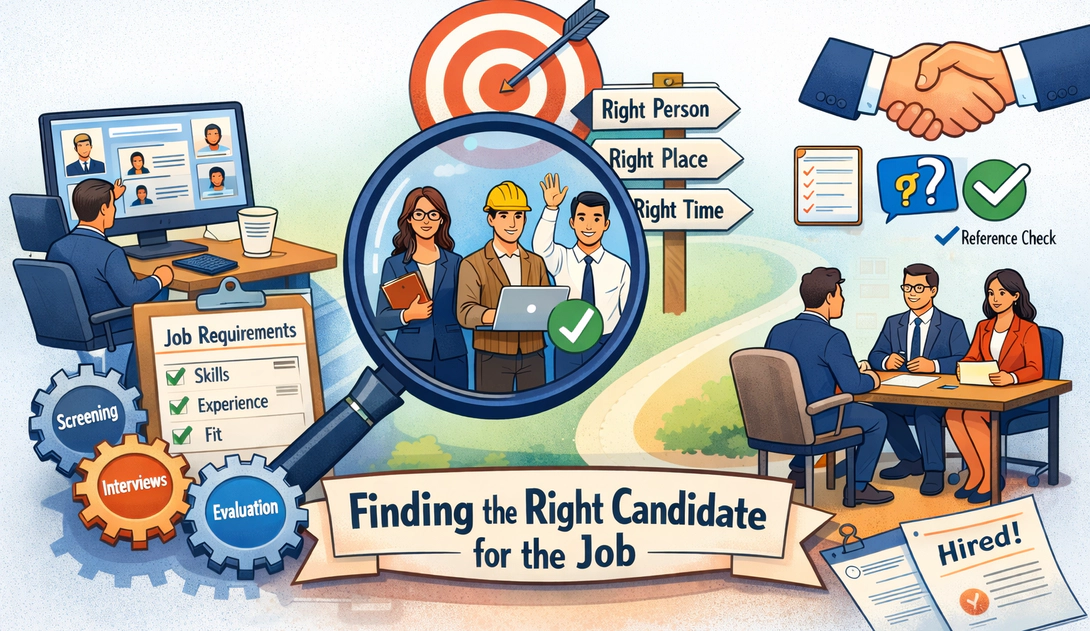
Candidates complain that they are struggling to secure a job; on the other hand, recruiters often wonder how to find the right candidate for a job, especially in a competitive market. There is an important thought here. A successful recruitment is when you recruit the right people at the right place at the right time. Today, we will discuss how to find the right candidate for a job.
Let’s Know About the Right Candidate
There is a common misconception that the right candidate means the person who has a lot of experience, skills, and managerial power. This misconception pushes us into finding the best candidate. Sometimes, the best candidate cannot be the right candidate.
There are some common practices among recruiters; they want overqualified candidates. If the position or designation requires a mid-level experienced candidate, recruiters try to find a more experienced person. In the short term, it looks like a smart recruitment, but after a few days, the employee leaves the job.
On the other hand, when a designation requires high experience with high technical and managerial requirements, sometimes we become convinced only by the number of years of experience.
So it is very important to find out what your requirements are. Your goal should be to find the right candidate, not just the best one.
Understand the Context
Every job circular has a background. Different situations demand different types of candidates. If your organisation is hiring to build a team, the context will be different. If you are finding a candidate to replace someone, the context is also different.
Sometimes a team needs a good supervisor. Sometimes a team needs some hard-working executives. So what the team demands, what the company expects, and what the job requires, all these situations have to be considered.
Collect Data and Information
You have to collect proper data and information about the position. There can be different types of requirements. Suppose the company’s requirements and the team supervisor’s requirements can be different. But as an HR or recruiter, you have to find out the proper data and information.
You have to communicate with the team supervisor, team members, operations manager, and cross-functional teams. It seems complicated, but when you understand everyone’s expectations, it will be easy to create a roadmap.
Job Analysis Before Hiring
Before starting recruitment, you have to clearly understand the job role. This is called job analysis or role analysis. Without this, you cannot define the right candidate.
Think about these things:
- Key responsibilities - what exactly the candidate has to do every day
- Hard skills - technical knowledge or subject-based skills required
- Soft skills - communication, teamwork, adaptability, leadership, and so on
- Future needs - the candidate’s growth potential and whether they can handle bigger responsibilities in the future
When these are clear, you will know how to find the right candidate for a job in a more effective way.
Match with Your Budget and Organisation Goal
When you recruit people, you should find a person who will be aligned with your organisational goals. You also have to maintain the budget. Company- or industry-wise, there can be a yearly budget, a department-wise budget, and a designation-wise budget. So calculate all of this before finalising recruitment.
Employer Branding
Remember that candidates also choose employers, not only employers choose candidates. If your business has a good reputation, culture, and growth opportunities, you will attract better people.
Employer branding means how your organisation looks to the outside world. Is it a place where people feel valued, respected, and motivated to work? If the answer is yes, then quality candidates will apply more easily. Employer branding plays a big role in how to find the right candidate for a job.
Draft a Job Circular
After collecting all data and information, try to build a draft job circular. In this process, you have to collect data and information from your industry. At the same level, see how other company circulate their job circulars, and which formats are popular. It will help you to create a standard job circular.
You can follow a common job circular format, or you can also mention your customised requirement. But always remember that a job circular has a purpose. The purpose of a job circular is to encourage capable candidates to apply for the job. The more resumes or CVs you can collect, the more fruitful it will be for you to sort and find the required candidate.
Circulate in the Best Platforms
The perfect platform is important for collecting quality resumes. Focus on industry-based platforms such as LinkedIn and reliable job portals. Remember that there are a lot of platforms, but you should not circulate on every platform. Try to find the best platforms for your industry and position. You can also explore Crawljobs as a useful platform for a job circular platform.
Emphasise Internal Sources
Try to influence your internal employees to recommend candidates from their own circle. Existing employees know about the internal situation, the team situation, and the requirements. When they provide you with their networks, they usually consider these things.
Screen Resumes and CVs
There is a common pattern where recruiters invest very little time in CV or resume screening. But this is not always the right process.
Every single CV or resume should be prioritised. Sometimes people’s skills or experience are not presented with highlights. Screening authorities should maintain a mechanism to find the most promising CVs from the pile.
Create a Selection Process
According to the nature of the job, you have to design a selection process. There can be technical assessments, written assessments, and interviews. Sector-wise and industry-wise, the process can be different. Sometimes, for senior designations, only a formal interview is conducted, while for technical roles, multiple steps may be required.
Create Marking Criteria
For effective evaluation, HR or recruiters should finalise a marking criteria with specific indicators. It helps the assessor to assess with an ideal structure.
There can be a minimum pass mark. Marking criteria should be more quantitative, because quantitative evaluation is more specific and reliable.
Create a Proper Arrangement for Technical Exams
If there is a technical part in the selection process, recruiters should arrange all formalities for the technical assessment. HR doesn’t always need to play the vital role here. The person who is technically sharp and can assess the candidate properly should conduct this process.
Create Questions for Written Exam
A question bank is a very important part of hiring the right candidate. The question format is crucial because it depends on what type of evaluation you want.
There can be multiple-choice questions or short questions to evaluate technical skills. By asking broader questions, you can identify their critical thinking and problem-solving ability.
Interview Board
Sometimes recruiters give less priority to forming a proper interview board. Without a strong interview, finding the right candidate is not possible.
A perfect and comfortable interview board can bring out the best in candidates. On the other hand, one unprofessional interview board member can create obstacles for the candidate and prevent them from giving their best.
Interview board members should be from different departments. They should be aligned with the marking criteria, with the background, and with the expectations of the specific job position. During interviews, members should prepare well and think about questions to ask job candidates to get deeper insights.
Interview Session
The interview session is the most effective way to identify the right candidate. Before the interview, there should be a clear purpose and criteria. Depending on the job position, the interview may include a technical part, a behavioural part, and a management ability checking part.
Questions to Ask Job Candidates
There are some common questions to ask job candidates that can help you identify the right person. Some examples are:
- Tell me about yourself
- Why do you think you are perfect for this role?
- Tell me about your strengths
- Tell me about your weaknesses
- What type of strengths do you have that make you confident you are perfect for this job?
- What will be your strategy to maintain this job role?
- What is your future goal?
- How is it connected to this job?
- Do you know about our organisation?
- Are you aligned with our goals?
- Have you ever used our product or service?
- What type of strategy will you take if you get the chance?
These questions to ask job candidates help recruiters evaluate not only technical knowledge but also personality, confidence, and long-term alignment.
Reference Checks and Background Verification
Before finalising any candidate, you should verify their background. Check references from their past workplaces, confirm their experience, and see if their work history is reliable.
This simple step can prevent hiring the wrong person. Many recruiters skip it, but it is one of the easiest ways to make sure you are really hiring the right candidate.
Finalise Candidate
After the interview session, the interview board and recruiters can finalize the potential candidates. It is better to keep a waiting list, because sometimes the selected candidate may not join. In such cases you can choose others from the waiting list.
A lot of recruiters make mistakes at this stage. Sometimes they compromise with their required expectations just because they cannot find an employee who fulfills all criteria. But if you did not find the right candidate, you should arrange another interview session or written exam depending on the situation.
Finally, if you find the right candidate, the process does not end here. It is very important to retain the employee. Regular communication, compensation and benefits, good work environment, and recognition help you retain the best performers.