Remote jobs are everywhere, at least on paper. A quick search turns up thousands of listings, flashy promises, and more than a few scams dressed up like real opportunities. If you want to know how to find legitimate remote jobs and avoid scams, you need more than a keyword search. You need a system for checking employers, reading job descriptions carefully, spotting fake offers, and targeting the right remote roles for your skill level. This guide covers the full picture, from entry-level remote jobs to salary expectations, resume tips, interviews, and the real difference between fully remote, hybrid, distributed, and remote-eligible roles.
A lot of articles on remote jobs barely scratch the surface. They list a few websites and call it a day. That doesn’t help much if you’re trying to separate a solid customer support role from a fake data entry scam, or if you’re wondering whether a “remote” posting actually means “live within 50 miles of the office and come in twice a week.” Let’s fix that.

What counts as a remote job, exactly?
A remote job means the role is designed to be done away from the employer’s office as the normal arrangement, not as an occasional perk. That sounds simple, but employers use remote, hybrid, and work from home in sloppy ways, and candidates waste hours applying to jobs that aren’t actually a fit.
Quick comparison: remote vs hybrid vs work from home
| Arrangement | What it usually means | What to check before you apply |
|---|
| Remote job | The role is built to be performed outside the office on a regular basis, often full-time | Approved countries or states, time zone overlap, travel expectations, equipment policy |
| Hybrid job | The role mixes home-based work with scheduled office attendance | Number of office days, office location, onboarding expectations, whether attendance is flexible or fixed |
| Work from home | Often describes where you work on a given day, not the structure of the role itself | Whether it’s a permanent setup or just occasional flexibility, and whether the role could later shift on-site |
A quick rule of thumb helps here. Remote describes the operating model of the job. Hybrid describes a split schedule between home and office. Work from home often describes a temporary or informal arrangement, not a fully remote role with remote-first processes.
Fully remote
A fully remote role means you do your work away from a company office on a full-time basis. You might be allowed to work from anywhere within a specific country, or from a shortlist of approved countries or states. Some fully remote jobs still require occasional travel for offsites, training, or annual meetings.
Hybrid
A hybrid role mixes remote work and in-office work. The schedule varies a lot. Common setups include 2 to 3 office days per week, one team meetup per month, or office attendance during onboarding only. If you don’t live near the office, hybrid probably isn’t a fit, even if the posting says “remote flexibility.”
Distributed
A distributed company has employees spread across multiple cities, states, or countries, with no single central office for daily work. That’s usually a good sign for remote culture because the business was built around remote collaboration, not just patched into it later. Distributed teams often document processes better and rely less on hallway conversations.
Remote-eligible or remote-possible
This language is slippery. Remote-eligible often means the employer may allow remote work for the right candidate, or that the role can be remote in some locations but not others. Sometimes it means the job can start remotely and later shift to hybrid. Read every line. If location restrictions aren’t clear, ask before the first interview.
Remote within a region or time zone
Many legitimate remote jobs are not “work from anywhere” jobs. They might require candidates to live in the U.S., in a specific state, or within overlapping hours with Eastern Time, Pacific Time, or Central European Time. A posting that says remote but requires a 9 a.m. to 5 p.m. ET schedule is still remote, but it is not location-free.
If a job title says remote, but the description says “must live within commuting distance,” treat it like a hybrid job, not a remote one.
Why remote job scams are so common
Scammers love remote hiring because distance makes fake companies easier to stage. They can copy a real employer’s logo, post a convincing listing, run interviews through chat only, and ask for personal information before a candidate realizes something is off. Job seekers in a hurry are especially vulnerable.
The Federal Trade Commission has repeatedly warned job seekers about fake check scams, reshipping scams, and postings that ask for payment for training or equipment. Official guidance from the FTC is blunt: honest employers won’t ask you to pay to get hired. That’s a good rule to tattoo onto your job search brain. According to the FTC, job and fake employment agency scams have cost consumers substantial losses in recent years, with reports climbing as online recruiting has expanded. See the FTC’s consumer alerts for current scam patterns: https://consumer.ftc.gov.
Common reasons scams work so well include:
- Candidates apply to dozens of jobs quickly and don’t verify each employer.
- Remote listings often use generic titles like administrative assistant, data entry clerk, or personal assistant.
- Scam offers promise unusually high pay for simple work, which lowers skepticism.
- The hiring process feels less tangible because there is no office visit.
- Fake recruiters can impersonate real companies on job boards and messaging apps.
How to find legitimate remote jobs and avoid scams
This is the heart of the process. Don’t just ask whether the job exists. Ask whether the employer, recruiter, hiring process, and payment flow all make sense together.
1. Check the employer outside the job board
Search the company name independently. Look for an official website, a careers page, active leadership profiles, recent press coverage, and an online footprint that predates the job ad. A legit company usually leaves tracks. If the business only exists on a job board and a thin LinkedIn page created last month, be careful.
2. Verify the job appears on the company careers page
This is one of the fastest scam filters. If you see a remote job on a third-party site, go to the employer’s actual careers page and find the same opening there. If it’s missing, don’t assume it’s fake right away, but don’t apply blindly either. Contact the employer through official channels and ask.
3. Inspect the recruiter identity
Real recruiters usually use a company email domain, not Gmail, Outlook, or random addresses. Their LinkedIn profiles should show a believable work history and a real employer relationship. A profile with no connections, no photo, or no activity isn’t automatic proof of fraud, but it does lower trust.
4. Read the job description like an auditor
Scam listings often sound vague, repetitive, or weirdly enthusiastic. Watch for grammar issues, broad responsibilities, and pay ranges that seem detached from reality. “No experience, work 2 hours a day, earn $1,200 a week” is nonsense. So is a remote role with no mention of team structure, reporting line, tools, schedule, or location eligibility.
5. Never pay upfront
No matter how polished the company looks, don’t pay for training, certification, software, or equipment as a condition of employment. Some scams send a fake check, ask you to buy equipment from an approved vendor, then the check bounces. The FTC specifically warns about this pattern.
6. Be suspicious of text-only interviews
Some companies use chat in early screening, sure. But if the entire process happens over Telegram, Signal, WhatsApp, or Microsoft Teams chat with no live conversation, that’s a serious red flag. Most real employers will schedule at least one voice or video interview.
7. Protect your personal data
You may share a resume, portfolio, and general location during the hiring process. You should not share your Social Security number, bank details, or a photo of your ID before an official offer and a verified onboarding process. Even then, use the employer’s secure system, not email.
8. Look for trust signals in the posting
The best legitimate remote job listings usually include:
- A clear employer name and company website
- Specific job responsibilities and required skills
- Salary range or compensation structure
- Geographic eligibility, such as U.S.-only or global remote
- Time zone expectations and working hours
- Benefits, equipment policy, and reporting structure
- A standard application flow through an official ATS or company site
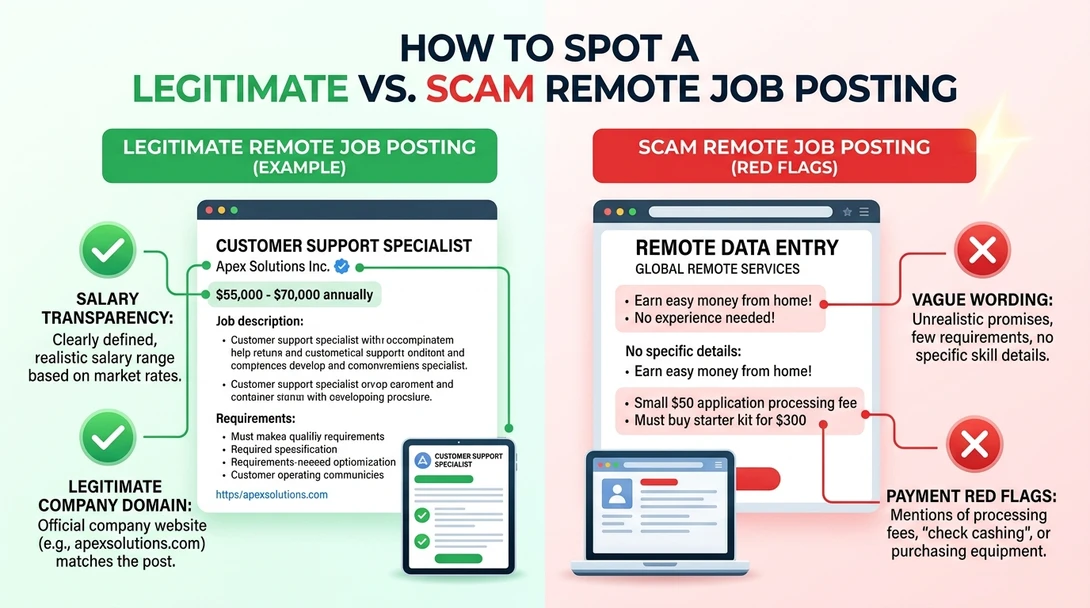
Quick scam red flags checklist
If you spot two or three of these at once, walk away:
- The employer contacts you immediately after you apply with no screening
- The pay is unusually high for simple admin or data entry work
- The recruiter uses a personal email account
- The company asks you to pay for anything
- The interview happens only over text chat
- The listing copies language from other job ads word for word
- There is no real company website or the site was created recently
- You are asked to receive or forward packages or payments
Best remote job categories by industry, skill level, and salary
Not every job function works equally well remotely. Some are naturally remote-first, while others depend on local regulations, physical equipment, or in-person service. Here are the categories that consistently show up in serious remote hiring. Salaries vary by employer, seniority, and geography, but these ranges are useful benchmarks for the U.S. market in 2024 and 2025.
Technology and software
Tech still leads remote hiring. Software engineering, QA, DevOps, cybersecurity, product management, data analytics, and technical support all translate well to distributed work. Entry-level roles are harder to get than they were in 2021, but support, QA, junior web development, and data operations still offer openings.
Typical salary bands:
- Technical support specialist: $45,000 to $70,000
- QA analyst: $55,000 to $85,000
- Junior software engineer: $70,000 to $110,000
- Data analyst: $65,000 to $100,000
- Product manager: $100,000 to $160,000+
Customer service and customer success
This is one of the strongest paths into legitimate remote work. Many companies hire remote customer support reps, technical support agents, implementation specialists, and customer success associates. The work is structured, measurable, and often trainable, which makes it attractive for both employers and career changers.
Typical salary bands:
- Customer support representative: $35,000 to $55,000
- Customer success associate: $45,000 to $70,000
- Customer success manager: $65,000 to $110,000
Sales and business development
Remote sales roles are common, especially in SaaS, financial services, education, staffing, and business services. Inside sales, account executive, sales development representative, and account management roles frequently operate remotely. Compensation often includes variable pay, so compare base salary and commission separately.
Typical salary bands:
- Sales development representative: $45,000 to $70,000 base, plus bonus
- Account executive: $70,000 to $140,000 base, often with significant commission
- Account manager: $60,000 to $110,000
Marketing and content
Content marketing, SEO, email marketing, paid media, social media, design, and lifecycle marketing are all remote-friendly. Employers like these roles because output is visible. You can point to campaigns, traffic growth, conversion rates, open rates, and content samples.
Typical salary bands:
- Content coordinator: $45,000 to $65,000
- SEO specialist: $55,000 to $85,000
- Paid media manager: $70,000 to $120,000
- UX designer: $80,000 to $130,000
Operations, finance, and HR
A lot of operations work moved online and stayed there. Recruiting coordinators, payroll specialists, bookkeepers, operations analysts, claims specialists, and HR coordinators often work remotely. Some finance roles require location-specific licensing or tax knowledge, so read the eligibility rules closely.
Typical salary bands:
- Recruiting coordinator: $45,000 to $65,000
- Bookkeeper: $45,000 to $70,000
- Payroll specialist: $50,000 to $75,000
- Operations analyst: $60,000 to $90,000
Education, healthcare, and specialized professional services
Remote doesn’t just mean tech. Instructional design, online tutoring, telehealth coordination, medical coding, legal support, grant writing, and compliance work can all be remote. These areas often require certifications or prior industry exposure, but they are usually more stable than generic work-from-home listings.
Common types of at-home jobs and the skills they need
A lot of people search for at-home jobs when they really mean remote jobs, flexible jobs, freelance work, or side-income work done from home. Those buckets overlap, but they are not identical. The useful question is simpler: what kind of work can realistically be done from home, and what skills does each type require?
Below are common at-home job types people actually see in job listings, along with the skills that usually matter most. Some are full-time employee roles. Others are contract or freelance setups. Either way, the skill pattern tends to stay pretty consistent.
Customer support and chat support
Typical work includes answering tickets, handling live chat, troubleshooting basic issues, processing refunds, and explaining account or product details. Good employers care less about a perfect background and more about calm communication and consistency.
Key skills usually needed:
- Clear written communication
- Patience with repetitive questions
- Basic troubleshooting
- CRM or help desk tools such as Zendesk or Intercom
- Ability to stay organized while handling multiple conversations
Virtual assistant and administrative support
These jobs often include calendar management, inbox handling, travel coordination, document formatting, research, and light project support. Solid VA roles are usually tied to established businesses, agencies, or executives with clear needs. The sketchy ones promise easy money for vague personal assistant work. Skip those.
Key skills usually needed:
- Scheduling and prioritization
- Professional email writing
- Google Workspace or Microsoft Office proficiency
- Attention to detail
- Comfort handling recurring tasks without constant reminders
Sales development and lead generation
A lot of entry-level at-home jobs sit in outbound sales. That can mean prospect research, email outreach, call blocks, CRM updates, and appointment setting for account executives. It’s not for everyone, but it is a real path into stable remote work.
Key skills usually needed:
- Confidence on phone or video
- Persuasive writing for cold outreach
- Basic research skills
- Resilience, because rejection is part of the job
- CRM discipline in tools like HubSpot or Salesforce
Content writing, editing, and social media support
This work can include blog drafts, product copy, email campaigns, proofreading, content calendars, caption writing, and basic reporting. Employers usually want proof, not just interest. A few strong samples beat a vague claim that you “love writing.”
Key skills usually needed:
- Strong grammar and tone control
- Research and source checking
- Ability to write for a specific audience, not just in a generic style
- Editing for clarity and accuracy
- Familiarity with content tools or scheduling platforms
Bookkeeping, billing, and back-office support
These at-home roles handle invoices, payment tracking, expense categorization, payroll support, benefits administration, or claims processing. The pace is often more structured than people expect. Accuracy matters more than speed alone.
Key skills usually needed:
- Comfort with spreadsheets and financial systems
- Accuracy with numbers and records
- Confidentiality and discretion
- Process-following without shortcuts
- Familiarity with bookkeeping or payroll software for some roles
Tutoring, training, and education support
At-home education work ranges from live tutoring to course support, curriculum assistance, grading help, and learner onboarding. Some roles are highly specialized. Others mostly require subject fluency and the ability to explain ideas clearly.
Key skills usually needed:
- Clear verbal communication
- Patience and lesson pacing
- Subject matter confidence
- Video platform comfort
- Ability to explain the same concept in more than one way
Data operations and detail-heavy support roles
These jobs can include data cleanup, catalog updates, content moderation, spreadsheet maintenance, document review, and system auditing. They tend to attract scam listings, especially when labeled as simple data entry with oversized pay. Real versions exist, but they usually describe the workflow clearly.
Key skills usually needed:
- Sustained attention to detail
- Basic spreadsheet skills
- Pattern spotting and consistency
- Comfort with repetitive work
- Ability to follow written instructions exactly
Entry-level remote jobs and no-experience pathways
Here’s the honest version: truly entry-level remote jobs exist, but the best ones are competitive. Employers know everyone wants them. You can still break in, but you need to target roles where trainability matters more than years of experience.
Strong entry-level remote job categories include:
- Customer support representative
- Sales development representative
- Junior recruiter or recruiting coordinator
- Data labeling or data operations associate
- Content assistant or editorial assistant
- Virtual assistant for established companies, not random classifieds
- Billing, claims, or scheduling coordinator
- Junior QA tester or support analyst
The best no-experience pathway is adjacent experience
A lot of candidates make the mistake of saying they have no experience. That’s usually not true. Retail, hospitality, campus jobs, volunteering, internships, and freelance projects often map directly to remote work. A barista who handled customer complaints, trained coworkers, and worked under time pressure has experience relevant to customer support. A student newspaper editor has relevant content experience. A retail associate who hit sales targets has evidence for SDR roles.
Build proof fast
If your resume feels thin, spend two to four weeks creating evidence:
- Complete one short job-relevant course from a recognized provider
- Build a small portfolio, such as writing samples, campaign mockups, dashboards, or a GitHub project
- Volunteer for admin, support, or communications work in a nonprofit or community group
- Learn common remote tools like Slack, Zoom, Google Workspace, Notion, Zendesk, HubSpot, or Jira
- Practice written communication, because remote employers care about it more than many candidates realize
Remote job search strategies that actually work
Spraying out 200 applications is a miserable strategy. It feels productive, but the hit rate is usually awful. A better approach is narrower and more deliberate.
Target role families, not random listings
Pick 2 or 3 role types that fit your background. For example: customer success, content marketing, and recruiting coordination. Then tailor your resume and search terms around those categories. If your profile is all over the place, recruiters won’t know where to place you.
Use remote-specific filters wisely
Filter by remote type, experience level, salary, and posting date. Fresh listings matter. In remote hiring, early applicants often get more attention because application volume spikes fast. A role posted 24 hours ago can already have hundreds of applicants.
Search for the words employers actually use
Try search strings like:
- remote customer success associate
- work from home support specialist
- distributed content marketing coordinator
- remote eligible operations analyst
- fully remote recruiting coordinator
- remote USA only or remote global
Keep a simple application tracker
Use a spreadsheet or Notion board with company name, title, date applied, source, salary, interview stage, recruiter name, and notes about location restrictions. This stops duplicate applications and helps you follow up like a professional instead of a frantic tab collector.
Mix job boards with direct employer research
Job boards are great for discovery. Direct employer research is great for quality. Make a list of 30 to 50 remote-friendly employers in your field and check their career pages weekly. Remote-first companies often post on their own sites before listings spread elsewhere.
Network without being weird about it
You don’t need a fake inspirational post every morning. Just reach out to people doing the jobs you want. Ask sharp questions. Keep it short. A message like this works better than most candidates expect: “Hi Maya, I’m targeting remote customer success roles and noticed you moved from support into CSM work at your company. I’d love to ask 3 quick questions about what they value in applicants.” Clean, respectful, no drama.
Resume tips for remote jobs
A remote job resume should do two things at once. First, it has to prove you can do the job. Second, it has to prove you can do the job without constant supervision in a distributed environment. Those are not the same thing.
Show remote-ready skills explicitly
Don’t assume recruiters will infer them. Mention strengths like:
- Async communication
- Cross-functional collaboration
- Documentation
- Time management
- Self-direction
- CRM, ticketing, project management, or communication tools
Use accomplishments, not task lists
Bad bullet: “Responsible for handling customer emails.”
Better bullet: “Resolved 60 to 80 customer tickets per day while maintaining a 96% satisfaction score and documenting recurring product issues for the engineering team.”
Specific numbers matter. They make you sound real. They also help recruiters compare candidates quickly.
Add remote context if you have it
If you’ve worked across time zones, supported distributed teams, handled video meetings, or used remote collaboration tools, say so. Even partial remote experience counts. Many candidates leave this out and miss an easy credibility boost.
Tailor the top third of the resume
The summary and first few bullets matter most. Match them to the job description. If the role emphasizes customer retention, onboarding, and CRM reporting, your opening section should reflect those themes. Recruiters skim hard. Help them.
Interview advice for remote roles
Remote interviews test more than your answers. They also test your setup, your communication habits, and whether you seem like someone who can work independently without disappearing for six hours. Fair or not, that’s part of the evaluation.
Expect questions about communication and autonomy
Common remote interview questions include:
- How do you prioritize your work when your manager isn’t online?
- How do you handle unclear instructions in an async environment?
- How do you stay organized when managing multiple deadlines remotely?
- What tools have you used for remote collaboration?
- How do you build relationships with teammates you haven’t met in person?
Prepare a strong home setup answer
You don’t need a designer office. You do need a reliable explanation. Mention a stable internet connection, quiet workspace, headset, webcam, and your ability to protect confidential information if the role involves customer or financial data.
Ask better questions yourself
Good candidates ask remote-specific questions such as:
- Is this role fully remote, hybrid, or remote-eligible?
- What time zones does the team work across?
- How much of the workday is synchronous versus async?
- How do managers track performance and communication?
- Does the company provide equipment or a home office stipend?
- Are there travel requirements for onboarding or team meetings?
Those questions do two things. They help you evaluate fit, and they signal that you understand remote work isn’t just “doing the same office job in pajamas.”
Compensation transparency, salary benchmarking, and location rules
Remote pay is messy. Some companies pay a single national rate. Others adjust by city, state, or country. A San Francisco benchmark may not apply if the employer uses geo-adjusted compensation bands. Job seekers get tripped up here all the time.
According to the U.S. Bureau of Labor Statistics and employer compensation reports, roles in software, analytics, and product still command the highest remote salaries, while support and administrative roles tend to cluster lower. Salary transparency laws in places like California, Colorado, New York, and Washington have also pushed more employers to publish pay ranges, which is good news for candidates. For occupational wage data, the BLS remains one of the best public sources: https://www.bls.gov.
How to benchmark a remote salary
Use three reference points:
- Public wage data from the BLS or similar official sources
- Salary data from major job platforms and compensation sites
- Posted ranges from similar employers hiring for remote roles today
Then ask: is this company paying national market, high-cost city market, or location-adjusted market? A posted range of $55,000 to $70,000 for remote customer success may be perfectly normal. A “data entry” role paying $95,000 is probably fake.
Global remote vs U.S.-only remote
A job can be remote and still legally limited. Employers may restrict hiring because of payroll, tax registration, labor law compliance, export control rules, or data security requirements. Some companies hire globally through employers of record. Others only hire where they have legal entities. If a listing says “remote worldwide,” confirm whether that means contractor only, employee in selected countries, or truly open hiring.
Time zones matter more than candidates think
Remote work isn’t always flexible in the way people imagine. Some companies operate asynchronously and only need a few overlap hours. Others expect you online for the full business day in one time zone. If you’re based three or more hours away, ask early. That one detail can decide whether the job is workable long term.
Remote work tools, productivity expectations, and home office basics
Legitimate remote employers usually have a clear operating system. That means documented tools, defined meeting rhythms, performance metrics, and security standards. If a company can’t explain how work gets done remotely, that’s a warning sign.
Common tools by function include:
- Communication: Slack, Microsoft Teams, Zoom, Google Meet
- Project management: Asana, Jira, Trello, ClickUp, Notion
- Customer support: Zendesk, Intercom, Freshdesk
- Sales and CRM: HubSpot, Salesforce
- Documentation: Notion, Confluence, Google Docs
- Security: VPNs, single sign-on, device management tools
Your home office doesn’t need to be fancy. It does need to be functional. At minimum, aim for reliable internet, a quiet workspace, a webcam, a decent headset, and enough privacy for calls. If you live with roommates, kids, or chaos in general, have a realistic plan for meetings and focused work blocks. Employers appreciate honesty more than fake perfection.
How to spot strong remote employers
Some companies post remote jobs because they genuinely know how to run remote teams. Others do it because office leases are expensive and leadership hasn’t figured out the rest. You want the first group.
Signs of a strong remote employer:
- The company clearly states remote policies and location eligibility
- The job description explains schedule expectations and time zones
- Interviewers can describe onboarding, communication norms, and performance metrics
- The company provides equipment, stipend, or IT support
- Employees mention documentation, autonomy, and manager availability in reviews
- The careers page is organized and roles appear current, not stale
You don’t need a famous employer, either. Plenty of mid-sized SaaS firms, agencies, online education companies, healthcare service providers, and digital operations businesses run excellent remote teams. Prestige is overrated. Competence pays the bills.

Frequently asked questions about remote jobs
Do remote jobs pay less?
Sometimes, but not always. High-skill remote roles in software, product, design, and revenue teams can pay extremely well. Entry-level support and admin roles usually pay less. The bigger factor is often the job family and employer pay model, not the fact that the work is remote.
Are remote jobs with no experience legitimate?
Some are. Customer support, scheduling, junior sales, recruiting coordination, and content support are common entry points. Be skeptical of generic “data entry” or “personal assistant” jobs offering very high pay with no clear employer information.
Will employers provide equipment?
Many legitimate employers do. They may ship a laptop, monitor, headset, and security tools, or offer a home office stipend. Some expect you to use your own basic setup. What they should not do is ask you to buy equipment through a vendor using a check they sent you. That scam is older than some interns.
Are benefits different for remote employees?
Often they are similar to on-site roles for full-time employees, including health insurance, PTO, retirement plans, and parental leave. Contractors are a different story. Read the classification carefully. “Remote” tells you where you work, not whether you’re an employee or contractor.
Do I need to live in the same state or country as the company?
Not always, but many employers restrict hiring to certain states or countries for legal and payroll reasons. Never assume a remote job is open everywhere. If the posting is vague, ask before spending hours on an application.
Final advice: treat remote job hunting like risk management
The best remote job seekers are not the ones who apply the fastest. They’re the ones who combine speed with judgment. They verify employers, target realistic roles, tailor their resumes, ask sharp questions, and ignore anything that smells like easy money.
If you’re serious about finding legitimate remote jobs, focus on three things. First, apply to roles that actually match your background. Second, verify every employer before sharing sensitive information. Third, learn how remote teams operate, because hiring managers can tell the difference between someone who wants flexibility and someone who can actually thrive in a distributed environment.
Remote work is still a great option. You just have to approach it with clear eyes. That alone puts you ahead of a big chunk of the market.