A blank stretch in your work history can feel like a flashing warning sign. Many job seekers panic about employment gaps on a resume, assuming recruiters will instantly reject them. Reality looks different. Most hiring managers understand that careers are not perfectly linear anymore. Layoffs, caregiving, education, freelancing, and mental health breaks all happen.
What matters is how you present the gap. A short explanation that highlights skills, learning, or productive activity usually removes the concern. Hiring teams mostly want reassurance that you stayed engaged and that you’re ready to work again.
According to a 2023 LinkedIn hiring survey, 79% of hiring managers said they would hire candidates with career gaps if the applicant explained the time productively. Recruiters see layoffs and career breaks every week. Tech layoffs alone affected more than 260,000 workers in 2023 according to Layoffs.fyi.

This guide shows exactly how to explain employment gaps on a resume. You’ll see real examples, copy‑paste templates, ATS optimization tips, formatting strategies, and advice for short breaks, multi‑year interruptions, and sensitive personal situations.
What Is an Employment Gap?
An employment gap is any period when you were not working in a traditional paid role and that period appears between jobs on your resume.
Recruiters usually notice a gap when the dates between roles don’t line up. A job ending in March 2022 followed by another starting in January 2023 signals a 10‑month gap.
Not every gap causes concern. Careers include natural pauses. What matters is whether the timeline raises questions about skill relevance or availability to work.
Typical examples of employment gaps include:
- Job search periods after layoffs
- Caring for children, elderly parents, or disabled family members
- Illness or recovery from medical issues
- Returning to school or completing certifications
- Travel or relocation
- Starting a business that didn’t succeed
- Freelance or contract work that wasn’t full time
- Burnout recovery or personal sabbaticals
Many professionals accumulate at least one gap over a 20‑ or 30‑year career. The key difference between a concerning gap and a normal one is context and transparency.
Why Employment Gaps Matter to Recruiters
Hiring managers don’t automatically reject resumes with gaps. They simply ask three quick questions when they see one.
- Was the candidate doing something productive during the gap?
- Did their skills stay relevant?
- Is the candidate stable and ready to return to work?
A gap without explanation creates uncertainty. A short line clarifying the reason often solves the issue instantly.
Experienced recruiters often scan resumes for less than 8 seconds during the first review, according to eye‑tracking studies by TheLadders (2022). Clear explanations prevent hesitation during that quick scan.
When You Should Explain a Resume Gap
Not every small gap requires explanation. Many candidates worry about gaps that recruiters barely notice.
Typical guidelines recruiters use:
- 0–3 months: usually ignored
- 3–6 months: optional explanation
- 6–12 months: brief explanation recommended
- 1+ year: always address clearly
Short gaps often come from job searching, relocation, or contract transitions. Long gaps require a little more framing so employers understand what happened.
Resume Formatting Tricks That Reduce the Visual Impact of Gaps
Resume formatting affects how noticeable a gap appears. Small adjustments often reduce unnecessary attention without hiding information.
Common formatting strategies recruiters see:
- List years instead of months for roles when the timeline still remains accurate
- Group short freelance or contract projects under one entry
- Use a functional or hybrid resume format emphasizing skills instead of strict chronology
- Focus the resume on the last 10 to 15 years of experience rather than listing every early‑career job
- Combine related short roles under a single heading like “Independent Consultant”
A resume should stay honest. Formatting can reduce visual clutter, but it should never distort the timeline or invent roles.
Resume Example: How to Write an Employment Gap Correctly
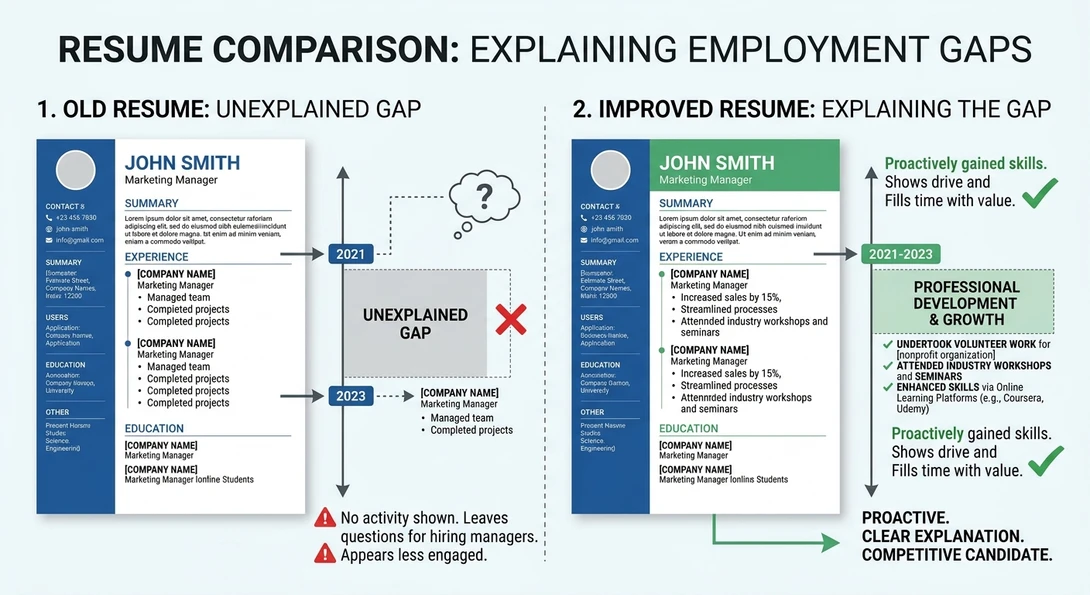
Most candidates either hide the gap or write nothing at all. Both approaches raise suspicion. A simple entry works better.
Weak Example (Raises Questions)
Work Experience
Marketing Specialist, BrightWave Media
2019 – 2022
Marketing Coordinator, PixelBridge
2017 – 2019
This version hides a 14‑month gap in 2023. Recruiters notice immediately.
Improved Example (Transparent and Professional)
Marketing Specialist, BrightWave Media
2019 – 2022
Professional Development Sabbatical
2022 – 2023
- Completed Google Analytics certification
- Managed freelance marketing projects for two local businesses
- Built portfolio website and marketing case studies
Recruiters instantly see the gap explained and productive activity listed. Suspicion disappears.
Where Should You Explain the Gap? Resume vs Cover Letter vs Interview
Job seekers often debate where the explanation should appear. Each document plays a slightly different role.
Best practice used by experienced recruiters:
- Resume: brief factual label such as “Career Break” or “Family Caregiver”
- Cover letter: short explanation with context
- Interview: full story and lessons learned
Trying to hide a major gap until the interview rarely works. Recruiters notice timeline inconsistencies early. A short resume entry removes confusion before the conversation even begins.
Advice Based on Gap Length
Different gap lengths require different explanations. A three‑month break does not need the same treatment as a two‑year pause.
Explaining a 3 Month Employment Gap
Short gaps are common between jobs. Avoid overexplaining. One short line works.
Resume example:
Career Transition Period
Jan 2024 – Mar 2024
- Conducted targeted job search and completed advanced Excel training
Interview explanation template:
After my previous role ended, I spent a few months focusing on a targeted job search and upgrading my Excel and data analysis skills. That preparation helped me sharpen the skills I’m excited to bring to this role.
Explaining a 1 Year Employment Gap
One year gaps require context plus evidence of activity. Focus on learning, freelance work, or personal responsibilities handled professionally.
Resume example:
Family Caregiver
2023 – 2024
- Managed full‑time care for family member while maintaining freelance bookkeeping clients
- Completed QuickBooks certification and online accounting courses
Interview template:
I took about a year away from full‑time work to care for a family member. During that time I kept my accounting skills active through freelance bookkeeping and completed a QuickBooks certification. The situation is now resolved and I’m fully ready to return to a full‑time role.
Explaining Multiple Years Away from Work
Long gaps require more structure. Treat the period almost like a role with measurable activities.
Example:
Independent Consultant and Skill Development
2020 – 2023
- Completed 12 online courses in data analysis and Python
- Built portfolio projects analyzing public datasets
- Provided freelance analytics support to three startups
Explaining Very Long Gaps (5–10 Years)
Long career interruptions happen more often than people think. Parenting breaks, long‑term illness, immigration, or caregiving for aging parents commonly create gaps lasting many years.
A resume should focus on transferable responsibilities rather than the absence of formal employment.
Example:
Family Estate and Care Management
2014 – 2023
- Managed legal and financial affairs for elderly parent including medical advocacy and power‑of‑attorney decisions
- Coordinated healthcare providers, insurance claims, and long‑term care planning
- Oversaw property management and budgeting across multiple accounts
Those responsibilities involve planning, negotiation, budgeting, and crisis management. Recruiters often recognize the leadership involved once it is clearly described.
Privacy Concerns When Explaining Personal Gaps
You do not need to disclose every personal detail behind a career break. Medical issues, family crises, or divorce are private matters.
Recruiters rarely need the full story. A general description usually works better.
Examples of privacy‑friendly explanations:
- “Family caregiving responsibilities”
- “Medical leave, now resolved”
- “Personal sabbatical focused on professional development”
- “Relocation and career transition period”
Oversharing can create unnecessary discomfort in interviews. Hiring managers primarily want reassurance that the situation is stable and that you are ready to work again.
Real Stories: Caregiving and Career Interruptions
Long caregiving breaks are one of the most common sources of multi‑year employment gaps. Recruiters see them frequently, especially among mid‑career professionals.
Consider a real example shared in a hiring community forum. A finance professional paused her career for nearly seven years while caring for a parent with advanced Parkinson’s disease. During that time she managed medical decisions, coordinated insurance claims, handled legal documents, and supervised home healthcare providers.
On her resume she framed the experience like this:
Family Care Manager
2016 – 2023
- Coordinated multidisciplinary medical care across five providers
- Managed insurance appeals and long‑term care planning
- Oversaw household finances and legal documentation
Those responsibilities translate directly to project management and operations roles. After updating her resume this way she secured interviews within two months.
Ethical Questions About Labeling Gaps
Some candidates attempt to hide gaps by labeling the period as “freelance consulting” even when little or no paid work occurred. That approach carries risk.
Recruiters sometimes verify consulting claims through references or portfolio work. If the role cannot be supported with examples or clients, credibility drops quickly.
Better alternatives include honest labels such as:
- Professional Development
- Career Break
- Independent Learning
- Family Caregiver
Transparency builds trust early in the hiring process. Exaggerated titles rarely help in the long run.
Activities That Strengthen Your Resume During Unemployment
A career gap becomes easier to explain if you can point to meaningful activity during the time away.
Common resume‑friendly activities include:
- Online courses or certifications
- Volunteer work or nonprofit projects
- Professional association memberships
- Freelance or contract assignments
- Personal projects related to your field
- Building a portfolio or website
For example, a marketing professional who spent eight months unemployed might list:
Professional Development
2023
- Completed HubSpot Content Marketing certification
- Volunteered managing social media for a local nonprofit
- Produced three SEO case studies analyzing ecommerce websites
ATS Optimization When Listing Employment Gaps
Many companies screen resumes with applicant tracking systems. Formatting choices affect whether your resume gets parsed correctly.
Key ATS tips for employment gaps:
- Use standard titles like “Career Break” or “Professional Development”
- Include date ranges like any other job entry
- Add skill keywords relevant to the job
- Avoid graphics or timeline designs that confuse ATS parsing
- List certifications, freelance projects, or volunteer work during the gap
Example ATS‑friendly entry:
Professional Development
2023 – 2024
- Completed AWS Cloud Practitioner certification
- Built cloud deployment projects using Docker and Terraform
ATS systems scan those keywords just like they would in a normal job entry.
Industry Specific Advice for Resume Gaps
Different industries interpret employment gaps differently. Understanding that culture helps you frame the explanation correctly.
Tech Industry
Tech recruiters care less about gaps and more about recent skills and projects. Portfolio work often matters more than continuous employment.
Good gap activities for tech professionals:
- Building GitHub projects
- Completing coding bootcamps
- Contributing to open source projects
- Freelance development or contract work
Example entry:
Open Source Developer
2023 – 2024
Healthcare
Healthcare hiring managers focus on certifications and licensing status. A gap becomes less concerning if professional credentials remain active.
Include items like:
- Continuing education courses
- Volunteer clinical work
- Certification renewals
Remote and Freelance Careers
Remote work culture already overlaps with freelancing and contract work. Gaps can often be reframed as project based work.
Example:
Freelance Content Strategist
2022 – 2023
- Produced SEO content for five ecommerce brands
- Increased organic traffic by 48 percent for one client

Emotional Reality of Returning to Work After a Long Gap
Returning to the workforce after caregiving or health challenges often feels intimidating. Skills may feel outdated. Confidence can drop after years outside traditional workplaces.
Recruiters who specialize in return‑to‑work programs often emphasize a simple strategy: start with small professional reentry steps. Short contracts, certifications, or volunteer roles help rebuild recent experience.
Many large companies now run formal returnship programs designed specifically for professionals who paused their careers. Goldman Sachs, Amazon, and IBM all launched structured returnship initiatives during the past decade. These programs typically target candidates with two or more years away from the workforce.
Cover Letter Example Explaining an Employment Gap
A cover letter gives you slightly more room to explain context without cluttering the resume. Keep it brief and forward focused.
Last year I took time away from full‑time work after my company went through a large restructuring that eliminated several departments. During that transition I completed advanced training in data visualization and worked on freelance analytics projects for small businesses. Those projects strengthened my ability to translate complex datasets into clear dashboards, which aligns closely with the requirements for this position.
Real Recruiter Perspective on Employment Gaps
Recruiters see gaps constantly. What frustrates them is not the gap itself. It is the lack of explanation.
A resume gap isn’t the problem. Silence about the gap is the problem. A single line explaining what you did removes most concerns immediately.
Community discussions among hiring managers reveal a consistent pattern. Clear explanations rarely hurt candidates. Unexplained timelines slow down the screening process and sometimes lead to rejection simply because recruiters move on to clearer resumes.
Hiring managers care more about recent ability to perform the job than about perfect timelines. A candidate who demonstrates skill, learning, or initiative during a gap often looks stronger than someone who simply held a low impact job.
Step by Step Method to Fix Employment Gaps on a Resume
Follow this quick method if your resume currently has unexplained gaps.
- Identify gaps longer than six months
- Decide the honest reason for each gap
- Create a simple role title for that period
- Add two or three bullet points describing activities or learning
- Include relevant skills or certifications
Small adjustments like this dramatically improve recruiter confidence during the first resume review.
Final Thoughts
Employment gaps on a resume are far more common than most candidates realize. Layoffs, career exploration, caregiving, freelancing, education, and health challenges all create pauses in traditional work history. Recruiters understand this reality.
Clear communication solves most concerns. A short entry describing learning, freelancing, volunteering, caregiving, or professional development gives hiring managers the context they need. Combine that explanation with strong achievements and relevant skills. The gap quickly stops being the focus of the conversation.
Your resume tells a career story. A gap is just one chapter. Frame it well and most employers will move on quickly to the skills and experience that actually matter.