If you want a direct answer to how to build a personal brand that attracts employers, start here: make it easy for recruiters and hiring managers to understand who you are, what you do well, and why you fit the role they need to fill. That sounds simple, but most candidates muddy the message. Their resume says one thing, LinkedIn says another, their portfolio feels random, and their interview answers drift all over the place. Employers notice that mismatch fast.
A strong personal brand is not about sounding famous, polished, or “thought leader” adjacent. It’s about clarity, credibility, and consistency across every hiring touchpoint. Recruiters are usually scanning under time pressure. A 2024 Jobvite recruiter survey found speed and efficiency still dominate modern recruiting workflows, which means candidates who look coherent at a glance have a real advantage.
Most articles stop at vague advice like “be authentic” or “post on LinkedIn.” That isn’t enough if your goal is interviews. This guide focuses on what actually moves hiring outcomes: how employers evaluate personal brands, how ATS and LinkedIn keywords affect visibility, how to align your resume with your online presence, and how to build a brand even if you have little experience or you’re changing careers.

What employers mean by “personal brand” during hiring
Employers usually don’t sit around saying, “Let’s evaluate this person’s personal brand.” They evaluate signals instead. They ask questions like: Does this candidate seem credible? Do they know what they want? Are they consistent? Can I picture them representing the team well?
Your personal brand is the sum of those signals. It includes:
- Your resume headline, summary, and achievement bullets
- Your LinkedIn headline, About section, featured content, and activity
- Your portfolio, personal website, GitHub, case studies, or work samples
- Your online footprint, including old posts, bios, speaking clips, and comments
- The way you introduce yourself in networking and interviews
- Recommendations, referrals, and what former colleagues say about you
A hiring manager doesn’t need to see a huge audience or a viral post. They need to see a believable professional identity. That’s the real standard.
The best personal brands in hiring are not the loudest. They’re the easiest to understand and trust.
How recruiters and hiring managers actually evaluate your brand
Here’s the part most competing articles miss. Employers don’t evaluate your brand in one neat step. They build a rough impression through a sequence of checks. If you know that sequence, you can design your brand around it.
1. Searchability and keyword match
Recruiters often start with search, not admiration. On LinkedIn Recruiter and ATS platforms, they search by job title, skills, certifications, industry keywords, and location. If your profile says “problem solver” but not “FP&A analyst,” “B2B demand generation,” or “warehouse operations supervisor,” you may not even appear.
Branding that attracts employers is partly a messaging exercise and partly a discoverability exercise. You need language that humans like and systems can find.
2. First-glance credibility
Once they land on your profile or resume, recruiters look for quick proof. Clear title. Relevant experience. Specific wins. Industry fit. Signs you understand the role. If the first impression is vague, they move on. Usually fast.
3. Consistency across channels
This is where many candidates lose trust. Your resume says operations manager. LinkedIn says business strategist. Your portfolio shows mostly UX work. Your interview story says you’re moving into sales. That kind of sprawl makes employers nervous because they can’t tell what lane you’re actually in.
4. Evidence of competence
Good branding doesn’t replace proof. It frames it. Employers want outcomes, examples, and signs of judgment. A software engineer’s brand gets stronger with GitHub repos, shipped features, architecture writeups, or quantified performance gains. A marketer’s brand gets stronger with campaign metrics, positioning work, and sample assets.
5. Reputation and risk check
Hiring teams may scan your public footprint. They aren’t just looking for scandals. They’re checking for professionalism, communication style, and anything that contradicts your application. The Society for Human Resource Management has long reported that employers review social presence as part of candidate screening, especially for public-facing or leadership roles.
6. Interview alignment
Your brand either gets confirmed in the interview or falls apart there. Strong candidates sound like the person the resume and LinkedIn already introduced. Their examples reinforce the same strengths. Their pitch is tight. Their stories connect to the role.
The 7-step framework for building a personal brand that attracts employers
Step 1: Choose the hiring market you want to win
General branding advice tells people to “define yourself.” That’s too broad for job search results. Start with the market instead. Ask: Which employers do I want to attract in the next 6 to 12 months?
Get specific on:
- Target job titles
- Industry or niche
- Seniority level
- Geography or remote preference
- Type of company, such as startup, enterprise, nonprofit, or agency
- Problems you want to be hired to solve
A finance candidate targeting FP&A roles at SaaS companies should not use the same brand language as someone aiming for controller roles in manufacturing. Same broad field, different employer expectations.
Step 2: Build a one-sentence value proposition
This sentence becomes the spine of your brand. It should tell employers who you are, what you do, and what kind of value you create. Keep it plain. Keep it useful.
Use this formula:
I help [target employer or team] achieve [outcome] by using [skills, domain expertise, or approach].
Examples:
- I help B2B SaaS teams grow pipeline through lifecycle email, paid acquisition, and conversion-focused messaging.
- I help operations teams reduce delays and improve throughput by building cleaner processes, stronger vendor coordination, and better reporting.
- I help product teams turn user research into simpler onboarding flows and higher activation rates.
That sentence is not fluff. It gives structure to your headline, About section, resume summary, networking intro, and interview opener.
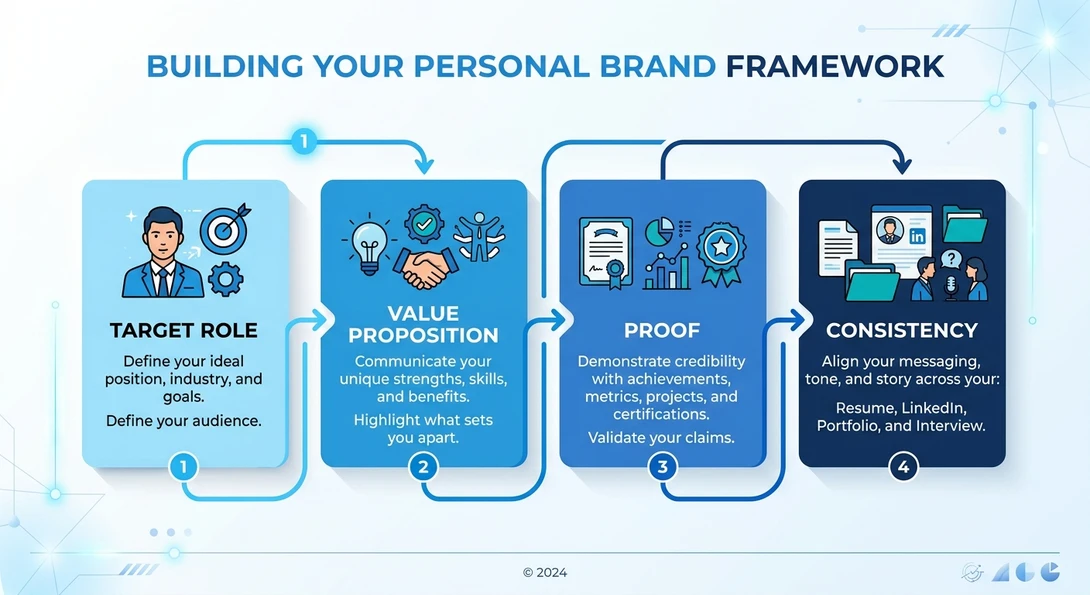
Step 3: Pick 3 brand pillars and back each with proof
Employers remember people in patterns. Three brand pillars are usually enough. More than that and your message gets muddy.
For example, a mid-level marketing manager might choose:
- Demand generation
- Cross-functional campaign execution
- Performance measurement
Now add proof under each pillar. Think metrics, examples, and visible work.
- Demand generation: Grew MQL volume 38% year over year through paid search and webinar campaigns.
- Cross-functional execution: Partnered with sales and product teams to launch 12 campaigns in 9 months.
- Performance measurement: Built reporting dashboards that cut weekly reporting time from 4 hours to 45 minutes.
No proof, no brand. Just adjectives.
Step 4: Translate your brand into recruiter-friendly keywords
This is where branding meets ATS and LinkedIn search behavior. Pull 20 to 30 target job descriptions and look for repeated language in:
- Job titles
- Core skills
- Tools and platforms
- Certifications
- Functional keywords
- Industry terms
If you’re targeting data analyst jobs, terms like SQL, Tableau, Power BI, stakeholder reporting, dashboard development, Python, forecasting, and data validation may matter. If you’re targeting project management jobs, phrases like Agile, Scrum, Jira, roadmap, cross-functional alignment, budget tracking, and risk management might show up repeatedly.
Use those keywords naturally in your:
- Resume headline and summary
- LinkedIn headline and About section
- Skills section
- Portfolio case studies
- Interview language
Don’t keyword-stuff. Recruiters can smell that nonsense immediately. The goal is relevance, not a robot poem.
Step 5: Align every hiring asset around the same message
This is the section a lot of candidates need most. How to align branding across resume, LinkedIn, portfolio, and interviews is not glamorous, but it’s where personal brand starts producing interviews instead of just compliments.
Resume
Your resume should lead with the role you’re pursuing, not your entire life story. Use a headline or summary that matches target jobs. Then make achievement bullets reinforce your brand pillars.
Bad summary:
“Experienced professional with strong communication skills seeking growth opportunities.”
Better summary:
“B2B demand generation marketer with 5 years of experience driving pipeline growth through paid media, email automation, and campaign analytics. Increased qualified leads by 38% year over year and improved landing page conversion by 21%.”
LinkedIn
Your LinkedIn headline should do more than state “open to work.” Use it to communicate role, specialty, and value.
Template:
[Target role] | [Specialty or domain] | [Outcome you help create]
Examples:
- Financial Analyst | FP&A, forecasting, and SaaS metrics | Turning messy data into planning decisions
- UX Designer | Research-driven product design | Improving onboarding, usability, and activation
- Operations Manager | Logistics, inventory, and process improvement | Reducing delays and increasing throughput
Your About section should expand that message with proof, not repeat generic soft skills.
Portfolio or work samples
Portfolios often fail because they showcase everything instead of relevant work. Curate only the projects that support your target brand. A designer applying for product design roles should not lead with old print flyers unless the role actually values that. A PM should show case studies, roadmaps, and decision-making, not just screenshots of tools.
Interviews
Your first answer to “Tell me about yourself” should sound like the verbal version of your brand. Keep it to 45 to 90 seconds. Include present focus, relevant past, and what you want next.
Template:
“I’m a [role] with experience in [core area]. Over the past [X years], I’ve focused on [brand pillars], including [1 or 2 proof points]. What interests me about this role is the chance to bring that experience to [specific team problem or company goal].”
Step 6: Create visible proof, even if you aren’t famous
A personal brand gets stronger when employers can see receipts. You do not need a massive audience. You need credible artifacts.
Good proof can include:
- Case studies with challenge, action, and result
- Before-and-after project examples
- Presentations, talks, or workshop materials
- GitHub repos or code samples
- Writing samples or strategy memos
- Testimonials from managers, clients, or peers
- Certifications tied to your target role
If you’re early in your career, build proof through class projects, volunteer work, freelance assignments, simulations, hackathons, or self-initiated projects. Employers care far more about demonstrated thinking than whether a project came from a Fortune 500 logo.
Step 7: Maintain and measure the brand like a job search asset
Branding should produce outcomes. Track whether it is. Watch these signals for 30 to 60 days after updates:
- LinkedIn profile views
- Search appearances on LinkedIn
- Recruiter InMails or direct messages
- Resume-to-interview conversion rate
- Portfolio clicks or featured link views
- Quality of outreach, not just volume
If your profile views rise but you’re getting messages for the wrong roles, your keyword mix may be off. If applications are high but interviews are low, your brand may be too generic or poorly aligned to the roles you’re targeting.
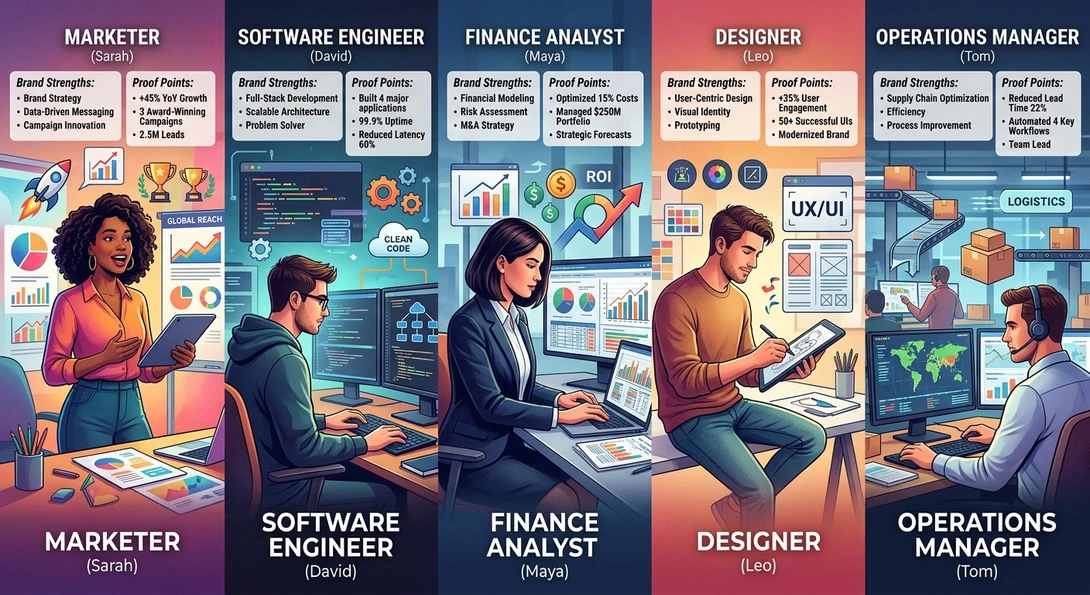
Personal brand examples by job function and career stage
Broad advice gets slippery unless people can picture what “good” looks like. Here are examples of strong personal brands by role and stage.
Early-career candidate with limited experience
Brand focus: curiosity, relevant skills, reliability, and proof of initiative.
Example: “Entry-level data analyst focused on SQL, Excel, and dashboard reporting, with hands-on project work in customer churn analysis and KPI tracking.”
Proof: school projects, Tableau dashboard, capstone, internship wins, volunteer reporting work.
Career changer moving into tech
Brand focus: transferable strengths plus new technical proof.
Example: “Former teacher transitioning into customer success, bringing 7 years of stakeholder communication, training, and problem resolution, plus Salesforce and SaaS onboarding experience.”
Proof: customer onboarding coursework, CRM projects, peer training examples, measurable retention or engagement results from prior role.
Mid-level marketer
Brand focus: channel expertise, revenue impact, and cross-functional execution.
Example: “B2B marketer specializing in lifecycle and demand generation programs that increase qualified pipeline and improve conversion efficiency.”
Proof: MQL growth, pipeline influenced, email performance, landing page optimization, sales alignment examples.
Finance professional
Brand focus: accuracy, business partnership, forecasting, and decision support.
Example: “FP&A analyst supporting SaaS growth through forecasting, board reporting, and expense planning tied to ARR and margin goals.”
Proof: forecast accuracy, reporting automation, variance analysis, scenario planning.
Designer
Brand focus: problem-solving, user empathy, and outcome-driven design.
Example: “Product designer translating user research into onboarding and checkout experiences that reduce friction and improve conversion.”
Proof: usability findings, prototype iteration, activation rate gains, portfolio case studies with clear rationale.
Operations leader
Brand focus: process discipline, cost control, throughput, and team leadership.
Example: “Operations manager focused on process improvement, inventory accuracy, and vendor coordination across fast-moving distribution environments.”
Proof: cycle time reductions, on-time delivery gains, labor savings, SOP implementation.
Industry-specific personal branding advice
Tech
Tech employers usually reward specificity. “Software engineer” is weaker than “backend engineer focused on Python APIs, cloud infrastructure, and performance optimization.” Show repositories, architecture decisions, shipped product work, and business impact.
Marketing
Marketing brands should connect creativity to revenue or growth metrics. Employers want more than “storytelling.” Show campaign strategy, channel ownership, CAC or CPL awareness, testing, and collaboration with sales or product.
Finance
Finance branding should feel precise and trustworthy. Focus on analysis quality, controls, forecasting, reporting cadence, systems knowledge, and executive support. Be careful with inflated claims. Finance hiring managers are especially sensitive to fuzzy language.
Design
Design brands live or die on the portfolio. Pretty visuals aren’t enough. Show process, constraints, decision-making, collaboration, and measurable results. If you can’t explain why the work mattered, employers won’t either.
Operations
Operations candidates should emphasize efficiency, reliability, systems thinking, and execution. Metrics matter a lot here: throughput, error rates, inventory accuracy, safety, labor productivity, fulfillment speed.
How to build a personal brand with little experience or during a career change
This is where people panic and start overcompensating. Don’t. If you lack direct experience, your job is to reduce employer doubt.
Do these five things:
- Choose one clear target role, not three unrelated ones
- Highlight transferable skills that matter in that role
- Build 2 to 4 proof assets tied to real work scenarios
- Use role-specific keywords so recruiters can find you
- Tell a clean transition story that explains why the move makes sense
For example, a former retail manager moving into HR could position themselves around employee training, scheduling, conflict resolution, hiring support, and performance coaching. That story is much stronger than pretending the past never happened.
Common personal branding mistakes that turn employers away
A weak personal brand usually isn’t weak because the person lacks talent. It’s weak because the signal is messy. These are the biggest mistakes I see:
- Being too generic, with phrases like results-driven, strategic thinker, or dynamic professional and no proof
- Targeting too many job types at once
- Using inconsistent titles or career stories across channels
- Posting unprofessional or combative content publicly
- Letting old bios, outdated roles, or abandoned portfolios sit untouched
- Overbuilding the “personal” side and underbuilding the employer-relevant side
- Ignoring keywords and then wondering why recruiters don’t find you
- Listing responsibilities instead of achievements
One more opinionated point: trying too hard to sound impressive usually backfires. Plain, specific language beats inflated branding every time.
Reputation management: clean up your digital footprint before applying
Search your own name in Google with and without your city, employer, and profession. Check image results too. Review LinkedIn, X, GitHub, Medium, portfolio sites, old bios, speaker pages, and anything that appears on page one or two.
Fix what you can:
- Update outdated headlines and bios
- Remove low-quality or irrelevant work samples
- Hide or delete unprofessional public content
- Refresh profile photos if needed
- Standardize your current role direction across platforms
You don’t need to look sterile. You do need to look intentional.
Templates you can use today
Personal brand statement template
“I help [target team or employer] achieve [result] through [skills, expertise, or approach].”
LinkedIn headline template
“[Target role] | [Specialty] | [Business outcome or area of impact]”
Short professional bio template
“I’m a [role] with [X years] of experience in [field]. My work focuses on [brand pillar 1], [brand pillar 2], and [brand pillar 3]. I’ve helped [team, company type, or client type] achieve [specific outcomes].”
Elevator pitch template
“I’m a [role] specializing in [focus area]. Recently, I’ve worked on [type of work or result]. I’m now looking for opportunities where I can help [target employer] with [specific need].”
Practical personal brand checklist tied to job search outcomes
Use this checklist before you apply to jobs. If you can’t say yes to most of these, your brand probably needs tightening.
- My target job title is obvious within 5 seconds of viewing my resume or LinkedIn
- My resume summary and LinkedIn headline describe the same professional direction
- I use keywords that match the roles I want
- My top 3 strengths are supported by metrics or examples
- My portfolio or work samples show relevant proof, not random work
- My interview intro matches what employers already saw online
- My public online presence does not undermine my candidacy
- I can explain my career story clearly, including transitions
- I track profile views, recruiter outreach, and interview conversion
- I revise my messaging if I’m attracting the wrong jobs or no jobs at all
How to know your personal brand is working
You’ll know your brand is working when people start describing you the way you want to be known. Recruiters reach out for the right kind of roles. Hiring managers mention the same strengths you intended to signal. Interviews feel smoother because you aren’t inventing a new story each time.
Good signs include:
- More recruiter messages that match your actual target roles
- Better response rates from applications
- Faster trust-building in screening calls
- Stronger interview-to-offer conversion over time
- More referrals from people who can explain your value accurately
If none of that is happening, don’t assume branding is useless. Usually the issue is one of three things: weak positioning, poor proof, or inconsistent execution.

Final takeaways
The best answer to how to build a personal brand that attracts employers is not “be visible everywhere.” It’s this: be specific, be consistent, and show proof. Employers don’t hire the most branded candidate. They hire the candidate who looks relevant, credible, and easy to trust.
Treat your personal brand like part of your job search infrastructure. Build it around the roles you want, align it across resume, LinkedIn, portfolio, and interviews, and measure whether it’s improving recruiter interest and interview results. That’s how branding stops being a buzzword and starts helping you get hired.