If you’re trying to pick a career with real momentum, not just hype, this guide gives you a definitive ranked list of fastest-growing UK careers with clear methodology and recent UK-specific data sources.
A lot of articles throw together vague “in-demand jobs” lists and call it research. That’s not very useful if you want to compare salary ranges alongside job growth data, figure out where the jobs are, or decide whether a realistic switch is possible without spending three years back in full-time education.
This article does the job properly. You’ll get a ranked list, plain-English methodology, regional breakdowns of fastest-growing careers across the UK, day-to-day role descriptions, qualification paths, and honest notes on which jobs suit graduates, non-graduates, and career changers.
The ranking draws on recent UK labor market sources including the Office for National Statistics, GOV.UK skills and shortage occupation publications, Explore Education Statistics, NHS workforce demand, LinkedIn Jobs on the Rise trend reporting, and broad UK salary/job posting benchmarks from large recruitment platforms and salary trackers such as Reed, Totaljobs, Hays, and Glassdoor. External sources are cited where relevant.
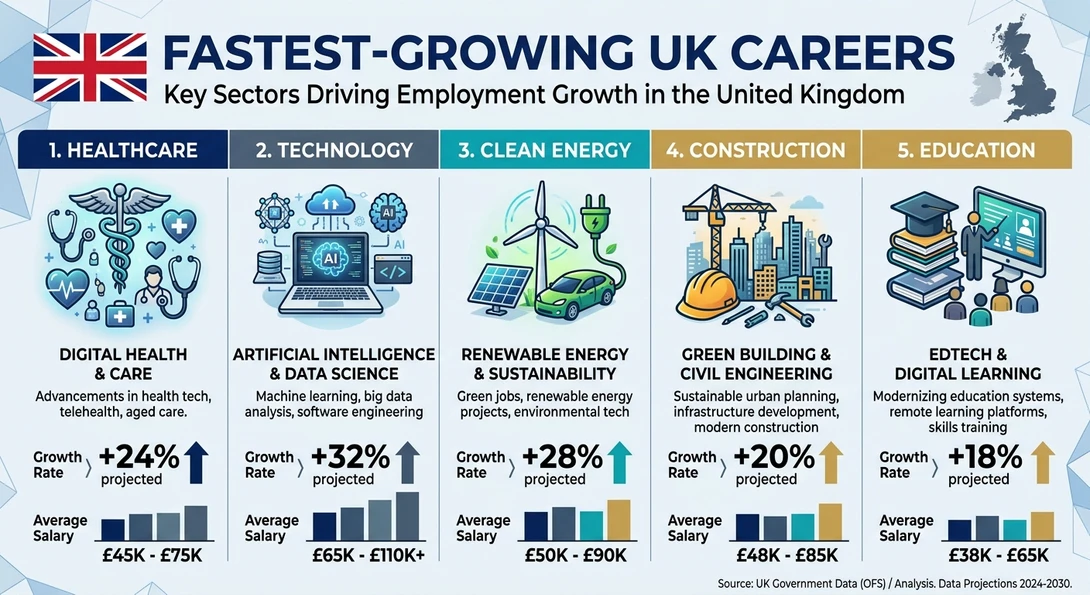
How this ranking was built
No single UK dataset publishes a neat “top 25 fastest-growing careers” table that answers everything job seekers want. So this ranking uses a blended methodology.
Each role was scored against five factors:
- Growth trend in UK employment, vacancies, or multi-year hiring momentum
- Hiring volume or breadth of demand across employers and regions
- Shortage intensity, meaning how hard employers report it is to fill the role
- Salary upside, especially after 2 to 5 years of experience
- Accessibility, including whether people can enter through training, certifications, apprenticeships, or career-change routes
This is not a pure “highest salary” list, and it’s not just a “most vacancies right now” list either. A care worker role may have huge vacancy numbers but lower pay growth. A data role may grow fast with strong pay but require more technical skill. Ranking them together gives a more realistic picture.
For current labor market context, the UK labor market has continued to show persistent shortages in health, social care, digital, skilled trades, and education. Skills England and GOV.UK publications on priority skills to 2030 point to continuing demand in engineering, health, digital, construction, and green transition occupations. The Department for Education’s Occupations in Demand release also highlights recurring shortages and demand pressure across technical and public-service roles. See GOV.UK priority skills and Occupations in Demand 2025.
The best fast-growing career is not always the one with the biggest percentage jump. It’s the one with staying power, enough vacancies to actually get hired, and an entry route you can realistically complete.
Ranked list: the fastest-growing careers in the UK
1. Registered Nurse
Typical salary: £28,000 to £45,000+, higher with specialization or agency work. Growth case: sustained national demand, severe shortages, aging population, and long-term NHS recruitment pressure.
Day to day, registered nurses assess patients, administer medication, coordinate care, update records, work with doctors and therapists, and support families through stressful moments. It’s hands-on, emotionally demanding, and absolutely not a desk job.
Entry usually requires a nursing degree and NMC registration, but healthcare assistants often progress into nursing through employer-supported routes. Career changers can enter through accelerated postgraduate nursing programs if they already hold a degree in another subject. Regional demand is strong everywhere, especially in London, the North West, the West Midlands, Scotland, and Wales.
2. Software Developer
Typical salary: £35,000 to £75,000+, with senior engineers often above that. Growth case: digital transformation across nearly every sector, from finance to retail to government.
A software developer spends the day writing code, fixing bugs, reviewing pull requests, joining sprint planning, testing features, and talking to product or design teams. Remote and hybrid options are common, which helps widen the opportunity beyond London.
You can still get in without a computer science degree. Bootcamps, portfolio projects, GitHub work, and junior apprenticeships open real doors, especially in web development, QA automation, and support-to-dev pathways. Regional hotspots include London, Manchester, Bristol, Leeds, Edinburgh, Belfast, and Cambridge.
3. Data Analyst
Typical salary: £30,000 to £55,000. Growth case: companies want better forecasting, reporting, automation, and customer insight, even when they freeze other hiring.
Most data analysts clean data, build dashboards, write SQL queries, spot trends, and explain what the numbers mean to non-technical teams. That last part matters more than people think. Plenty of applicants can build a chart. Fewer can explain why sales in Yorkshire fell 9% while the South East held steady.
This is one of the best career-change options in the UK. If you can learn Excel, SQL, Power BI or Tableau, plus basic statistics, you can become employable faster than in many technical careers. Demand is especially strong in London, Manchester, Birmingham, and major financial or ecommerce hubs.
4. Cybersecurity Analyst
Typical salary: £40,000 to £80,000. Growth case: constant security threats, rising compliance requirements, and a well-documented UK cyber skills gap.
On a normal day, cybersecurity analysts monitor alerts, investigate suspicious behavior, assess vulnerabilities, update security tools, support incident response, and train staff on basic security hygiene. The work can be quiet for hours, then suddenly very tense.
Good entry points include IT support, networking, and systems administration. Certifications such as CompTIA Security+, ISC2 CC, and later CISSP can help, especially for career changers without a degree. London, the South East, government contractors, defense hubs, and financial services employers lead demand.
5. Social Worker
Typical salary: £33,000 to £50,000+, with experienced and locum professionals often higher. Growth case: persistent shortages and rising case complexity in child protection, adult services, and mental health support.
Social workers assess risk, coordinate safeguarding plans, visit families, write reports, liaise with schools and healthcare teams, and make difficult judgment calls. It’s demanding work with a lot of paperwork, but it also has a very direct social impact.
You’ll usually need a recognized social work qualification and registration with the relevant regulator. Career changers often come from teaching assistants, youth work, housing, probation, or care settings. Demand is high across England, Scotland, Wales, and Northern Ireland, especially in local authorities struggling to fill permanent posts.
6. Electrician
Typical salary: £32,000 to £50,000+, often higher for self-employed or specialist work. Growth case: housing upgrades, infrastructure work, EV charging, retrofit projects, and ongoing shortages in skilled trades.
Electricians install, test, maintain, and repair electrical systems in homes, offices, factories, and construction sites. A typical day might include fault finding, wiring, reading technical plans, and making sure work meets safety standards.
This is one of the strongest non-degree routes on the list. Apprenticeships remain the gold standard, but adult training plus supervised experience can also work. Demand is especially strong in London, the South East, the Midlands, and growth corridors tied to housebuilding and commercial fit-outs.
7. Heat Pump Engineer / Renewable Energy Technician
Typical salary: £35,000 to £55,000. Growth case: net-zero policy, retrofit demand, low-carbon heating targets, and a shortage of trained installers.
These professionals assess properties, install heating systems, test equipment, explain system use to customers, and troubleshoot performance issues. The role mixes customer interaction, site work, and technical know-how.
Good pathways include transitioning from plumbing, gas, electrical, or HVAC backgrounds, then adding manufacturer training and low-carbon certifications. This is one of the clearest growth stories in the UK right now, but the workforce pipeline still lags demand. Scotland, the South West, London, and retrofit-heavy local authority areas are worth watching.
8. Teaching Assistant / SEN Support Specialist
Typical salary: £21,000 to £30,000, sometimes more in specialist settings or London. Growth case: continued school staffing pressure, SEND support needs, and broad nationwide hiring.
The day often includes classroom support, one-to-one help for pupils, behavior support, admin, and adapting materials for children with additional needs. It can be chaotic. It can also be hugely rewarding if you like practical, people-focused work.
Formal requirements vary. Many employers value experience with children, safeguarding awareness, patience, and communication over academic prestige. This is a realistic route for career changers from care, youth work, sports coaching, or customer service. Demand is spread widely across the UK rather than concentrated in one city.
9. Civil Engineer
Typical salary: £35,000 to £65,000+. Growth case: infrastructure, transport, flood defense, utilities, and housing projects continue to drive need for engineers.
Civil engineers work on design, site coordination, cost control, compliance, structural or environmental assessments, and contractor communication. Some are office-heavy. Others spend lots of time on site in boots and a hard hat.
A degree helps and often remains standard, but technician and apprenticeship pathways are growing. Regional hotspots include the North West, the Midlands, London, Scotland, and areas seeing transport or utility investment.
10. Occupational Therapist
Typical salary: £29,000 to £47,000+. Growth case: aging population, rehabilitation needs, hospital discharge pressure, and demand in schools and community services.
Occupational therapists help people regain independence after illness, injury, disability, or mental health challenges. Daily tasks include assessments, practical adaptation plans, home visits, coordination with families, and writing treatment notes.
You’ll need an approved qualification and HCPC registration. Career changers often come from psychology, education, support work, or healthcare support roles before training. Demand is broad across the NHS, councils, private rehab, and specialist education settings.
11. Project Manager
Typical salary: £40,000 to £70,000. Growth case: organizations keep launching digital, operational, compliance, and transformation projects even during uncertain hiring cycles.
Project managers plan timelines, coordinate stakeholders, control budgets, track risks, run meetings, and keep teams moving. Much of the job is communication, prioritization, and problem-solving under pressure.
This role is highly accessible for career changers. If you’ve managed deadlines, vendors, budgets, or internal rollouts in another job, you may already have the bones of project experience. PRINCE2, Agile, Scrum, and PM qualifications can strengthen your profile. Strong demand exists across London, Manchester, Birmingham, Leeds, and remote-first employers.
12. AI / Machine Learning Specialist
Typical salary: £50,000 to £100,000+. Growth case: strong momentum, but lower overall vacancy volume than software development or nursing.
The work often includes building models, preparing datasets, testing performance, writing Python code, collaborating with product teams, and translating business questions into technical experiments. It pays well because the skill bar is high and demand is moving fast.
This is not the easiest switch for most people. Good entry routes include moving from data analysis, data engineering, software development, or academic research. London, Cambridge, Oxford, and major fintech or healthtech employers dominate demand.
Quick comparison: growth vs volume vs shortage
A useful way to read the UK market is to separate three things that often get mixed together.
- Fast growth rate: AI specialists, heat pump engineers, cybersecurity analysts, data analysts
- Huge hiring volume: nurses, care-related roles, teaching support, software developers, electricians
- Acute shortage level: nurses, social workers, electricians, cybersecurity analysts, occupational therapists
That means a role like AI engineer may grow very quickly but still have fewer total openings than nursing. Meanwhile, teaching assistant roles may not look flashy in trend reports, yet they can offer far more entry-level vacancies in many towns and cities.
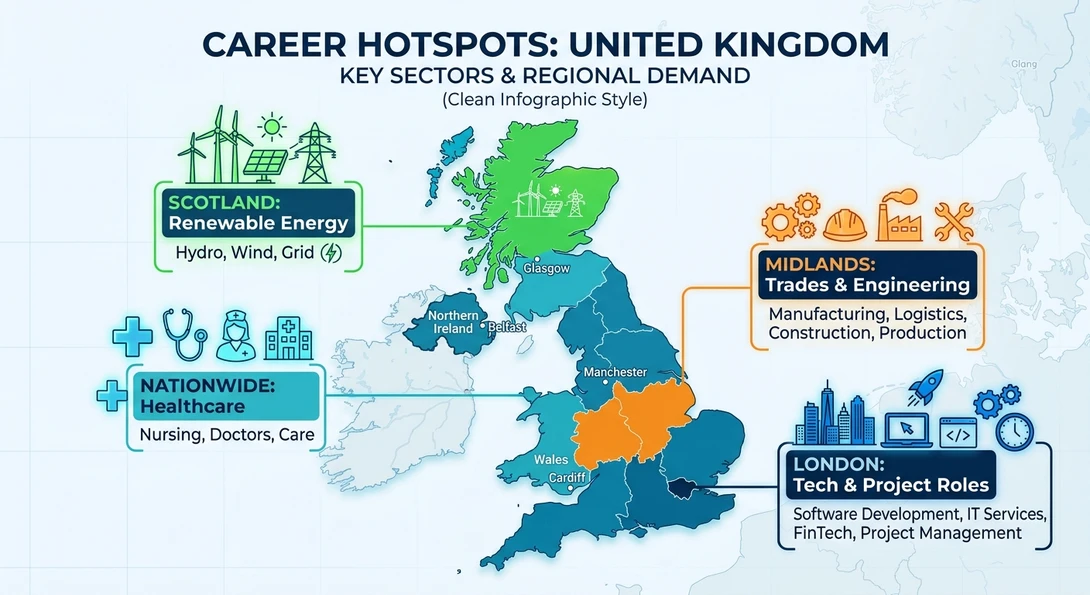
Regional breakdowns of fastest-growing careers across the UK
London and the South East
Best bets: software development, cybersecurity, data analytics, project management, nursing, occupational therapy. Salaries tend to be highest here, but so is competition and cost of living. Hybrid work gives some relief, though not as much as people hoped in 2022.
North West and Yorkshire
Best bets: software development, nursing, teaching support, project management, civil engineering, social work. Manchester and Leeds continue to punch above their weight for digital jobs while also supporting major public-sector hiring.
Midlands
Best bets: electricians, civil engineers, project managers, nurses, data analysts, renewable energy technicians. The Midlands benefits from logistics, construction, manufacturing, and major infrastructure links.
Scotland
Best bets: renewable heating and retrofit, civil engineering, nursing, software development, occupational therapy. Edinburgh remains strong for fintech and software, while decarbonization work supports trade and energy roles.
Wales
Best bets: nursing, teaching support, social work, electricians, occupational therapy. Public service roles remain especially significant, and local shortages often improve chances for applicants willing to work outside major cities.
Northern Ireland
Best bets: software development, cybersecurity, nursing, project management, teaching support. Belfast has built a solid reputation in tech and professional services, while healthcare demand remains strong.
Best fast-growing careers by background
Best for graduates
- Software developer
- Data analyst
- Civil engineer
- Occupational therapist
- AI or machine learning specialist
Best for non-graduates
- Electrician
- Teaching assistant or SEN support
- Renewable energy technician, if you already have a trade background
- Junior project coordinator roles
- IT support leading into cybersecurity
Best for career changers
- Data analyst
- Project manager
- Cybersecurity analyst via IT support
- Teaching assistant or SEN support
- Social worker, if you can commit to retraining
Entry requirements and realistic pathways for career changers
Here’s the honest version. Not every fast-growing job is equally accessible. Some can be entered in 6 to 12 months. Others need regulated qualifications that take years.
Fastest entry, usually 3 to 12 months: teaching assistant, junior data analyst, IT support to security pathway, project coordinator, some customer-success or operations roles that can lead into project management.
Mid-range entry, usually 1 to 3 years: electrician through apprenticeship or adult training plus experience, software developer through serious self-study and portfolio building, renewable energy technician via reskilling from adjacent trades.
Longer regulated pathways, usually 2 to 4 years: nursing, occupational therapy, social work, most civil engineering routes without prior relevant experience.
A common mistake is chasing a role because it appears in a trend report, then ignoring the practical path. If you need income within six months, cybersecurity might be realistic if you already work in IT. Occupational therapy probably isn’t.
How to stand out in a fast-growing field
Job growth helps, but it doesn’t guarantee interviews. Plenty of fast-growing careers also attract waves of underprepared applicants.
- Build evidence, not just interest. A portfolio, certification, volunteer experience, or practical project beats vague enthusiasm every time.
- Match your CV to the actual role title used in ads. “Operations professional” is weaker than “Project Coordinator with budget tracking and supplier management experience.”
- Apply regionally, not just nationally. Some careers have much stronger local demand than national headlines suggest.
- Learn the first tools employers ask for. For data roles, that’s often SQL and Power BI. For cybersecurity, ticketing, networking, and basic cloud. For project roles, planning tools and stakeholder reporting.
- Use adjacent experience. A retail manager can move into project or operations work. A care worker can move toward nursing or occupational therapy support. A plumber can pivot into heat pump installation.
Remote and hybrid opportunities
The strongest remote and hybrid options on this list are software development, data analysis, cybersecurity, AI, and project management. These fields often support national hiring, which can reduce the penalty of living outside London.
Healthcare, education, social work, skilled trades, and most renewable installation roles are location-bound. That sounds like a drawback, but it can be an advantage. Local shortages can make employers more flexible on training, start dates, and transferable experience.
Sources and why they matter
For labor market demand and skill shortages, the most useful UK-wide sources are the Office for National Statistics, GOV.UK priority skills work, and the Department for Education’s occupations-in-demand reporting. For sector reality checks, NHS workforce hiring, professional regulators, and major recruitment salary guides help fill in what official datasets don’t show quickly enough.
Useful references include the Office for National Statistics, NHS Health Careers, National Careers Service, GOV.UK priority skills, and Occupations in Demand 2025.

Final verdict
If you want the safest combination of demand, volume, and long-term resilience, nursing, software development, data analysis, electrician work, and project management stand out. If you want the strongest future-facing upside, cybersecurity, renewable energy, and AI look excellent, but some of those paths require more groundwork.
My blunt advice is this: don’t choose based on trend headlines alone. Choose a role where the UK market is growing, the salary can actually improve your life, and the entry path fits your timeline, finances, and temperament. A fast-growing career only helps if you can realistically get into it and stay in it.
For most people, the sweet spot sits where growth meets access. That usually means data, project work, software, trades tied to electrification, or regulated public-service careers with sustained shortages. Start with the route you can complete, then build from there.