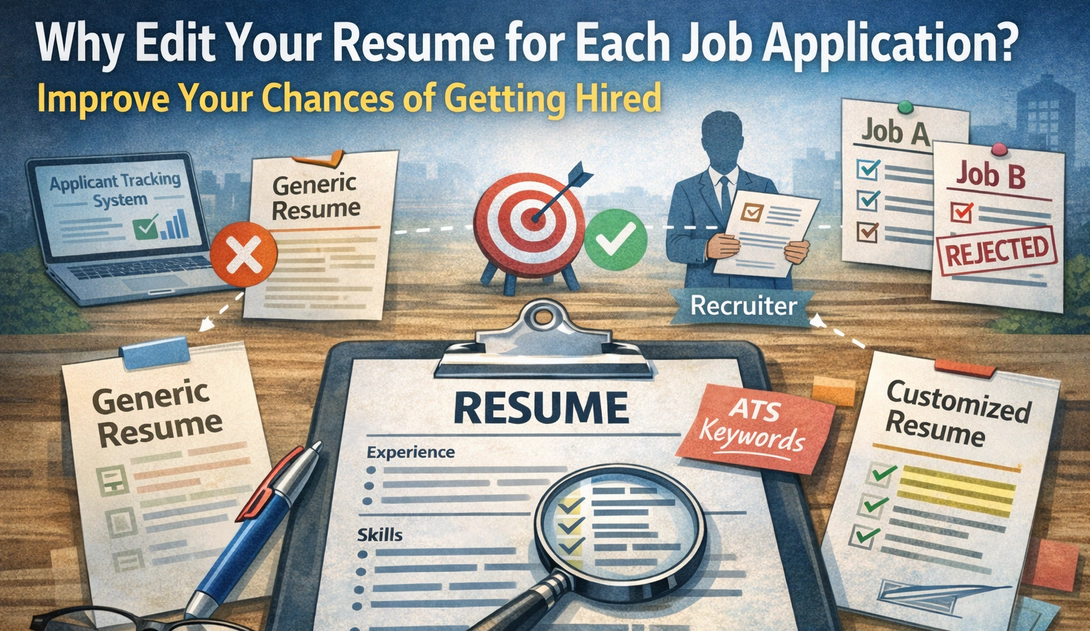
Most candidates use the same resume for all job applications, but they don’t understand the importance of a customized resume or how to tailor it for each position. Many applicants believe one strong resume is enough for every job, but in reality, this is a big mistake. Every job is unique, every organization has different requirements, and recruiters expect to see resumes that are specifically tailored to match their needs. That’s why editing your resume for each job application is important if you want to stand out. Before we go deeper, let’s understand the purpose of a resume first.
Purpose of a Resume
There are millions of applicants competing for one job position. HR professionals or recruiters have very little time, sometimes just 30 seconds, to decide whether a candidate is suitable for the next step. They cannot call everyone for an interview, so they rely on resumes as a filtering tool.
A resume is the key to entering the interview stage. It is not just a piece of paper but the first impression that determines whether you are shortlisted or rejected. Recruiters quickly scan resumes to check whether the skills, education, and experience match the job description. If your resume is too generic or irrelevant, it will be ignored immediately.
Recruiters want resumes that are tailored to specific requirements. They check whether the resume matches the job advertisement, job responsibilities, and organisational needs. If you use the same resume for different organisations, it will rarely align perfectly with each job, and your chances of rejection will increase.
How Every Job is Different
Many job seekers think that the same position or designation is identical across different organisations. This is a major misunderstanding. Even if the job title is the same, responsibilities, required skills, and expectations can vary significantly depending on the industry or organisation.
For example, suppose you apply for five different sales executive positions using the same resume. On paper, it seems logical because the job title is the same. However, in reality, one company may need a sales executive with pharmaceutical knowledge, another may require someone with expertise in mobile phone sales, and another may be searching for a software sales specialist.
If your resume only mentions super shop sales expertise and you send it to a pharmaceutical company without highlighting your pharmaceutical degree or training, recruiters will not see a relevant match and will likely reject your application.
Another example is applying for a call center job. Suppose the job circular specifically mentions that candidates with night shift experience will be given preference. You had two years of night shift experience at a previous job, but because you used a generic resume and didn’t highlight this experience, recruiters may assume you are not suitable. Once again, your resume gets rejected.
This proves that every job circular and every job application is different, and a customized resume is necessary to demonstrate the right fit.
Customization and Digital Sorting (ATS)
In the past, resumes were reviewed manually. Now, many organisations use digital systems called Applicant Tracking Systems (ATS). These systems automatically filter resumes using specific keywords and criteria. If your resume does not include the right keywords from the job description, the system may mark it as irrelevant and reject it before a human recruiter even sees it.
This means that using a generic resume further reduces your chances. A customized resume that includes keywords directly taken from the job circular increases the likelihood of passing ATS filters and reaching a human eyes.
Which Points Normally Differ?
Even for the same job title, there are several areas where job requirements differ. Let’s look at some of the major differences.
Responsibility
Industry wise, responsibilities can be very different. One job may focus more on outdoor activities, another on indoor activities. Some roles require constant client interaction, while others are about backend operations. Reporting structure and supervisor style may also vary.
Skills
Some companies prioritise hard skills like coding, software use, or technical expertise. Others focus on soft skills such as communication, teamwork, and adaptability. Depending on the service type, years of experience may also matter more than skills, or vice versa.
Organogram
The organisational structure affects the role. A “manager” in one company may be a mid-level position, while in another company the same title may represent a senior leader. Salary, authority, and expectations can therefore be very different.
Tasks
Tasks are rarely identical. Different environments and cultures require different tools and methods. Suppose you are comfortable with Windows, but the organisation needs someone experienced with iOS. If you don’t mention iOS knowledge, your RESUME will not be shortlisted.
Factors to Consider Before Customizing a Resume
Resume customization is not random - it should be based on several important factors.
Country Culture
The overall resume format is influenced by culture. For example, in some countries, attaching a photo is common, while in others it is discouraged. Similarly, some employers prefer a concise one-page resume, while others accept longer formats.
Understand the Industry
Every industry expects a different style. A government job resume often looks very different from a private sector resume. IT resumes usually highlight technical skills, while creative resumes may include portfolios and design elements. Understanding these differences is crucial.
Work Culture
Some workplaces are very formal, while others are semi-formal or even informal. Your template design and presentation should match the work culture. For instance, a startup might appreciate creativity in resume design, while a bank will expect a more traditional structure.
Experience
The length of your resume should reflect your experience. A fresh graduate should usually keep it to one page, but someone with 15 years of experience may need two or three pages.
Market Trends
Resume styles evolve over time. A format that was popular last year may already feel outdated. For example, infographic resumes may work in creative fields, but in corporate roles, ATS-friendly simple formats are often more effective.
Organisation Requirements
Sometimes organisations provide specific instructions in the job advertisement, such as word limits, file format, or required sections. If you ignore these, your resume may be rejected automatically. Always read the job circular carefully.
How to Customize Your Resume for Each Job Application
Now let’s discuss, step by step, how to customize your resume effectively.
Create a Basic Resume
Start by preparing a master resume that includes all your education, experience, skills, training, and achievements. This will be your foundation for building customized versions for different jobs.
Research About Your Field
Identify your industry and research 5 to 10 organisations within it. Learn about their mission, values, culture, and job expectations.
Analyze Different Job Circulars
Compare job circulars carefully. Highlight the similarities and note the differences. This will help you decide which skills and experiences to emphasize.
Collect Resume Formats
Gather different resume samples and formats from your industry. This will give you ideas on how to present your customized resume more effectively.
Create Different Templates
Develop multiple templates based on the formats you’ve collected. For example, create one template for sales roles, another for IT positions, and another for creative jobs.
Cover Letter
A cover letter is very important. It reflects your motivation, purpose, and connection to the specific role. Always customize your cover letter by including the company name, job title, job source, and your most relevant skills.
Career Objective
Like the cover letter, your career objective should also be customized. A generic objective appears meaningless. Rewrite it each time to reflect your vision for that specific job.
Skills Section
Don’t list every skill you have. Instead, select the ones that directly match the job description. Use the exact wording from the job circular when appropriate to help pass ATS filters.
Experience Section
If you have worked in multiple places, prioritize the roles most relevant to the new position. Highlight similar responsibilities and measurable achievements.
Responsibilities Section
Carefully rewrite your responsibilities to align with what the job circular demands. This helps recruiters easily visualize you in the new role.
Why Edit Your Resume for Each Job Application?
By now, it is clear that editing your resume for each job is not just a suggestion but a necessity. Recruiters expect resumes that show attention to detail and a strong match with the position. Sending a generic resume shows a lack of effort, while a customized resume demonstrates seriousness and professionalism. This simple step can significantly increase your chances of selection.
Your resume is not only your career summary but also your ticket to the next stage of the hiring process. Every job is different, and every organisation has unique expectations. That’s why you should edit your resume for each job application. A customized resume stands out, passes ATS filters, and speaks directly to the recruiter’s needs. If you invest a little extra time in tailoring your resume, the reward could be an interview call that changes your career path.