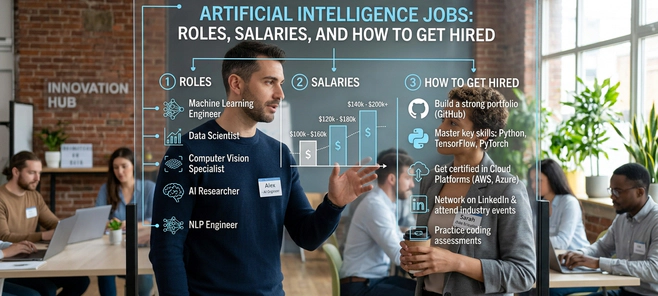
Artificial intelligence jobs have moved from niche research labs into mainstream hiring across software, healthcare, finance, retail, defense, logistics, and SaaS. That shift created a lot of opportunity, but it also created confusion. Job titles overlap, salary ranges swing wildly, and plenty of strong candidates still don’t know where they fit. This guide breaks down artificial intelligence jobs by role, experience level, salary, remote work trends, and hiring expectations, so you can figure out what to target and how to actually get hired.
A quick reality check helps here. Most companies aren’t hiring “AI people” in the abstract. They’re hiring machine learning engineers who can productionize models, data scientists who can turn messy data into business decisions, applied scientists who can improve ranking or recommendation systems, and AI product managers who can ship useful products without making legal or ethical mistakes. The details matter, and that’s exactly where most career guides get too vague.

What counts as an artificial intelligence job?
Not every job with “AI” in the title is deeply technical, and not every deeply technical AI job includes the words “artificial intelligence.” That’s one reason job seekers miss good opportunities. Some roles sit in engineering, some in analytics, some in product, and some in research.
Common artificial intelligence jobs include:
- Machine Learning Engineer
- AI Engineer
- Data Scientist
- Applied Scientist
- Research Scientist
- NLP Engineer or LLM Engineer
- Computer Vision Engineer
- MLOps Engineer
- AI Product Manager
- Data Engineer supporting AI teams
The U.S. Bureau of Labor Statistics doesn’t classify all AI jobs under one title, but related categories point to strong growth. Data scientists are projected to grow 35% from 2025 to 2035, much faster than the average for all occupations. Computer and information research scientists are projected to grow 22% over the same period.
The hiring market rewards usefulness, not hype. Companies pay for AI that improves revenue, reduces cost, speeds up operations, or creates better products.
Side-by-side comparison of the most common AI job titles
A lot of candidates apply too broadly because these titles sound interchangeable. They aren’t. Here’s the practical difference.
Machine Learning Engineer
This role usually sits closest to software engineering. You’re building training pipelines, deploying models, writing production code, monitoring performance, and working with cloud infrastructure. If a company needs someone who can make models run reliably at scale, this is often the hire.
AI Engineer
This title has gotten broader since generative AI went mainstream. In some companies, it’s basically a machine learning engineer. In others, it’s more focused on integrating foundation models, building retrieval-augmented generation pipelines, prompt workflows, evaluation frameworks, and AI features inside products. Read the job description carefully. The title alone won’t save you.
Data Scientist
Data scientists spend more time on analysis, experimentation, business metrics, and model interpretation. Some build production ML systems, but many focus on forecasting, segmentation, A/B testing, stakeholder communication, and decision support. Great role for people coming from analytics who want to move toward AI gradually.
Applied Scientist
Applied scientists bridge research and shipping. The work often includes experimenting with models, improving performance, publishing internally, and solving hard domain-specific problems. Compared with machine learning engineers, they usually go deeper on algorithms and model quality. Compared with research scientists, they’re closer to product deadlines.
Research Scientist
This is the most academic of the common AI job titles. Employers often want a PhD, publication record, or serious research background. You’ll see these roles in frontier labs, large tech firms, and specialized R&D environments. Entry is harder, and this is not the default path for most job seekers.
NLP Engineer, LLM Engineer, or Generative AI Engineer
These jobs focus on language systems such as search, summarization, chat agents, classification, document intelligence, and RAG pipelines. Employers commonly ask for Python, PyTorch, Transformers, vector databases, evaluation tooling, and API orchestration. The title changed fast after 2023, but the underlying employer question is simple: can you build language-powered systems that work in the real world?
Computer Vision Engineer
This role centers on image and video tasks such as detection, classification, OCR, segmentation, quality inspection, autonomous systems, and medical imaging. Industries include manufacturing, retail, healthcare, automotive, and defense.
MLOps Engineer
MLOps engineers keep the AI factory running. Think CI/CD for models, reproducible training environments, feature stores, monitoring, observability, inference scaling, and governance. A lot of organizations need this badly, even if candidates chase the flashier titles.
AI Product Manager
This isn’t a coding-heavy role in most companies, but it absolutely belongs in the AI hiring conversation. AI product managers shape use cases, prioritize roadmap decisions, work across legal and design, define success metrics, and keep teams grounded in business value. Strong fit for experienced PMs moving into AI products.
Artificial intelligence jobs by experience level
This is the part most articles skip, and it matters because employers hire very differently at each level.
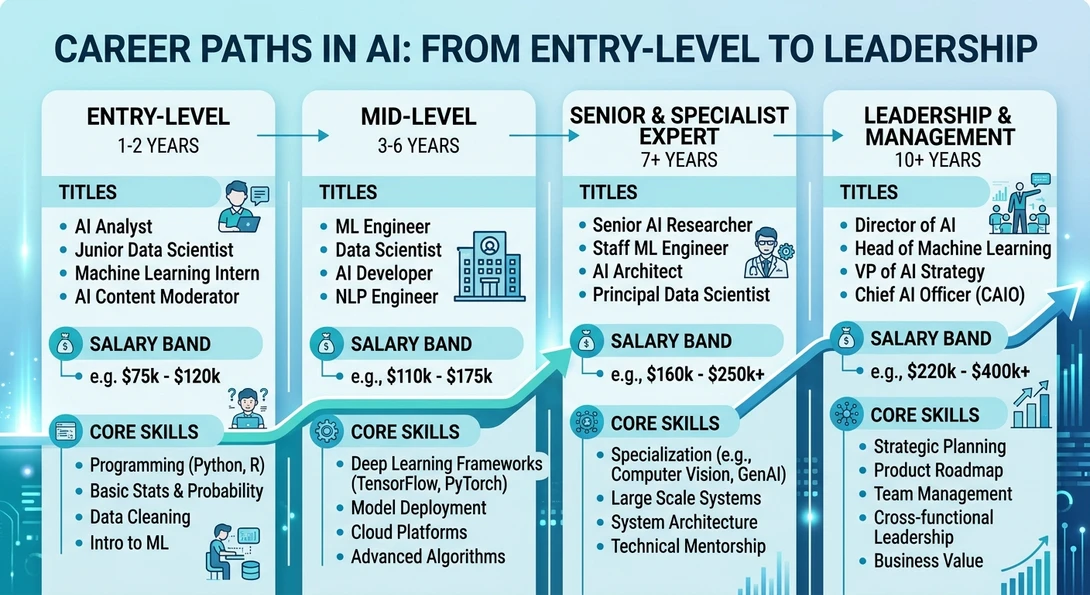
Entry-level AI jobs
True entry-level artificial intelligence jobs exist, but they’re narrower than people think. You’re more likely to land roles such as junior data scientist, data analyst with ML exposure, associate machine learning engineer, AI QA specialist, prompt evaluation analyst, annotation operations specialist, or software engineer on an ML platform team.
Typical expectations include:
- Solid Python and SQL
- Basic statistics and model evaluation
- Familiarity with scikit-learn, pandas, and notebooks
- 2 to 4 good portfolio projects
- Some proof you can work with messy, real data
- Clear communication, especially around results and tradeoffs
A lot of entry-level candidates make the same mistake. They build a chatbot demo in a weekend, then assume that’s enough. It isn’t. Employers want to see problem framing, clean code, documentation, evaluation, and business context.
Mid-level AI jobs
Mid-level usually means 2 to 5 years of relevant experience. Here, companies expect you to own projects, not just assist. Titles include machine learning engineer, AI engineer, data scientist II, NLP engineer, computer vision engineer, and MLOps engineer.
You should be able to ship end-to-end work: define the problem, prepare data, choose methods, evaluate results, deploy something useful, and explain performance limitations to non-technical stakeholders. This is where hiring volume is often strongest because companies want people who can contribute quickly without senior-level compensation.
Senior AI jobs
Senior roles usually start around 5 to 8 years of relevant experience, though title inflation is common. Senior machine learning engineers, senior applied scientists, staff AI engineers, and principal data scientists are expected to influence architecture, mentor others, improve team standards, and make tough tradeoffs under uncertainty.
This is also where domain expertise starts to pay off. A senior AI engineer in healthcare who understands clinical workflows and model risk can beat a technically stronger generalist. Same story in finance, cybersecurity, or supply chain.
Leadership AI jobs
Leadership roles include AI director, head of machine learning, VP of AI, chief data scientist, and chief AI officer. The work shifts away from individual modeling and toward org design, hiring, budget decisions, governance, platform strategy, vendor selection, and linking AI investment to revenue or efficiency outcomes.
These jobs don’t go to the smartest coder in the room by default. They go to people who can align technical decisions with business goals, manage risk, and build teams that ship.
Artificial intelligence job salaries in the U.S.
Salary data in AI is messy because titles overlap and compensation changes fast. Geography, equity, industry and company size all matter. The bands below are indicative ranges for US base salary compiled from public job postings, not survey data, so treat them as a starting point for negotiation rather than a benchmark. For live figures, check current openings for AI engineer, machine learning engineer, data scientist and data engineer roles.
Indicative base salary ranges, US market
- Entry-level AI or ML roles: $85,000 to $125,000 base
- Mid-level machine learning engineer or AI engineer: $125,000 to $180,000 base
- Senior AI engineer or applied scientist: $170,000 to $240,000 base
- Staff, principal, or specialized LLM roles: $220,000 to $320,000+ base in top-tier firms
- AI product manager: $140,000 to $230,000 base depending on scope
- Leadership roles: often $220,000 to $400,000+ base, with bonus and equity driving total comp much higher
For public benchmarks, the U.S. Bureau of Labor Statistics put the median annual wage at $120,230 for data scientists and $140,300 for computer and information research scientists in May 2025. Those categories are broader than AI alone, but they give a useful floor for market expectations. High-end AI compensation, especially in major tech companies and frontier model firms, can go far above these medians once stock is included.
Industries also pay differently:
- SaaS and big tech usually pay the most, especially for product-facing AI roles
- Finance and defense often pay well for specialized, secure, or regulated work
- Healthcare can pay strongly at the senior level, especially in imaging, diagnostics, or operations optimization
- Retail and logistics hire heavily for forecasting, pricing, recommendations, and operations, but compensation is often more moderate outside elite firms
Common tools and tech stacks employers ask for
If you want to read AI job descriptions more intelligently, watch the tool stack. It usually tells you what the company really needs.
Most technical artificial intelligence jobs ask for a mix of these:
- Python, SQL, Git, Linux
- pandas, NumPy, scikit-learn
- PyTorch or TensorFlow, with PyTorch showing up more often in newer ML roles
- Spark or distributed data tools for large-scale environments
- AWS, Azure, or Google Cloud
- Docker, Kubernetes, CI/CD, and infrastructure-as-code
- MLflow, Weights & Biases, Airflow, Databricks, or SageMaker
- Vector databases, embedding pipelines, and LLM frameworks for generative AI roles
- Tableau, Power BI, or experiment platforms for analytics-heavy jobs
A subtle point that matters in hiring: employers don’t need you to know every tool. They want confidence that you can learn adjacent tools quickly because you already understand the underlying workflow.
Can you qualify for AI jobs without an advanced degree? Yes, but be strategic
This is where a lot of people either get discouraged too early or become wildly unrealistic. You do not need a PhD for most artificial intelligence jobs. You also shouldn’t pretend a few online certificates make you competitive for research scientist roles. Both things are true.
You can absolutely break into AI without an advanced degree if you target the right roles:
- Data analyst moving into applied analytics and lightweight ML
- Software engineer moving into ML engineering or AI infrastructure
- Backend engineer moving into inference systems or AI platform work
- Product manager moving into AI product management
- QA, operations, or support professionals moving into AI evaluation, prompt testing, or data operations
What matters most is proof of skill. A strong GitHub portfolio, deployed project, Kaggle performance with explanation, technical blog posts, and measurable work outcomes often matter more than one more credential line. For many mid-market companies, hiring managers care less about pedigree than whether you can solve their actual problems without drama.
A sensible no-advanced-degree path looks like this: learn Python and SQL, strengthen statistics, build 3 to 5 projects with clean documentation, contribute to something collaborative, and apply for adjacent roles if direct AI titles feel out of reach. That’s not glamorous advice, but it works.
Portfolio and resume advice tailored to AI job seekers
Your portfolio should answer one question fast: Can this person turn data and models into business value? If the answer isn’t obvious in two minutes, your materials need work.
What a good AI portfolio includes
- A short problem statement with clear business context
- The dataset source and its limitations
- Model choices and why you picked them
- Evaluation metrics that actually fit the problem
- Error analysis, not just the best accuracy screenshot
- A deployed demo, API, dashboard, or notebook walkthrough
- Clean README files and reproducible setup instructions
Three strong projects beat ten shallow ones. A fraud detection pipeline, demand forecasting model, support ticket classifier, or document extraction tool usually impresses more than another generic sentiment analysis notebook.
Resume tips that work better in AI hiring
Lead with outcomes, not task lists. Instead of saying you “worked on machine learning models,” say you built a churn model that improved retention targeting by 14%, or reduced inference latency by 38%, or automated document processing that saved 120 analyst hours per month. Numbers matter.
Group tools intelligently. Don’t dump 35 technologies into one line and hope recruiters are impressed. Match your resume to the role. For ML engineering jobs, prioritize Python, PyTorch, AWS, Docker, APIs, and deployment. For data science jobs, highlight experimentation, SQL, statistics, visualization, and business analysis. For LLM roles, show evaluation, prompt design, retrieval systems, embeddings, and production guardrails.

Remote artificial intelligence jobs and hybrid work trends
Remote artificial intelligence jobs still exist in healthy numbers, but the market changed between 2022 and 2025. Many employers pulled back from fully remote hiring, especially for junior roles, while keeping hybrid options for experienced engineers and product leaders. The highest-paying AI jobs are often clustered around tech hubs, but plenty of companies now hire across states for mid-level and senior talent.
Here’s the practical pattern:
- Entry-level AI roles are more likely to be hybrid or office-based
- Mid-level and senior technical roles have better odds for remote consideration
- Leadership and cross-functional AI roles often require hybrid presence for stakeholder management
- Contract and consulting AI work remains especially remote-friendly
If remote work is non-negotiable for you, apply with discipline. Target companies that already operate distributed engineering teams. Read job descriptions for clues like timezone requirements, occasional travel, and state hiring restrictions. Don’t assume a role is remote just because the function is technical.
Industry-specific AI jobs worth knowing
General AI titles get the clicks, but industry-specific hiring is where a lot of solid careers are built.
Healthcare
Jobs include medical imaging engineer, clinical data scientist, healthcare NLP specialist, and AI product roles in diagnostics, claims, or operations. Employers care about privacy, explainability, workflow fit, and regulation. Domain knowledge helps a lot.
Finance
Common work includes fraud detection, credit modeling, risk scoring, trading research, compliance monitoring, and document intelligence. Strong math, governance awareness, and auditability matter here.
Defense and government
These roles often focus on computer vision, sensor fusion, cybersecurity, logistics optimization, and intelligence workflows. Security clearance can be a major differentiator.
Retail and e-commerce
Recommendation systems, pricing, demand forecasting, search relevance, customer service automation, and supply chain optimization are common. These teams often value business impact over academic purity, which can be great for practical builders.
SaaS
SaaS companies hire heavily for copilots, support automation, search, analytics assistants, document workflows, and personalization. Fast product cycles mean they like candidates who can ship, measure, and iterate quickly.
How to get hired for artificial intelligence jobs
A good AI job search is narrower than most people expect. Spraying applications at every role with “AI” in the title usually fails. A tighter strategy works better.
1. Pick one primary lane
Choose machine learning engineering, data science, LLM applications, MLOps, computer vision, or AI product. You can have adjacent interests, but your resume and portfolio should tell one clear story.
2. Build role-matched evidence
If you want ML engineering jobs, ship APIs, pipelines, and deployment examples. If you want data science roles, show experimentation, forecasting, segmentation, and stakeholder communication. Match proof to the target.
3. Apply where signal quality is better
Use aggregators, niche AI job boards, company career pages, and LinkedIn, but don’t stop there. Alumni groups, open-source communities, technical Slack groups, hackathons, meetups, and founder networks often surface better leads with less competition.
4. Get good at interviews that companies actually run
Expect some mix of coding, ML fundamentals, case studies, system design, experiment design, product sense, and behavioral interviews. For generative AI roles, you may also see RAG architecture, evaluation strategy, hallucination mitigation, cost-performance tradeoffs, and safety questions.
5. Follow up like a pro
After interviews, send a short note that reinforces fit. Mention one business problem you could help solve. Most candidates waste this chance by writing bland thank-you emails. Be specific and useful instead.
Final takeaways
Artificial intelligence jobs are real, growing, and lucrative, but they aren’t one-size-fits-all. Some roles are research-heavy. Many are engineering-heavy. Others sit closer to analytics or product. Once you understand the differences, the market gets much easier to read.
The smartest move for most job seekers is simple: pick the lane that matches your current strengths, build proof that fits that lane, and apply with focus. You don’t need perfect credentials. You do need evidence, clarity, and a bit of patience. That’s how people actually get hired.